Summary
Here’s a summary of where we stand.
- MPs have voted by 464 votes to 38 - a majority of 426 - in favour of government regulations allowing Britain to opt back in to some EU police and criminal justice measures. The coalition exercised its right to opt out of around 110 measures en masse, but it is opting back into 35. The vote technically only covers 11 of these - and not the European arrest warrant (EAW) - but the government said it would treat the vote as a vote on all 35.
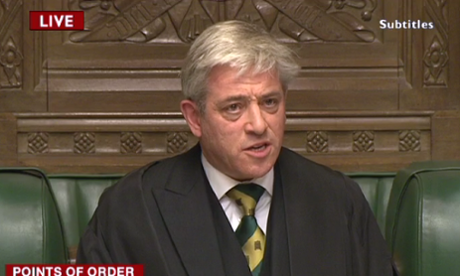
- John Bercow, the Commons speaker, has strongly criticised the government for not allowing MPs to have a specific vote on the EAW. It was breaking a promise given by David Cameron, Bercow said. People were “contemptuous” of conduct like this. (See 5.08pm.)
- Labour has forced the Commons to curtail the debate early. Yvette Cooper, the shadow home secretary, used a rare Commons procedure to force a vote on a proposal to put off the debate until a later date. She said ministers should allow a proper debate and vote tomorrow on all measures, including the EAW. Cooper’s motion was defeated. But, under Commons rules, that meant MPs went straight on to a vote on the main business, instead of carrying on the debate until 10pm. Cooper’s move caused some panic on the government benches, and David Cameron had to rush back from the Mansion House banquet, dressed in white tie, to vote.
-
Cooper has accused Theresa May, the home secretary, and Michael Gove, the chief whip, of not allowing a vote on the EAW because they wanted to minimise the Tory revolt. At one point it was claimed up to 100 MPs might rebel over this. In the debate Cooper said:
Isn’t the truth that they took [the EAW] out of the motion because the home secretary and the chief whip thought they were being clever. They took it out because they wanted to minimise the rebellion. They wanted to tell journalists that it was a vote on the European arrest warrant, but tell the backbenchers not to worry, because they were only voting on prisoner transfer arrangments instead. They wanted to pretend to parliament that it was a vote on package of 35 measures, and yet their MPs fend of Ukip in their constituencies by claiming that they never voted for the most controversial plans.
But May said there was no vote on the EAW because parliament did not need to vote to allow the government to opt back into it. On the 11 measures, MPs did have to vote for them to be incorporated again into UK law, she said. It has been reported that Tory whips are blaming the Home Office for the decision not to allow a vote on a motion that could be amended.
- Labour and Tory figures have started to blame each other for the fact that the Commons has not had a proper debate on the EAW. (See 8.51pm.)
-
Some 38 MPs have voted against the EU criminal justice measures. According to one account, 37 were Tories. Some of them were probably using their vote to signal their opposition to the EAW, while others may have been motivated by more widespread opposition to EU involvement in criminal justice matters.
That’s all from me for tonight.
Thanks for the comments.
Updated
Cooper accuses May of handling the EAW debate 'dreadfully'
Yvette Cooper, the shadow home secretary, has put out this statement following the vote.
Labour proposed to the government to have a vote on the European Arrest Warrant and the remaining EU measures tomorrow, which there is time for and which we would support. It was within the government’s power to put right the chaos and deception they have created, but they chose not to do so.
The House of Commons should be able to vote to endorse the European Arrest Warrant, putting it beyond legal challenge – which we know Eurosceptics have been planning. Despite being promised this vote, the Commons has been denied the chance to give overwhelming backing to this crucial crime fighting measure. The government must put that right at the earliest opportunity.
Theresa May was very foolish not to listen to the strong support across the House both for the European Arrest Warrant and for the opportunity of a comprehensive vote. She has handled this dreadfully. It’s a complete mess.
And here is some Twitter comment from journalists.
From ConservativeHome’s Paul Goodman
Tory Whips very clear that cause of today's palaver was Home Office desire not to have amendable motion - i.e: it's not our fault, Guv.
— Paul Goodman (@PaulGoodmanCH) November 10, 2014
From Sky’s Faisal Islam
EAW story done now... Government wins a battle... But not a great day in long war over Europe... Ukip will use as exhibit 1 in campaigning
— Faisal Islam (@faisalislam) November 10, 2014
From the Telegraph’s Dan Hodges
So there wasn't a major revolt against the EAW. Which shows Tories were on top of the rebellion. Which proves it was all a cock-up.
— Dan Hodges (@DPJHodges) November 10, 2014
From the BBC’s Mark D’Arcy
This is the most extraordinary tangle I've ever seen Commons get into. Expect a viscous blame game to follow. #EAW
— Mark D'Arcy (@DArcyTiP) November 10, 2014
And Isabel Hardman at Coffee House says Yvette Cooper and John Bercow have done most to annoy government ministers. Here’s an extract from her blog.
Today has seen one of the best Commons performances that Yvette Cooper has given as Shadow Home Secretary. She managed to highlight the absence of the arrest warrant before the vote and exploited Speaker Bercow’s statement to the full. Then she showed cunning by introducing the motion that the question on the order paper asking MPs to vote on the measures was delayed.
But the main catalyst was Speaker Bercow, who gave the statement saying this was not a vote on the warrant that so enraged Tory MPs. Conservative ministers are furious with Bercow now.
And heres’s Ian Swales, the Lib Dem MP, on the result of the vote.
38 UKIP cheer leaders in parliament vote against EU justice laws to keep us safe. 37 are still in the Tory party.
— Ian Swales (@iswales) November 10, 2014
Labour and Tories blame each other for EAW debate being shelved
Well, after that expect an almighty blame game as Labour and the Tories blame each other for parliament not having a proper debate on the European arrest warrant.
The real victors are probably Ukip, who will be able to claim that the Commons has reneged on a promise to allow MPs to debate and vote on the European arrest warrant.
Here is some preliminary blame-slinging.
From Labour whips
426 maj for opt-ins they dared bring forward, so why did govt not bring forward motion on full package inc EAW rather than play silly games?
— Labour Whips (@labourwhips) November 10, 2014
From the Conservative MP James Wharton
Labour, trying to be too clever by half with Parliamentary procedure, have closed down debate on the European Arrest Warrant! Not clever.
— James Wharton MP (@jameswhartonmp) November 10, 2014
From the Conservative MEP Daniel Hannan
Seriously, what *is* it about Euro-integrationists and their dislike of votes? #EAW
— Daniel Hannan (@DanHannanMEP) November 10, 2014
From Labour’s John Prescott
So a Prime Minister who promises a referendum on Europe can't even deliver a Commons vote. Weak, weak, weak #MajorMinor #EAW
— John Prescott (@johnprescott) November 10, 2014
Government wins main vote with majority of 426
The government has now won the main vote by 464 votes to 38 - a majority of 426.
Updated
In an interview with ITV’s The Agenda being broadcast later tonight, George Osborne, the chancellor, said the government was not “frightened” by the prospect of Tory backbenchers rebelling over the EAW. When this suggestion was put to him, he replied:
Not at all. We have got a debate on at the moment about what is a successful negotiation by this government, which is that we got out a lot of Europrean rules which don’t work for us and we are just staying in ones that do, such as this European arrest warrant.
Updated
Here’s Ukip’s Douglas Carswell on tonight’s proceedings.
Govt plan to get EAW thru Commons with minimal fuss not really worked out
— Douglas Carswell MP (@DouglasCarswell) November 10, 2014
PM promised vote on EAW in PMQs. Tonight he rushes back in white tie to quash it
— Douglas Carswell MP (@DouglasCarswell) November 10, 2014
MPs are now voting on the main motion - the draft criminal justice and data protection (protocol no 36) regulations 2014.
Here’s an explanatory note covering the 11 measures covered by the regulations.
EAW in explanatory note: non-asterisked = HoC vote not required...11/35 measures do require "transposition" http://t.co/RQxRkBsvB1
— Faisal Islam (@faisalislam) November 10, 2014
Updated
Government wins procedural vote with majority of 43
The government has won. Labour’s motion has been defeated by 272 votes to 229 - a majority of 43.
Updated
David Cameron has returned from the Mansion House to vote in white tie, Nick Robinson reports.
PM has races back from Mansion House dinner to vote dressed in White tie
— Nick Robinson (@bbcnickrobinson) November 10, 2014
John Bercow, the Commons speaker, is now repeating what the motion means.
It is a proposal by Yvette Cooper that the motion be not now put.
If MPs agree, the draft regulations will not be further considered tonight.
If MPs vote against, the speaker will be required to go straight to a further vote on the regulations.
Bercow says if the Commons wishes to vote further motions on this matter tomorrow, it can. There would have to be an emergency business motion, he says.
His role is to facilitate the will of the House, he says.
So he puts Cooper’s motion to a vote: that the question be not now put.
MPs are now voting.
John Baron, a Conservative, says the solution would be for the government to make it clear that it will make time available for a proper debate.
David Davis says that did not happen.
He says he won’t vote for the Cooper proposal. But he may abstain, or double vote.
Jacob Rees-Mogg, a Conservative, says he supports Yvette Cooper’s move. He would like to have a full debate on the EAW.
David Davis says there is no guarantee that the government would then allow a proper debate.
Rees-Mogg says Davis is right. But the government would be under huge pressure to allow a proper debate.
Davis says he is not willing to take a chance. That is why he is opposing Labour’s move, he says.
David Davis, a Conservative, says this has been, in many ways, the most disorderly debate he has seen in 20 years.
Labour’s move is undemocratic, he says. It has denied MPs the chance to debate the EAW, he says.
Pete Wishart, the SNP MP, tries to move a closure motion again. He uses the wording he used earlier.
I tried to move - the question be not now put - now be put. Almost got away with it. This is Westminster. #EAWshambles
— Pete Wishart (@PeteWishart) November 10, 2014
John Bercow says he will not allow a closure motion now. But he says he might allow one soon.
Bill Wiggin, a Conservative, says a constituent of his gave £2 to a beggar in Romania. He was accused by the police of paying for sex, and marched to a cash point machine. He refused to pay because he had done nothing wrong. After being held in jail for three months, he was allowed to return to the UK. Without his knowledge, he was tried in Romania and sentenced to seven years in jail. Wiggin says his constituent was told that he would not be extradited, but might have to pay damages. But he was subsequently arrested in Tenerife on an European arrest warrant.
The man was then held in a Madrid prison while he appealed. The UK authorities asked the Spanish not to extradite him. But he was sent to Romania, where he spent 21 months in prison in appalling conditions,
John Bercow, the speaker, intervenes. He says MPs are supposed to be debating Cooper’s proposal.
Martin Horwood, a Lib Dem MP, says he voted with Labour earlier against the business motion.
But Yvette Cooper has got a bit carried away. There is no reason for not voting on the 11 measures MPs all agree on, he says.
Cooper intervenes. She says Labour is using this procedure because it wants a vote on all 35 measures tomorrow.
Horwood says Labour could use its opposition day debate to have a vote on the EAW.
Kenneth Clarke is still speaking.
He says Yvette Cooper is making a fuss even though she agrees with all of what Theresa May is proposing.
The alliance between Cooper and the Tory Eurosceptics is an odd one, he says.
Chris Bryant, the Labour MP, says he agrees with Clarke on European issues. But, to carry public support, the Commons needs to follow proper procedure. There should be a vote on the EAW. That is what the European scrutiny committee, the justice committee and the home affairs committee want, he says.
Clarke says Labour is showing “synthetic anger”.
These are serious issues. Having a row now would be “a triumph for Ukip”, but something the Commons should reject.
Kenneth Clarke, the Conservative former minister, says no one enjoys a good procedural row as much as him. And this is one of the best, he says.
Twenty years ago it was fine for MPs to have a row like this. Normally it happened in the middle of the night.
But now the public are not so understanding, he says.
Steven Baker, a Conservative, says he disagrees. This is about parliament seizing back control of the agenda.
Clarke says MPs will win back the support of the public if they have a serious debate. Instead they are having an arcane debate. Most MPs have not heard of this procedure (moving that the question be not now put). He has never heard a frontbench spokesperson use this, he says.
Michael Ellis, a Conservative MP, asks May to comment on his belief that Labour’s conduct almost suggests it is leaderless.
The Times’s Ann Treneman is not impressed.
michael ellis is workintg very very hard for his lickspittle of the year award.
— ann treneman (@anntreneman) November 10, 2014
Douglas Carswell, the Ukip MP, is tweeting from the chamber.
Massive mood gap between whips / T May cluster on frontbench and sullen, mutinous MPs behind. Ominous
— Douglas Carswell MP (@DouglasCarswell) November 10, 2014
Back in the Commons May says it is obvious that some MPs wanted to express their views on the EAW. The government allowed that.
But Labour is blocking it, he says.
Nick de Bois, a Conservative, says today’s debate has been badly handled.
Given that Gov, Lab & Lib Dems want to all go back into EAW it's extraordinary that today's parliamentary process has ended up in this mess
— Nick de Bois MP (@nickdebois) November 10, 2014
Labour’s Mike Gapes says Yvette Cooper is in control.
Yvette Cooper is doing very well and dominating this debate. Home Sec May is in trouble. There must be a separate EAW debate and vote.
— Mike Gapes MP (@MikeGapes) November 10, 2014
And William Bain, another Labour MP, says it’s an “appalling mess”.
Appalling mess by Mrs May: should sort it out & come to House with proper motion allowing for vote on all elements including EAW tomorrow
— William Bain (@William_Bain) November 10, 2014
Yvette Cooper says Labour wants a vote on all measures tomorrow.
If that can’t be done, the government can use Labour’s opposition day to get this through before 1 December.
May says Cooper can have a vote tonight. But Labour has chosen to “play politics with this matter”, she says.
Sir Tony Baldry, a Conservative, asks the speaker how many MPs wanted to speak in tonight’s debate.
Around 20, John Bercow says. But they would be able to speak in a future debate on this.
My colleague Rowena Mason thinks Theresa May may be playing for time.
Is Theresa May now repeating herself in the House of Commons to play for time, while the whips round up supportive Tories from the bar?
— Rowena Mason (@rowenamason) November 10, 2014
Here is some more Twitter comment on what’s going on from two MPs.
The govt has completely lost control of the House. A shabby shambles.
— Chris Bryant (@ChrisBryantMP) November 10, 2014
Commons catches ministers off guards. Whips operation floundering. Panic
— Douglas Carswell MP (@DouglasCarswell) November 10, 2014
Pete Wishart, the SNP MP, says he wants to put the question that the question not be put be now be put.
John Bercow says that is effectively a closure motion. He won’t accept it now.
Updated
Theresa May says if MPs reject the package of measures, that would have serious operational consequences.
Yvette Cooper asks May to confirm that there is time for a full debate tomorrow.
May says there is time for a full debate tonight.
But time is being wasted by Cooper’s proposal.
Michael Ellis, a Conservative, says this shows that Labour is not serious about justice and about law and order.
John Bercow, the Speaker, clarifies one point; if Cooper’s motion succeeds, that does not mean there will be no further debate on this, he says. It just means there will be no further debate tonight.
Tom Blenkinsop, a Labour MP, explains what is going on in Twitter.
Labour looking for common sense now and to end this farce and pushing to stop the Government's cop out motion from being voted upon.
— Tom Blenkinsop (@TomBlenkinsop) November 10, 2014
Is Theresa May gonna speak for 2h55mins to stop a motion put to not vote on Government's business? Tories treating parliament like a joke
— Tom Blenkinsop (@TomBlenkinsop) November 10, 2014
Theresa May, the home secretary, is speaking now.
Effectively she is speaking in a mini debate on Yvette Cooper’s proposal that the motion be not now put (ie, that the debate gets shelved).
Labour uses rare Commons procedure to try to shelve EAW debate
John Bercow, the Speaker, says this is debatable.
If Cooper’s proposal (see 6.59pm) is accepted, the debate will be postponed.
If Cooper’s proposal is rejected, there will be a vote straight away.
- Labour uses rare procedure to try to shelve tonight’s EAW debate.
Updated
Jacob Rees-Mogg says Ben Gummer does not read his communication from the whips properly. The paper with today’s business mentioned the vote on the criminal justice regulations, “which includes the European arrest warrant”, Rees-Mogg says.
Cooper says this shows how chaotic this is.
She appeals to May to stand up and say there will be a vote on all 35 measures.
May does not respond.
Cooper says if May brings this back tomorrow, with all 35 measures in it, Labour will support it.
Cooper says May is playing fast and loose. There is plenty of time to debate this tomorrow.
She moves that the question now be not put.
Cooper urges May to rethink her decision not to allow a vote on the EAW.
Some MPs will vote against. But Labour will enthusiastically vote in favour, she says.
She says May and the chief whip, Michael Gove, thought they were being clever. They wanted to tell journalists it was a vote on the EAW, but MPs it was not a vote on the EAW.
Ben Gummer, a Conservative, says he has been in receipt of letters from the whips. MPs knew perfectly well what they were voting on.
Chris Bryant, a Labour MP, makes a point of order. Erskine May says when a member quotes a document, it should be shown to MPs. So will Gummer reveal the letter he referred to.
John Bercow says he thinks that refers to state papers.
Sir Bill Cash, a Conservative, asks Cooper if she agrees with the use of the EAW in the case of Ashya King’s parents.
Cooper says that there was dreadful decision taking in this case. But there are mistakes in the UK made when people are arrested. That does not mean the power of arrest is a bad one.
Cooper says it is because the EAW is so important that we should be having a vote.
The home secretary has form on this, she says. David Cameron said getting net migration below 100,000 was a promise. Today May said it was just “a comment”, Cooper says.
Today May has also ignored Cameron’s promise on a vote on the EAW.
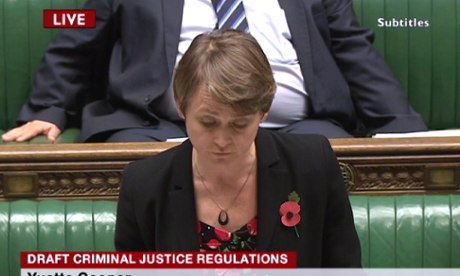
Yvette Cooper's speech
Yvette Cooper, the shadow home secretary, is speaking now.
She says today’s proceedings have been shambolic.
Theresa May explained why the EAW was necessary, she says.
So why are MPs not voting on it? It is extraordinary that the home secretary is playing games with measures that are so important.
She says Labour supports the 11 measures that are covered by today’s motion.
Labour supports the rest of the 35 measures the government is opting back into as well, she says.
A Tory MP asks Cooper if she thinks Britain was a safe haven for criminals before the EAW was introduced.
Cooper says it was harder than to sent criminals back to another country for trial. It took 10 years to extradite Rachid Ramda to France to face trial on terrorist charges, she says.
May says, after Gordon Brown signed the Lisbon treaty, the European court of justice got the final say over law and order measures.
The treaty was badly handled, she says.
That is why the government is not opting back into certain police and criminal justice measures.
But it also has a duty to keep the British public safe, she says.
Back in the Commons May says some opponents of the EAW say Britain should fall back on the old extradition procedures.
But, if that were to happen, extradition would become slower, she says.
She quotes from a report from the House of Lords committee on extradition law published today. The committee said:
On the basis of the evidence we have received, there is no convincing case for disagreeing with the conclusions previously reached by the European Union Committee that “If the United Kingdom were to leave the EAW and rely upon alternative extradition arrangements, it is highly unlikely that these alternative arrangements would address all the criticisms directed at the EAW. Furthermore, it is inevitable that the extradition process would become more protracted and cumbersome, potentially undermining public safety.”
On Twitter Douglas Carswell, the former Tory who is now a Ukip MP, is blaming Greg Hands, the Conservative deputy chief whip, for this evening’s debate turning out so badly for the government.
Govt avoids a total disaster on their own EAW (non-)motion by just 5 votes. Safe to say this ugly sleight of hand has appallingly backfired.
— Tom Newton Dunn (@tnewtondunn) November 10, 2014
@tnewtondunn Deputy Chief Whip stuffed up
— Douglas Carswell MP (@DouglasCarswell) November 10, 2014
Labour’s Chris Bryant asks May if she will allow a proper vote on the EAW next week.
May ignores the question (which I think we can take as a no.)
Pete Wishart, the SNP MP, intervenes.
May has been speaking about the EAW for 10 minutes, he says. Isn’t that against the guidance John Bercow issued earlier about what it would be in order to cover in the debate?
Bercow says he said earlier he would allow some “latitude”. (MPs normally have to stick to the topic being voted on in a debate.) He wants to be reasonable, he says. But the situtation is “sub-optimal”.
May is now addressing the EAW.
Extradition is always an emotive subject, she says.
She blocked the extradition of Gary McKinnon to the US.
(May is rehearsing arguments she made in a Sunday Telegraph article yesterday.)
Best tweet so far on the EAW shambles.
@RobDotHutton @rafaelbehr The Home Office has fallen apart since Norman Baker left
— Jonathan Calder (@lordbonkers) November 10, 2014
In a post for Coffee House, Isabel Hardman suggests that tonight’s events could intensify the feud between Michael Gove and Theresa May.
According to what Theresa May has been telling the Commons, the government decided not to have a specific vote on the EAW because it did not need to do so legally. (See 5.50pm)
But perhaps Michael Gove, the chief whip, or someone else thought that not having a separate vote would make it easier to minimise any rebellion? After all, it would be easier to persuade MPs opposed to the EAW not to vote against the government if the EAW was not actually included in the motion.
Sir Bill Cash, a Conservative, asks if the government will have a proper vote on the EAW later.
May says MPs are having a vote tonight.
May says if the government has not opted into the European arrest warrant, or other measures, by 1 December, it will have an operational gap.
That is why it is important to have a vote now, she says.
John Redwood, a Conservative, says the Tories stood on a manifesto saying they would reassert the primacy of parliament. Doesn’t May see the problem of handing over these powers to Brussels?
May says she will address the European court of justice later in the debate.
But these are important law and order matters, she says.
Philip Davies, a Conservative, says May describes this as a package of measures. So how should MPs vote if they agree with some but not others?
May says under the Lisbon treaty Britain has to opt back into these measures as a package.
And they inter-relate, she says.
35 Tories and three Lib Dems rebelled, say Labour
According to the Labour whips twitter account, 35 Tory MPs and three Lib Dems rebelled over the business motion
In very narrow win for the Government it looks like 35 Tory rebels, 3 Libs and 1 UKIP on the Business Motion.
— Labour Whips (@labourwhips) November 10, 2014
Updated
The SNP’s Pete Wishart asks why May did not include the EAW in tonight’s motion.
May says the motion only covers those matters that have to be transposed into UK legislation. The EAW does not need to be transposed into UK legislation because it is there already.
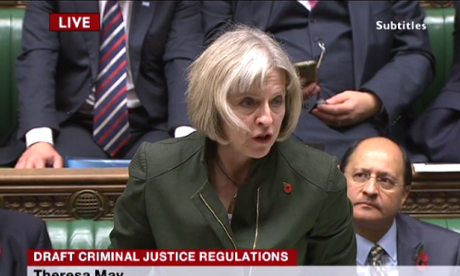
Theresa May's speech
Theresa May, the home secretary, is opening the main debate now.
She says the government will decide whether or not to opt in to all 35 police and criminal justice measures on the basis of tonight’s vote.
Yvette Cooper intervenes. John Bercow says this vote is not on the European arrest warrant. Is May saying she disagrees with the Speaker?
No, says May.
The government has won by 251 votes to 242 - a majority of nine.
That means the debate will run until 10pm.
Labour are voting against the business motion. Conservative and Lib Dem MPs are whipped to vote in favour.
The government’s majority is currently 76. So 39 government MPs would have to vote with Labour for the government to lose.
From the debate, it sounds as if there should be 39 Tory or Lib Dem MPs sufficiently angry to do so.
But there are claims that the government has encouraged some Eurosceptics to stay away tonight.
And some Eurosceptics may decide that a four and a half hour debate is better than a 90 minute one.
Here’s the text of the business motion that MPs are now voting on.
That, notwithstanding the provisions of Standing Order No. 16 (Proceedings under an Act or on European Union documents), debate on the Motion in the name of Secretary Theresa May relating to Criminal Law may continue until 10.00pm, at which time the Speaker shall put the Question, if it has not already been decided.
David Cameron is in the Commons for the vote on the business motion.
Division bell sounds and here's the PM, who promised a vote on the EAW before the Rochester by-election
— steve hawkes (@steve_hawkes) November 10, 2014
MPs are now voting on the business of the House motion.
There must be a very good chance that the government will lose, on the basis of the debate we’ve just had.
May is still speaking.
She says the government is clear that it will be bound by this vote.
The vote taking place now is on whether to have a debate lasting one and a half hours, or a debate lasting four and a half hours, she says.
(The government needs to pass a business motion because normally votes on statutory instruments like this only last 90 minutes.)
Theresa May, the home secretary, is speaking now.
She says that there was no requirement for the government to have a vote on opting back into the 35 EU police and criminal justice measures.
But some of those measures did have to be agreed by a statutory instrument.
Normally that SI would have been agreed by a committee after a short debate, she says.
Yvette Cooper intervenes. David Cameron promised there would be a vote on the European arrest warrant. Does she accept that promise has been broken?
May says the government only needs to hold a vote on some of the measures.
But May said the government took the view that today’s debate would cover the EAW. She was clear that she would speak on the EAW.
Jacob Rees-Mogg, a Conservative, intervenes. Earlier the speaker said MPs would only be able to mention the EAW peripherally in the debate, he says.
John Bercow says he did not use the word peripherally.
May says she is clear that MPs can discuss the EAW in the main debate.
The government is clear that tonigh’s vote on the regulations will decide whether or not we opt back into the EAW.
Sir Edward Leigh intervenes. MPs are voting on a matter that concerns liberty. They need to know that they are voting on. Bercow said the vote did not cover the EAW. But May says it will be an indicative vote.
Bercow says tonight’s vote is on the regulations.
The vote is not, repeat not, on the European arrest warrant.
David Hanson, the shadow Home Office minister, is winding up for Labour.
He says he agrees that the government has behaved in an underhand way.
He understands that May wants a vote on the European arrest warrant. The Lib Dems want a vote on it too. And so does Labour, because Labour thinks murderers, fraudsters and child abusers should be brought to justice.
He says, if the programme motion is defeated, the debate will only last 90 minutes. That would be appropriate for these minor 11 measures.
(On Friday a news release from three select committee’s said today’s motion only covered 10 of the 35 police and criminal justice measures. Now it seems to be 11.)
David Davis, a Conservative, makes a point of order. Would it be in order for Theresa May to intervene now?
John Bercow says there is provision for other MPs to speak. It would be odd to call her to speak now.
Davis says MPs do not know what they are debating. It would be helpful to hear from May.
Jacob Rees-Mogg, a Conservative, says the government cannot conceivably decide that a vote on one matter is indicative of another. What would happen next? Would it decide a vote to cut taxes was a vote to raise them? That would be the route to tyranny, he says.
Kenneth Clarke, the former minister, says MPs should allow the home secretary to offer a way out.
Rees-Mogg says this needs to be debate. This is not accidental, he says. David Cameron said there would be a vote. Other ministers said the same.
But then it turns out that ministers are offering a vote on obscure parliamentary instruments.
He says this approach is “fundamentally underhand”. That is why MPs from all sides are shocked.
Pete Wishart, the SNP MP, says people watching this will be appalled. Can’t the government say now what solution they propose?
John Bercow says he must allow other MPs to speak before calling the minister to wind up the debate on the timetable motion.
Sir Richard Shepherd, a Conservative, says the government is treating the Commons with contempt. MPs should talk out the timetable motion until the government returns with a proper timetable motion, he says.
John Bercow says public 'contemptuous' of conduct like the government's over this
Here’s the full quote from earlier, where John Bercow was accusing the government of breaking its promise on the vote. (See 4.41pm.)
I think I have given a fairly clear indication that this has been a sorry saga. And the House should not be put in this position. Most of us think that a commitment made is a commitment that should be honoured, and we should try to operate according to sensible standards, rather than try to slip things through through some sort of artifice. It may be the sort of thing that some people think is very clever, but people outside of the House expect straightforward dealing. And they are frankly contemptuous, and I use the word advisably, contemptuous of what is not straight dealing. Let’s try to learn from this experience and do better.
Bercow also said that there was nothing in standing orders to allow a vote on one matter to be a “proxy” on something else. He was responding to Christopher Chope, a Conservative, who said the government was saying tonight’s vote would be a vote on the EAW by proxy.
Sir Bill Cash, a Conservative, says today’s motion is unamendable. The government should all a proper debate and vote, with amendments.
This is a “travesty”, he says. It shows “a lack of transparency” and “a lack of honesty”.
Yvette Cooper, the shadow home secretary, is responding to Grayling.
This is a shambles, she says.
Grayling said the vote would be on all 35 measures. But Bercow himself said that was not right, she says.
Chris Grayling, the justice secretary, introduces the timetable motion.
He says he cannot support the home secretary because he is at the Mansion House tonight (where David Cameron is speaking) in his capacity as lord chancellor.
He was explaining why he would not be voting, but it did sound a little as if he were hinting that he does not support the European arrest warrant.
He says the vote will be on all 35 police and criminal justice measures.
Bercow accuses government of breaking its promise on EAW vote
Bercow is not getting even more critical.
Most of us think that a commitment made is a commitment that should be honoured.
It would be best to proceed by applying “sensible standards”, he says. The government is trying to slip thing through.
-
Bercow accuses government of breaking its promise on the European arrest warrant vote.
(I don’t think I’ve ever heard a speaker criticise a government in these terms from the chair. This is remarkable.)
Updated
Bercow criticises government for not allowing vote on European arrest warrant
Yvette Cooper, the shadow home secretary, says Theresa May should make a statement.
Bercow says May set out her views in the debate.
Jacob Rees-Mogg, a Conservative, says the government can put down clear motions if it wants. Isn’t this an act of prestidigitation? Wouldn’t it be better to have a clear motion?
Bercow says all sorts of things might be better.
He says he understands MPs feel “considerable irritation” on this matter.
But the House will want to debate what it wants to debate.
It would be better if these matters were met in a way that was straighforward. And commitments should be met.
(Now Bercow is directly criticising the government for its handling of this matter.)
- Bercow criticises the government for not allowing a vote on the European arrest warrant.
Updated
Sir Edward Leigh, a Conservative, says he is confused. He read in the Sunday papers that there would be a vote on the EAW.
We’re still on points of order.
Bercow says MPs wrote to him saying they wanted to speak on the EAW. He says he thought there would be a vote on the EAW too. But he’s just the speaker, he says.
Bercow says MPs will not technically vote on European arrest warrant
John Bercow, the Speaker, is making a statement about the European arrest warrant (EAW) debate.
He says, although the main debate only focuses on 10 EU police and criminal justice measures, he will allow some “latitude” to MPs. That implies that he will allow the EAW to be debated.
Yvette Cooper, the shadow home secretary, intervenes. Can Bercow confirm that there will not be a vote on the EAW?
Yes, says Bercow. Cooper is right.
Cooper goes again. She says Theresa May, the home secretary, wrote to her saying there would be a vote on the EAW.
Bercow says he is right. But May can offer her own take on the vote, he says.
Angela Eagle, the shadow leader of the Commons, says David Cameron said there would be a vote on the EAW before the Rochester byelection. Are ministers planning an emergency business motion?
Bercow says he has not heard that there will be such an emergency motion. It is not for him to interpret what Cameron meant, he says.
MPs debate the European arrest warrant
MPs are about to start their debate on the European arrest warrant (EAW).
At least, that’s what you’ll have heard on the news. But, this being the House of Commons, it’s not quite that simple.
In 2013 the government decided to exercise its right, under the Lisbon treaty, to opt out en masse from around 110 EU police and criminal justice measure. Having opted out en masse, it is opting back into 35 of these measures, included the European arrest warrant.
To implement this, the government is using secondary legislation. This evening MPs are actually voting on a statutory instrument (a piece of secondary legislation) - the draft criminal justice and data protection (protocol no 36) regulations 2014. And this SI only covers 11 of the 35 measures that the government wants to opt back into.
Yvette Cooper, the shadow home secretary, says this means the government has broken its promise to allow a vote on the EAW. And the chairmen of the European scrutiny committee, the home affairs committee and the justice committee have all protested about this. They have issued a joint press release saying there should be a separate vote on the EAW.
But, even if there will not be a separate vote on the EAW, there will be a debate on it. It will be the main topic of interest in the debate this afternoon. And Theresa May, the home secretary, is expected to say that the government will treat the vote as a vote on the EAW, even if that is not what it is technically.
May and Cooper will debate the EAW and the other measures later. First, though, there will be a debate on a business motion setting the timetable for today’s debate.
Here is some background reading.
UPDATE AT 8.25PM: The SI covers 11 measures, not 10, as I said earlier. (I’ve amended the text above). Here is a note with full details.
EAW in explanatory note: non-asterisked = HoC vote not required...11/35 measures do require "transposition" http://t.co/RQxRkBsvB1
— Faisal Islam (@faisalislam) November 10, 2014
Updated
Osborne v Balls - Verdict
Osborne v Balls - Verdict: That was an escape worthy of Houdini. The spin that George Osborne applied to his EU surcharge agreement on Friday was indefensible (see 3.34pm) and more or less everything Ed Balls said in his question to Osborne was fair. Indeed, it was better than fair. The questions about the legal advice, and other EU finance ministers saying the rebate would not apply, were good ones (which Osborne hasn’t answered). Osborne responded by saying that, if it was obvious the UK would get a rebate on the £1.7bn, Labour should have mentioned it. This was a sound point too, but what give it greater force was Osborne’s ability to highlight the £114,000-a-day figure in Balls’ Guardian article, which assumes a debt of £1.7bn, as evidence that Labour did not anticipate the rebate. It’s a rather nerdy, technical point, but it got Osborne off the hook after and awkward opening five minutes, and for the last 50 minutes or so he’s been preening at the despatch box, enjoying his debating victory.
My colleague Rafael Behr seems to agree.
George Osborne cruising through debate on EU budget contributions.
— Rafael Behr (@rafaelbehr) November 10, 2014
As does the Telegraph’s Dan Hodges.
George Osborne has just given a masterclass in how to respond to a PNQ.
— Dan Hodges (@DPJHodges) November 10, 2014
Labour’s Andy Love asks Osborne to name another EU foreign minister who agreed with him over the rebate (ie, about the rebate applying).
Osborne says neither Love, who is on the Treasury committee, nor any other Labour MP said the rebate would apply. Labour are trying to be wise after the event.
Ben Gummer, a Conservative, says Ed Balls has been absent from the airwaves defending the leader. Did they have spare time to advise Osborne on the rebate.
Osborne says it Labour will only say their leader is useless after the election. Balls never mentioned the rebate. He is not up to the job.
Philip Hollobone, a Conservative, says even the £850m bill is too large. Will a majority Conservative government renegotiate Britain’s EU membership fee.
Osborne says he understands the concern people feel. Under the Tories, there will be a referendum, he says.
Osborne says there is a pattern of forgetfulness on the Labour benches. They forget about the deficit, and now they forget about the rebate.
Labour’s Graham Stringer asks if Osborne will put his deal to a binding vote in the Commons.
Osborne says the normal scrutiny arrangements will apply. Osborne will give evidence to the Treasury committee. And the European scrutiny committee can look at this too.
Labour’s Luciana Berger asks Osborne to name one EU finance minster who supports his version of events.
Osborne says they all agreed to the conclusion of the meeting.
Osborne says it was not clear that the rebate would apply to this payment, or to what extent. That was only confirmed on Thursday last week.
David Nuttall, a Conservative, asks who needs the money most: the UK or the EU?
Osborne says he has negotiated a reduction.
Labour’s Paul Flynn accuses Osborne of a “confidence trick”.
Osborne says he won’t take lessons in getting money back from Europe.
Labour’s Gisela Stuart says she cannot find a serious commentator who did not think the UK would get its rebate. When will the system change?
Osborne says he knows the shadow chancellor is not a serious commentator, but he never assumed we would get the rebate. The interest rate calculations he included in his Guardian article imply that he thought Britain would be paying £1.7bn.
Here’s the Guardian article by Ed Balls and Douglas Alexander that Osborne was quoting earlier.
Osborne says the only involvement Balls has had with the EU rebate is to give away half of it.
Kenneth Clarke, the Conservative former chancellor, congratulates Osborne on a “surprisingly good” outcome. He says he expects the meeting was a cordial one. It was probably nothing like the “gunfight at the O.K Corral”, as people claim.
Labour’s Kate Hoey says this “fiasco” shows we are paying “far, far, far too much to the EU”. The sooner we get a referendum, the better, she says.
Osborne says he agrees. He hopes Hoey will persuade the Labour frontbench to offer one.
Labour’s Geoffrey Robinson, a former Treasury minister, accuses George Osborne of a “gross act of deception worthy of Goebbels”.
John Bercow, the Speaker, says MPs cannot accuse each other of deception. He tells Robinson to withdraw.
Robinson says it was a light-hearted remark. Bercow takes that as a withdrawal.
Osborne says he saw Robinson being handed his question by Balls’ team.
If it was obvious the UK would get a rebate, why did Balls’ Guardian article assume otherwise, he asks.
Osborne is responding to Balls.
Osborne says the British people do not like fools. That is why Balls is in opposition.
In a Guardian article at the end of last week Balls set four tests for Osborne. He passed the first three.
And the fourth was to ensure that the interest rate was fair.
Osborne said he disagrees. He does not think any interest should be applied.
And the figures in Balls’ article implied Britain would repay £1.7bn. So Balls himself never anticipate Britain getting the rebate.
Osborne says Balls should leave the strong leadership to the Conservatives. He should concentrate on throwing over the weak leadership in his party.
Updated
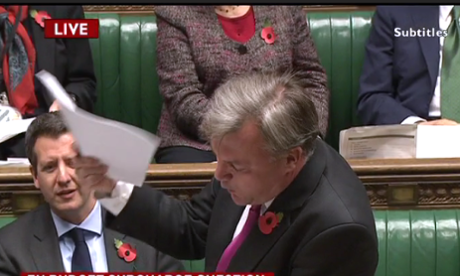
Ed Balls, the shadow chancellor, says if this was such a good deal, George Osborne would have offered to make a statement.
There is so much smoke and mirrors that he can barely see, Balls says.
He says this is a con trick.
Osborne claims that the rebate was in doubt. But no one ever suggested it was in doubt, he says.
On Friday the Treasury was telling journalists it had legal advice that the rebate might not apply. If such advice exists, it should publish it.
Balls says Daniel Hannan, a Conservative MEP, says it is not credible to claim the rebate was ever in doubt.
And he quotes other EU figures saying the UK was always due to get a rebate.
Can Osborne name a single finance minister who said the UK would not get a rebate?
And the Financial Times says Osborne did not even complain at the EU finance minister meeting about the overall size of the bill.
Balls says the British people don’t like being taken for fools.
Updated
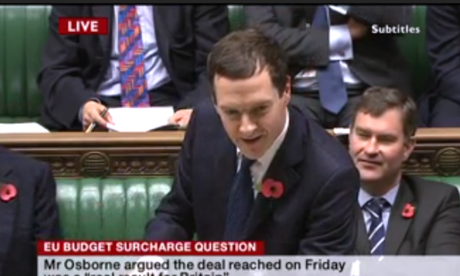
George Osborne, the chancellor, is responding to the urgent question.
He says the UK has halved the bill, delayed the bill and changed the rules so that this will never happen again.
David Cameron told the EU that, although surcharges were acceptable, a sudden demand for £1.7bn was unacceptable.
EU finance ministers discussed this on Friday. They agree that making the UK pay by 1 December was unacceptable. Instead Britain will pay in two instalments next year.
Second, it was agreed the UK would not pay interest.
Third, it was agreed that the UK would get a rebate. For the first time, the rebate will be paid when the money is paid. Previously it had not been clear that that the UK would get a rebate. This means Britain’s payments have been halved from £1.7bn to £850m.
Osborne says he has exceeded expectations.
And this shows why reform is needed.
Urgent question on George Osborne's claim to have halved Britain's £1.7bn EU surcharge
On Friday George Osborne claimed to have halved Britain’s £1.7bn EU surcharge.
Not everyone was convinced. The Guardian’s story carries the headline:
UK to pay £1.7bn EU bill in full despite Osborne’s claim to have halved it
And even rightwing journalists were sceptical about Osborne’s presentation.
The Daily Mail sees through pro-EU Osborne's spin pic.twitter.com/56z2iA05uu
— Tim Montgomerie (@montie) November 8, 2014
The FT's @TimHarford lambasts Osborne and the journalists who accepted his spin http://t.co/bEiwoSOTi1 pic.twitter.com/sHg3Uvz4al
— Tim Montgomerie (@montie) November 8, 2014
My apologies: @TimHarford was linking to a blog by @sjwrenlewis https://t.co/AyGzLByASA
— Tim Montgomerie (@montie) November 8, 2014
We’ll get the Treasury view in a moment.
John Cridland, the CBI director general, has issued this response to Ed Miliband’s speech.
Ed Miliband’s commitment to staying in a reformed European Union will be welcomed by business. We believe reform is achievable by working with our European allies to make the EU more open and competitive.
We’ve been calling on all political parties to get behind an independent infrastructure commission so we support Labour’s plan to back John Armitt’s proposals.
But Labour’s tendency to market invention could deter investment. We believe open markets are the best way to deliver growth for all.
Miliband's speech to the CBI - Summary
Traditionally the CBI is a home fixture for a Conservative leader, but an away match for a Labour one. Ed Miliband sounded conscious of this - more than once, he diplomatically stressed that Labour and business would not always agree - but his pro-EU message seemed to go down well. During the questions he was relaxed and sometimes funny, but his answer to the toughest question, about whether Labour has “a downer” on aspiration (see 3.03pm) was a bit disappointing. This was a moment where he needed to change gear, remind his audience quite how much executive pay has shot up over the last 30 years and make a passionate plea for fairness and redistribution. Instead, he sounded as if he wanted just wanted to change the subject quickly.
Here are the key points from his speech.
-
Miliband accused Cameron of putting Britain’s membership of the EU at risk. He would never do this, Miliband said.
You know that leaving the single market and stepping away from a trading block that allows us to work with the new economies, like Brazil, India and China, would be a disaster for our country.
It would risk billions of pounds in lost profits, risk millions of jobs and would make Britain weaker, not stronger, in the world.
And giving succour to the argument that the real answer is leaving the EU, or contemplating it, simply drags us closer to the danger of exit.
Every nod and wink to those who want to leave sends a message to potential investors in our country that Britan is not open for business, that our country is a dangerous bet.
We have seen over the last couple of years that, contrary to what some might have claimed, trying to use exit as a threat has simply weakened Britain’s influence not strengthened it.
Making ever-more incoherent demands, ever-more isolated from our partners.
All of this puts us on the conveyor belt towards exit with no idea how to get off.
I will not be part of it.
If I am prime minister I will never risk British businesses, British jobs, British prosperity by playing political games with our membership of the European Union.
-
Miliband said he wanted a Labour government to work with business to make the economy function better for workers.
Chris Ship’s question to Ed Miliband did not go down well in the hall, according to Twitter.
CBI delegates hiss and moan as Chris Ship from ITV asks miliband a question about leadership.
— Jim Pickard (@PickardJE) November 10, 2014
Miliband wraps up saying he thinks Labour has had a good dialogue with business.
He wants that to carry on if he wins the election.
Business will not support everything he does. But he wants them to work together, he says.
And that’s it. I’ll post a summary shortly.
Q: With the 50p rate of tax, and a mansion tax, how can we be sure you do not have some kind of downer on aspiration?
Miliband says his decision on 50p is that the government gave a big tax cut to the rich. If there are massive challenges, he cannot say he will keep that tax cut in place.
And, on the mansion tax, he says it is fair that the wealthy pay more from the NHS.
But he says he does not accept that he is against wealth creation.
Q: How will you address diversity in the real estate industry?
Miliband asks the caller what she thinks. She stresses the need for good careers advice.
He was in Milton Keynes recently. He met a young woman on a building site.
Work experience in schools is crucial, he says.
He also says he meets many businesses that complain that they cannot get into schools.
Q: Do you accept there is a crisis of confidence in your leadership? (From ITV)
No, says Miliband.
Q: Why should Scottish MPs vote on English-only matters? And should we have only half as many MPs?
Miliband says we need to take a proper look at this. It should not be rushed.
He also says we are “far too centralised” as a country.
He says he wants to give business a voice on this. That is why Labour wants to strengthen local enterprise partnerships.
Q: What will you do to make sure Britain is a really good place for manufacturing?
The EU issue is “incredibly important”, he says. Nothing would do more damage than leaving the EU.
It is also important to get energy policy rights.
Q: What can the UK learn from the Scottish referendum?
Miliband says the main lesson is that, if people think an election matters, they will turn out to vote.
He wants to show people that voting at the general election matters.
You sometimes hear people saying it does not matter who you vote for. But you did not find anyone saying it did not matter if you voted yes or no, he says.
Miliband's Q&A
Q: Have you read Thomas Picketty’s book?
Not all of it, says Miliband.
We don’t need to read the book to know equality is a massive issue, he says. Mark Carney, the Bank of England governor, gave a speech on this recently. Sir Mike Rake and John Cridland have made this point too.
Miliband says rising inequality explains anger with the EU.
There is a “shared agenda” here, he says.
Q: What would the impact be of a Tory/Ukip coalition?
Miliband says he won’t speculate on this.
Q: Do you ever wish you lost the Labour leadership in the light of what has happened?
Definitely not, says Miliband.
Updated
Miliband says he wants to work in partnership with business. But they won’t agree on everything.
We won’t agree about everything if I am prime minister. But in everything I do there will be consistent leadership.
I am not going to say it is OK to carry on as we are with the economy we have. Because I don’t believe it is.
I am not going to say we should close our borders. Because I don’t believe we should. I am not going to play politics with our membership of the European Union because I don’t believe it would make Britain stronger or more confident in the world.
Miliband says many young people feel the system does not work for them.
The last Labour government’s focus was on getting more young people into university. The next Labour government’s will be different; it will be to improve vocational training, he says.
Miliband says the CBI has influenced Labour’s thinking on this.
He says Labour wants to work with business to improve wages. It will offer tax incentives to firms that pay the living wage.
The next Labour government will not have extra money to spend, he says. That is why reform is necessary.
Miliband says he wants to change the economy works.
He is committed to maintaining a competitive tax regime, he says.
Failures in decision making have held Britain back, he says. That is why Labour will implement Sir John Armitt’s recommendation for an infrastructure commission.
The CBI has said regions need more power. And that is why Labour will devolve power over spending, he says.
Businesses have said the banking system does not work for them. That is why Labour will reform it, he says.
Miliband says, as prime minister, he would not play games with EU membership.
If I am prime minister I will never risk your businesses, British jobs, British prosperity by playing political games with our membership of the European Union.
Miliband says contemplating leaving the EU drags Britain closer to the exit door.
Giving succour to the argument that the real answer is leaving the EU, or contemplating it, simply drags us closer to exit. And every nod and wink to those who want to leave sends a message to potential investors in our country that we are not open for business.
We have seen over the last couple of years that trying to use exit as a threat has simply weakened our influence not strengthened it. And I will not be part of it.
Miliband says some people say the solution is to leave the EU.
Others say the problem is the European Union and the answer is to leave that: close our borders, turn our back on the world, and return to the way things used to be. These voices are loud and insistent. But in my view they are dead wrong and they need to be taken on ...
Leaving the single market and stepping away from a trading block that allows us to work with the new economies, like Brazil, India and China, would be a disaster for our country. It would risk businesses billions of pounds in lost profits, risk millions of jobs and would make Britain weaker, not stronger, in the world.
Miliband says there are huge reasons for optimism in this country.
But it is a joyless recovery for many, because it is a payless recovery, a recovery without wage growth.
Millions of people believe this country is not working for them. They fear deeply for the future of their kids. And they see a Britain that works only for some.
Ed Miliband's speech to the CBI
Ed Miliband is speaking now.
He starts by thanking Sir Mike Rake, the CBI president, for championing Britain’s role in the EU.
And he praises John Cridland, the CBI director general, for taking the CBI into issues like childcare.
Ed Miliband will be addressing the CBI shortly.
Frances O’Grady, the TUC general secretary, has put out a statement
TUC General Secretary Frances O’Grady backing his warnings about the dangers of leaving the EU.
It is time for unions, employers and sensible politicians to expose the dangers of even flirting with leaving the EU. The long-term solution to our living standards crisis includes creating more of the high-skill, well-paid jobs brought to the UK by inward investment – and under threat through talk of exit. We should not sacrifice economic growth for a family squabble between UKIP and the Conservatives.
But business leaders must recognise that employee rights, protection of the environment and high consumer standards are part of UK membership of the EU. Of course, there is room for reform, but the EU’s problems come not from giving workers legal rights to paid holidays, but depressing growth through austerity.
And here’s Yvette Cooper, the shadow home secretary, on Theresa May downgrading David Cameron’s promise to cut net immigration below 100,000.
The prime minister promised “no ifs, no buts”, his government would get net migration down to the “tens of thousands”. He said it was “a promise to the British people,” - part of the contract he put on leaflets to voters across the country. But today, the home secretary described the net migration target as a “comment”, rather than a promise. Did she think we’d just forget what the prime minister had said? Does she think voters won’t remember the Tory leaflets pushed through their letterboxes with this immigration pledge on? It’s time Theresa May stopped ducking and diving and took some responsibility for the fact that her net migration target is in tatters, so we can start having a serious conversation about the future of our immigration system and the reforms that are needed.
Here’s a Guardian video showing Chuka Umunna saying he has ‘1,000% confidence” in Ed Miliband as Labour leader.
Lunchtime summary
- David Cameron and Nick Clegg have both used speeches to the CBI to defend their respective party positions on Europe. Cameron used his speech (see 10.48am) to criticise Ed Miliband ( who is speaking this afternoon), saying the Labour leader did not have a plan for EU reform. Clegg said that Britain would have no proper future outside the EU, but that that did not mean he was opposed to EU reform. At the opening of the conference Sir Mike Rake, the CBI president and BT chairman, said that business was happy with the level of immigration from the EU and that, without immigration, much of Britain would still be waiting for superfast broadband.
EU migrants pay taxes, collect less benefits than British citizens, and many do not settle in the UK permanently ... Without the availability of this [migrant] labour, instead of 82% coverage, much of Britain would still be waiting for superfast broadband and those yet to get it would be suffering further delay.
In his speech, Cameron also claimed the government was embarked on the biggest programme of road building since the 1970s.
- Chuka Umunna, the shadow business secretary, has said a referendum on EU membership would be “dangerous”. He has also dismissed Labour criticism of Ed Miliband’s leadership as “noises off”.
- Theresa May, the home secretary, has downgraded a cast-iron pledge by David Cameron to reduce net migration to the tens of thousands to the status of a simple “comment”. BBC Radio 4 has announced that May will be the guest on Desert Island Discs on Sunday 23 November.
Updated
Ed Balls, the shadow chancellor, has been granted an urgent question at 3.30pm on the surcharge the UK is paying the EU.
UQ granted to @edballsmp on gov’s agreement on EU budget surcharge Wonder if @George_Osborne will come to tell us what a great deal he got?
— Labour Whips (@labourwhips) November 10, 2014
He will be able to ask about George Osborne’s extremely dubious claim to have halved the £1.7bn bill.
At the CBI Nick Clegg says it is a “myth” to think that you cannot be in favour of both the EU and EU reform. He has written whole books making the case for EU reform, he says.
There is no point just threatening to walk out, he says. That’s the kind of thing his kids behave when they want an ice cream. He tells them they can just walk off if they put it like that. If they want an ice cream, they should ask nicely and make an argument, he says.
Nick Clegg has just finished his speech to the CBI. He said that Britain had no future if it left the EU, that spending cuts in the next parliament would have to be accompanied by some tax rises and that, without another coalition government after 2015, the recovery would be at risk.
Q:
Here’s a Guardian video with a clip of David Cameron addressing the CBI.
And here is some more comment on David Cameron’s speech to the CBI.
From the Lib Dem MP Julian Huppert
I'm disappointed by Cameron's plans to spend even more money on building new roads if Tories win. We need spend on rail, buses, bikes #fb
— Julian Huppert (@julianhuppert) November 10, 2014
From Michael Dugher, the shadow transport secretary
Memo to media: Cameron's so-called 'roads revolution' involves schemes & money already announced in summer 2013. Not much of a revolution...
— Michael Dugher (@MichaelDugherMP) November 10, 2014
Roads revolution? One definition of revolution is to go round, to rotate, to spin. To that extent Cameron's roads plans are v revolutionary
— Michael Dugher (@MichaelDugherMP) November 10, 2014
From Daniel Hannan, the Eurosceptic Conserative MEP
The CBI, the EU and the Labour leadership are part of the same corporatist racket.
— Daniel Hannan (@DanHannanMEP) November 10, 2014
Please try to understand, @vincegraff, that British business and the CBI are two very different things.
— Daniel Hannan (@DanHannanMEP) November 10, 2014
Fifteen years ago, the CBI was shrilly insisting that it would be a disaster to keep the pound. Why do we listen to anything it now says?
— Daniel Hannan (@DanHannanMEP) November 10, 2014
Number 10 lobby briefing - Summary
Here are the key points from the Number 10 lobby briefing.
-
Number 10 has accepted that getting net immigration below 100,000 is an “objective”, not a firm promise. Asked about the status of that commitment, which was described as a mere “comment” by Theresa May this morning (see 9.19am), the prime minister’s spokesman replied:
There has been no change. That remains the objective towards which the prime minister [is working].
The spokesman refused repeated invitations to confirm that this was still a promise. Asked to accept that the government would fail to get net migration below 100,000 before the election, the spokesman said the government was continuing to work towards that objective.
- Downing Street played down suggestions that Tory MPs opposed to the European arrest warrant are being encourage to stay away this evening, rather than turning up to vote against the government. “The usual three-line whip arrangements apply,” the prime minister’s spokesman said. But, when asked if government MPs who did not vote would be punished, he said that was a matter for the whips.
-
Cameron is giving the annual Mansion House speech at the Lord Mayor’s banquet this evening. Traditionally it focuses on foreign policy.
More than four years after he became Labour leader, people are still getting Ed Miliband’s name muddled up with his brother’s. The latest culprit was Chuka Umunna, the shadow business secretary.
What made it even more embarrassing was that he talked about getting “Dave” into Number 10. Getting Dave back into Number 10 is, of course, the Conservative party’s central aim.
The CBI has issued a response to David Cameron’s speech. This is from John Cridland, the CBI director general.
The PM gave an upbeat speech with deficit reduction firmly in pole position. There was recognition that it is necessary to grow at the same time as cutting back, and it was good to hear the emphasis on both infrastructure investment and skills.
Business will welcome the PM’s endorsement of the CBI’s Europe strategy of ‘In with Reform’.
As you can tell, I’m back from the Number 10 lobby briefing. Downing Street are now saying that getting immigration below 100,000 is “an objective”, not a promise. (See 9.19am.) I’ll post a summary shortly.
The BBC’s Nick Robinson says there is a split between David Cameron and the CBI over immigration.
CBI President warns PM that to "close the door on essential migration" is a threat to recovery
— Nick Robinson (@bbcnickrobinson) November 10, 2014
PM says "I always listen to the CBI" but at their Conference he didn't address their warning re risks of cutting immigration. #CBI2014
— Nick Robinson (@bbcnickrobinson) November 10, 2014
Sir Mike Rake, the CBI president and BT chairman, spoke before David Cameron. Here are extracts from his speech and here is what he said about immigration.
Without the availability of [immigrant] labour, instead of 82% coverage, much of Britain would still be waiting for superfast broadband and those yet to get it would be suffering further delay.
Immigration has been and is part of the solution to the skills shortages faced by the UK.
But it’s clear that there is a disconnect between the experiences of businesses and the public at large.
With tightening immigration controls at the top of many voters’ priorities for government, it is an issue and concern that politicians cannot ignore. Businesses must recognise this.
Immigration can have consequences at a local level, with pressure on housing and schools. In some areas, concerns about immigration have become a substitute for frustrations with living standards.
Business has a vital role to play in ensuring the debate is based on the facts whilst recognising the genuine concerns of the public around immigration. Including on public services, jobs and welfare.
On welfare, free movement should offer the right to work, not the right to claim benefits, so action should be taken, both domestically and with EU partners, to ensure the rules are fit for purpose.
But it is not an either/or choice between immigration and increasing the skills of our workforce.
I’m off to the Number 10 lobby briefing. I’ll post again after 11.30am.
Cameron's speech to the CBI - Summary
Here are the main points from David Cameron’s speech and Q&A. The speech itself was thin - it was more of a chat than a speech - but, as an exercise in communication, it was good. It was clear, informal and good-humoured.
-
Cameron accused Ed Miliband of not having a plan for EU reform. Referring to the reports about what Miliband is planning to tell the CBI this afternoon, Cameron said:
Simply standing here and just saying ‘I will stay in Europe, I will stick with whatever we have come what may’, that is not a strategy, that is not a plan and that won’t work.
-
He said inward investment figures showed that his European strategy was not alarming business by creating uncertainty about Britain’s future in the EU.
Sometimes people say to me by raising issues about Europe and European reform, doesn’t that make life less predictable. I would argue quite the opposite. I think the worst thing for us to do as a country is to pretend this European debate is not happening. The best thing to do is to get out there, make the arguments, make the changes, and then put that to the British people. And I make one point about that; if there has been uncertainty, why is it this has been such an extraordinary period of investment into our country. There have been months under this government when we have been getting more investment into Britain than the rest of the European Union altogether.
-
He said welfare reform was an essential part of his plan to control immigration.
We need to have proper immigration control. We need to do more, both outside the European Union and, frankly, inside the European Union. But the flipside of the coin on immigration is a welfare system that rewards work and an education system that turns out people with the skills necessary to do the jobs that we are creating in our country today. No immigration policy will succeed unless it’s accompanied by that welfare and that education reform as well.
Sadly, Cameron was not asked about Theresa May’s comment this morning. (See 9.19am.)
- He said he did not want any further significant reform in education. The period of “really rapid change in terms of structures” was mostly over, he said. It was important now for the Michael Gove reforms to be allowed to bed down, he said.
- He accused Labour of wanting to put up business taxes and said that was “stupid”.
- He said he could sum up his manifesto in a sentence.
You asked about our manifestos. I can sum mine up in a sentence: we’ve got an economic plan, it’s working and we need to stick with it.
-
He said he wanted Spain to stay united. And, criticising Catalonia’s decision to hold an informal independence vote this weekend, he said referendums should be done through the proper constitutional frameworks, he says.
Q: Should people have to serve in industry for 10 years before they can become an MP?
Cameron says he has some sympathy for this.
MPs are not universally loved. But if you ask people about their own MPs, local MPs with a plan tend to be popular.
In terms of experience, there should be a range in the Commons. He says he spent more than seven years himself working for a FTSE 100 industry.
The 2010 intake changed the Commons a lot, he says. A lot of people on the government benches have worked in business.
He says he has been encouraged by how many people in business want to go on and serve in politics.
He says, if people in the audience know business figures who would make MPs, they should encourage them. My door is always open, he says.
And that’s it.
I’ll post a summary shortly.
Q: [From someone from Center Parcs] Do you accept that some decisions need more cross-party consensus?
Cameron says he introduced fixed-term parliaments. Sometimes in the shower in the morning he regets that (ie, he think he would like to call an election). But it was a good thing to do, he says.
He says he is glad that Labour is backing HS2.
But consensus for its own sake is not always a good thing. In politics, you need a choice. The CBI will hear from Nick Clegg and Ed Miliband later.
Labour is proposing to put up business taxes. He says he cannot think of a more stupid thing to do.
Q: Can we have some clarity on education qualifications? And could we have a 10-year plan on education?
The questioner is a teacher. Cameron thanks her for what she does. He says he has been going round looking at new schools with his 10-year-old daughter. He is very impressed by the schools he has seen.
We have gone through a phase of reform. Exams were dumbed down. There has been a change to standards and rigour and discipline.
The need now is to let those bed down, he says.
The period of really rapid change in terms of structures - that is mostly done.
Cameron says business leaders can be “extraordinary role models” if they go into schools. He can remember almost all the business figures who visited his school.
Q: What advice would you give the Spanish prime minister about Catalonian independence?
Cameron says he is delighted the UK voted to stay together.
Britain is a great friend and ally of Spain. We want Spain to stay united, to say together, he says.
Referendums should be done through the proper constitutional frameworks, he says.
Q: How can we ensure that the promise for inward investment are followed through?
Cameron says he follows these projects closely himself.
To keep encouraging inward investment, you need consistency and predictability, he says.
That is particularly important in energy.
Sometimes people say by raising issues of EU reform, he is increasing unpredictability, he says.
He says he does not accept that. He thinks the opposite is the case.
And inward investment has been high, in some months higher than for the rest of the EU. That shows his EU policy has not deterred investors, he says.
Cameron's Q&A
Q: Can you say more about your plan to improve adult skills?
Cameron says it is no longer the case that you just learn skills at school. He sees the open university as playing an important role in the economy.
Cameron claims Miliband has no plan for EU reform
Cameron is now wrapping up.
He says you never get anywhere unless you have a plan. He has a plan for EU reform. He wants to address immigration concerns, and then give the people a choice.
That is a strategy, he says. That is a plan.
Simply standing here, and saying I will stick in Europe come what may, is not a plan.
He’s talking about Ed Miliband, obviously, and the lines from Miliband’s speech that have been briefed in advance.
- Cameron claims Miliband has no plan to EU reform.
Cameron says his fifth priority is to increase exports.
Cameron says the fourth challenge relates to infrastructure.
He says the government has not given up on infrastructure investment. It is finishing Crossrail, it is committed to HS2 and it sees HS3 as an “extremely powerful” vision.
The govenrment is making the biggest investment in rail since the Victorian ages, he claims.
(He has made this claim before. It is highly contentious. There is more here.)
And he says the government has the biggest road expansion programme since the 1970s. Between now and 2020, there will be £15bn spent on roads, he says.
Cameron says the third challenge has been to get people into work.
A record number of people are in work, he says.
But there are still pockets of high unemployment.
Those who said private sector growth would never make up for the cuts in the public sector have been proved completely wrong.
Cameron says promoting employment involves skills, education and welfare reform, he says. And this ties in with immigration. No immigration policy will succeed unless there is also welfare reform.
Cameron says his second challenge has been making Britain a better place for businesses.
There are 400,000 more businesses in Britain now than when he became prime minister. And there have been 1m start-ups.
I need your help, he says. Businesses need to get into schools to encourage people to start businesses.
Cameron says his government has focused on five challenges.
First, it has cut the cost of government and reduced the deficit. The government has to live within its means, he says.
But there will be more cuts in the next parliament, he says. The next government will not be one that says who can spend your money better. It will still have to make savings, he says.
Cameron says he can sum up his manifesto in one sentence: we’ve got an economic plan, it’s working and he intends to stick with it.
He cannot claim to have solved all problems, he says. But he is making good progress. People see Britain as a place to invest. He had energy investors in Downing Street recently. He challenged them to say if any other country was a better place to invest. They could not identify one, he says.
David Cameron is about to start.
He is speaking from notes, not from a full text, and he will speak for 10 minutes before taking questions.
David Cameron's CBI speech
As the BBC reports, David Cameron is expected to use his CBI speech to say that the autumn statement next month will include plans for £15bn worth of road improvements over the next ten years.
Michael Dugher, the shadow transport secretary, says this is “a pre-election con trick”. There is no extra money, Dugher claims.
Alastair Campbell, Tony Blair’s former press secretary, has also been tweeting about this.
Cameron pre election 'I will lead greenest govt ever.' Speeches on environment. Zero. Action climate change. Similar. Now big thing roads
— Alastair Campbell (@campbellclaret) November 10, 2014
The speech itself will be starting shortly.
Chuka Umunna, the shadow business secretary, was on the Today programme this morning. As Nicholas Watt reports, he dismissed the Labour complaints about Ed Miliband’s leadership as “noises off” from “a small minority of people who are [criticising Miliband] anonymously and off the record.”
He also said having a referendum on the EU would be “dangerous”.
I do think it is dangerous because I think what people want us to concentrate on now is ensuring that we get our economy going and reform it so that it is delivering better jobs and growth. A reformed Europe is absolutely an essential part of that.
David Cameron will be addressing the CBI is about 10 minutes.
There is a live feed of the conference on the CBI’s website (although it’s a bit fiddly - you have to fill in a registration form).
Theresa May, the home secretary, was on the Today programme this morning. She was mainly talking about the European arrest warrant, which MPs will debate later this afternoon, but the most interesting part of the interview came when she downgraded the Conservative commitment to getting net immigration below 100,000 to “a comment”. Asked about this, she said:
When we made that comment, we said we would be aiming to bring the net migration down to the tens of thousands and we wanted to do that within this parliament. Yes, we were very clear that was what we wanted to do. And the reason we said that was because we felt that the levels of the tens of thousands, which was the level of net migration we had seen in the 1990s, was more sustainable than the levels that we’d seen previously.
But “comment” was not quite the way David Cameron put it in a speech in 2011. Here’s an extract.
I believe controlling immigration and bringing it down is of vital importance to the future of our country.
That’s why during the election campaign, Conservatives made a clear commitment to the British people that we would aim to reduce net migration to the levels we saw in the 1980s and 1990s ...
Yes, Britain will always be open to the best and brightest from around the world and those fleeing persecution.
But with us, our borders will be under control and immigration will be at levels our country can manage.
No ifs. No buts.
That’s a promise we made to the British people. And it’s a promise we are keeping.
Cameron is addressing the CBI later this morning. With luck, someone will ask him about this.
Here’s the agenda for the day.
Morning: David Cameron and Nick Clegg address the CBI.
11am: Number 10 lobby briefing.
2.30pm: Ed Miliband speaks to the CBI. As Nicholas Watt reports, Miliband will offer a guarantee that a Labour government will “never risk” the economy by threatening to take Britain out of the EU.
3.30pm: MPs begin debating the European arrest warrant.
As usual, I will be also covering all the breaking political news from Westminster, as well as bringing you the most interesting political comment and analysis from the web and from Twitter. I will post a summary at lunchtime, and another at the end of the day.
If you want to follow me on Twitter, I’m on @AndrewSparrow.