Afternoon summary
- Miliband will make an explicit appeal to younger voters on Thursday and Friday this week by promising to cut tuition fees and warning that elderly people have become runaway victors in Britain’s intergenerational contest. As Patrick Wintour reports, the Labour leader is expected to say that a Labour government would cut tuition fees from £9,000 to £6,000 a year.
-
Labour has said it will close off avenues for banks to get around its proposed bonus tax, a shadow minister has vowed. Speaking in a Commons debate on bank bonuses, Cathy Jamieson, the shadow Treasury minister, said:
Bonuses should be a reward for exceptional performance and not a compensation for failure. Despite the scandals that have emerged over the past year, most recently HSBC, it looks like this year it looks like this round of bank bonuses will once again be very generous.
Pay must be more closely aligned with long term performance so a Labour government will embark on a serious and far reaching programme of reform in the banking sector. We will reintroduce our successful tax on bankers bonuses which generated over £3bn in 2010.
We will act to ensure this tax incorporates any attempts made by banks in an attempt to circumvent the EU bonus cap.
That’s all from Aisha and me (Andrew Sparrow) today.
Thanks for the comments.
Here’s a Guardian video from PMQs.
Charlie Elphicke, Tory MP for Dover and Deal, says that it was under Labour people such as Fred Goodwin – former RBS chief executive –was awarded: “honours and baubles and backslaps”.
The Forex and Libor scandals happened under the previous government, he added.
Goodman also speaks about the recent letter signed by bishops of the Church of England. It writes banking should be based on fairness, generosity and sustainability, she said.
Helen Goodman, the Labour MP for Bishop Auckland, raises the issue of growth in the north-east.
She said that it is not “a thriving situation”.
Goodman says there is a disconnect between how HSBC takes care of its senior staff, yet has taken a local branch out of a town in her constituency – that has nearly 10,000 people and perhaps leaves them vulnerable to pay-lenders such as Wonga.
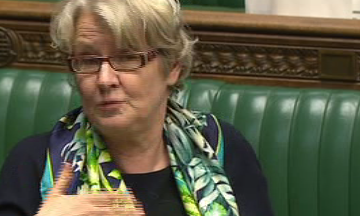
She says this demonstrates an “arrogance”.
The main highstreet banks have failed so disastrously, Goodman says, with regards to the growth of payday lenders.
Updated
Ian Swales, Lib Dem MP, says that an area that needs to be looked at is regulation on crowd-funding.
Bonuses have reduced in the last ten years according to Ian Swales, the Lib Dem MP for Redcar.
While in 2007 bankers’ bonuses was £11bn, in 2013 it was around £2bn but is now rising as banks have got their act together, he says.
He adds that he doesn’t agree with Labour’s motion and that it links bonuses with youth unemployment issues.
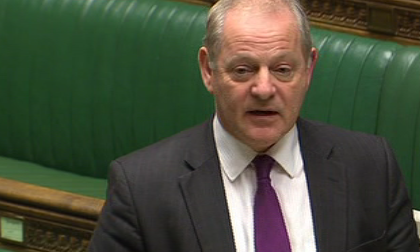
Liz McInnes, Labour MP for Heywood and Middleton, says that her party’s clawback reform to banking bonuses will extend back to at least 10 years.
She acknowledges that there has been a ring-fence between investment and high street banking.
Yet said the government has not done nearly enough to reign in, and has stopped short of all the recommendations.
HSBC bosses grilled
My colleague Graeme Wearden is live-blogging HSBC bosses being grilled over Swiss tax scandal in treasury committee questions.
He has said:
I hope the British public see that the action steps I gave taken leave HSBC in a better state...
You can follow all the updates here.
Back to the banking industry debate, according to Andrea Leadsom the economic secretary, the government still views the EU cap on banking bonuses as “flawed” despite dropping their legal challenge.
She warned that bankers will find “other ways to remunerate themselves, in fixed pay rather than in variable pay”.
“The way for [bankers] to be accountable is through variable pay which is performance based,” Leadsom said.
Breaking away from the bankers’ bonus debate, here are more reactions to PMQs from earlier.
The take from the Staggers blog is: “The Prime Minister was left looking as inert as Gordon Brown following the expenses scandal.”
It goes on:
It is some time since David Cameron has endured a defeat as bad as that he suffered at today’s PMQs. Ed Miliband unsurprisingly led on the lobbying scandal and pressed the case for reform of MPs’ second jobs (the subject of a Labour motion tonight). Cameron replied that he did not rule out “further changes” but the tone of lofty scepticism was unmistakable. At this, an animated Miliband pounced. Had the PM not once declared that “double-jobbing MPs won’t get a look-in when I’m in charge”? Cameron replied with what he thought was a trump card - Labour’s motion would allow MPs to serve as paid trade union officials - but it proved to be a dud. Miliband simply ruled out this exemption and invited the PM to do business. (There are, in any case, no Labour MPs who occupy this role.) He offered to consult on the level of an outside earnings cap, while demanding that the government agree to a ban on directorships and consultancies.
A wrong-footed Cameron could only respond with pre-heated attacks on the trade unions, intermingled with cheap barbs at Tristram Hunt and David Miliband over their outside earnings.
James Forsyth on the Coffee House blog, too, wrote that Miliband did well.
Ed Miliband boxed cleverer than David Cameron at PMQs today and came out with a comprehensive points victory. Miliband went, predictably, on the whole issue of second jobs for MPs.
It went on:
Cameron, equally predictably, responded that the Labour proposal wouldn’t deal with MPs being paid Union officials. Miliband then, nimbly, said that he’d be happy to amend it to make it clear that this was banned too at which point Cameron was pinned back on the ropes. He was left trying to make his way through the session with increasingly strident references to the influence that the unions have on the Labour party.
James Morris, Tory MP, stands up to say not all bankers are millionaires.
Leadsom thanks him for the comment and says that many bankers are horrified by misconduct of a few.
She lists what the government has done so far to regulate the banking industry:
- The government has made “reckless misconduct” in banking a criminal offence.
- Secondly she adds there has been a record £1.1bn in fines on five major banks for rigging the foreign currency markets.
- The serious fraud office has launched an investigation into the manipulation of LIBOR.
- Regulatory reforms, Leadsom says, will make banks serve better and that a management and certification regime has been put in place.
Updated
Leadsom, the economic secretary, says 15 top banks had signed the government’s code of practice on taxation.
It was signed back in 2010, and states:
HMRC and the banks should work together to encourage mutually open and transparent relationships.
It can be read here.
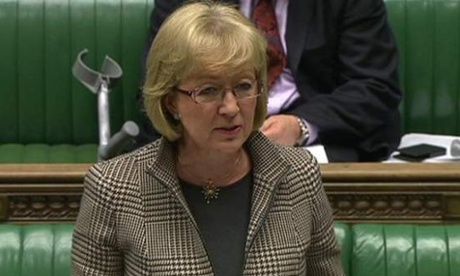
Andrea Leadsom, the treasury’s economic secretary and who worked in the banking and finance industry for 25 years, rises to the box and said “the party opposite has the cheek to come to the house to say this side of the house [the government] is responsible.”
She adds this debate is recycled to offer a distraction.
Yet, Leadsom says, the debate allows her to remind the house the steps the government have taken.
She adds the public, “quite rightly”, are absolutely furious about the banks.
Leadsom says the current government have the toughest remuneration regime than anywhere else in the world
She adds that under this government, banks will be able to become respectable again.
“Under this governmnet [we will] never go back to the bad old days of banking.
Most bankers are honest decent people, she says. She gives tribute to the people that oil the economy.
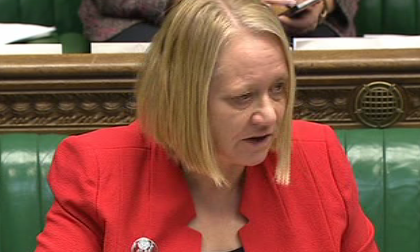
The starting point, Cathie Jamieson says, in Labour’s reforms include:
- Trust and fairness –so that bonuses are rewarded for exceptional performance and that it’s not compensation for failure
- Taxing bankers’ bonus will raise £3bn
- The tax from bankers’ bonus will go towards funding a compulsory jobs guarantee for young people, 16-24 year olds, who are out of work. Jamieson cites that 740,000 young people are out of work.
- Banks will be able to claw back any bankers’ bonuses if inappropriateness is revealed
Despite the revelations in the last few weeks, Cathie Jamieson MP says, two out of the four large banks in the UK including HSBC have had “drastic fall in profits”.
Yet HSBC award £7.6mn to chief executive Stuart Gulliver, she adds.
Andrew Gwynne, Labour MP for Denton and Reddish, asks whether the government has gone far enough. He asks whether there will be a proper investment banks, and banks that will continue lending to businesses.
Mark Garnier, Tory MP for Wyre Forest, stands again and says that lending in the past has been irresponsible and started the financial crisis in the first place.
Banking debate
MPs begin a debate on a Labour motion on bankers’ bonuses.
Labour’s Cathy Jamieson the shadow economic secretary is speaking and says we need “a culture change and an attitudinal change”.
She adds that banks have fallen short of high standards and “at times have acted recklessly.”
The 10-minute rules motion has passed.
Debbie Abraham tells MPs “Disabled people are twice as likely to be living in persistent poverty than non disabled people.”
Labour MP Grahame Morris tweeted:
In Chamber of Commons to support the excellent @Debbie_abrahams moving her 10-Minute Rule Bill on Employment of People with Disabilities
— Grahame Morris MP (@grahamemorris) February 25, 2015
Updated
Labour’s Debbie Abrahams is now speaking in the commons and has a ten minute rule bill on the Employment of People with Disabilities - which proposes listed companies, public bodies and voluntary agencies to report on the number and percentage of disabled people they employ.
Updated
Twitter round-up to PMQs
Hi I’m Aisha Gani and will be blogging here for the next two hours. You can follow me on twitter if you like – @aishagani.
Here’s a round-up of twitter reactions to PMQs:
The most reliable indicator of a Cameron defeat at #PMQs is the number of times he mentions the trade unions.
— George Eaton (@georgeeaton) February 25, 2015
More and more MPs now leave before #PMQs is over
— Isabel Hardman (@IsabelHardman) February 25, 2015
Feeling a bit end of term now. Who brought Connect 4? #pmqs
— Graeme Demianyk (@GraemeDemianyk) February 25, 2015
Why Dave's dodging TV debates? Second week Mili's beaten Cam in #pmqs - 2nd jobs today, tax dodging/HSBC last Weds
— Kevin Maguire (@Kevin_Maguire) February 25, 2015
Seen Nick Clegg in a hardhat on a building site near you? He's gone awol from PMQs again...
— Paul Waugh (@paulwaugh) February 25, 2015
Go on. Ukraine. Big subject, what's the PM's plan … Ask him someone #pmqs
— Rafael Behr (@rafaelbehr) February 25, 2015
David Cameron: "My fox is alive!" Ed Miliband: "Your fox is totes dead." #pmqs
— Stephen Bush (@stephenkb) February 25, 2015
PMQs - Verdict
PMQs - Verdict: Ed Miliband will be feeling very satisfied with that. He scored a clear win.
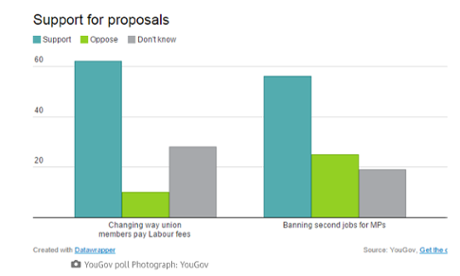
At PMQs who wins partly depends on what the issue is, and what the public think. If voters are inclined to agree with the argument you’re making before you even start, you’re likely to do well. And, on this, as these YouGov figures show, there is clear public support for a ban on MPs having second jobs.
But that was not the only reason Miliband won. Cameron was on the defensive, but he could have made a principled argument for MPs being allowed to have second jobs (as he did when he was responding to Sir Peter Tapsell - see 12.26pm). Instead, he used the spurious argument that Labour’s plan would allow MPs to serve as paid trade union officials, but not to run a business. This is bogus because, as Nick Robinson has just explained on the BBC’s Daily Politics, there are no Labour MPs who are paid union officials. And Miliband smartly offered to amend his motion to rule this out too. At that point Cameron resorted to raising a second objection (which Miliband also countered), and he looked like someone doing a wriggling eel impression.
Miliband also scored a good hit with his Cameron quote about “double jobbing” which, at the time, sounded like a killer point. But Andrew Neil on the BBC has just said Miliband was quoting Cameron out of context. Cameron used the phrase in the context of Northern Ireland, where he was referring to politicians sitting as members of the Commons and members of the Northern Ireland assembly.
One final thought. Given that this works so well for Miliband, perhaps he should have chosen to open the Labour debate on this issue himself. Cameron would have had to reply, and the issue would have received even more attention.
I’m off to the Guardian hustings now. (See 6.49am.) My colleague Aisha Gani will be taking over the blog now for the next two hours or so.
Updated
Labour’s Jeremy Corbyn says the EU should adopt a humane approach to dealing with migration from Libya.
Cameron says the government has introduced the modern slavery bill. And more needs to be done to help Libya.
And that’s it.
John Leech, the Lib Dem MP, asks about the announcement that Manchester is taking charge of its health budget.
Cameron says this is an important breakthrough, made possible by government reforms. It will make it easier for health and social care to be merged. He says Andy Burnham, the shadow health secretary, did not realise eight Labour councils were in favour.
Tessa Munt, the Lib Dem MP, asks about broadband rollout in her constituency.
Cameron says there is more do to on broadband rollout. We need to look at creative solutions to ensure the final 5% of homes are reached.
Labour’s John Cryer asks Cameron to set up a statutory register of paid lobbyists.
Cameron congratulates Cryer on being elected as chair of the parliamentary Labour party. But what needs fixing is Labour’s relationship with the unions.
Glyn Davies, a Conservative, asks about organ donation.
Cameron says there has been a substantial increase in organ donation, without the government adopting “presumed consent”, a policy he does not support, he says.
George Howarth, the Labour MP, says the cut in the allowance for disabled students has led to many of them saying they will have to drop out of their courses.
Cameron says he has looked into this. Under the new personal independence payment, the most disabled students will get more.
Cameron says Labour are keen to talk about second jobs because they don’t want to talk about the jobs revolution in the country.
A Labour MP asks Cameron how many jobs an MP should have.
Cameron says he has two: being an MP, and being prime minister. He does constituency work every day. But it would be wrong to say this takes more money than being prime minister.
Sir Peter Tapsell, a Conservative, says if MPs are not allowed a second job, membership of the Commons will be confined to inheritors of substantial fortunes or “obsessive crackpots” or “those who are unemployable anywhere else”.
Cameron says Tapsell does not fit into those categories. He says there are practicising doctors and dentists in the Commons, and people who run businesses. Pointing at Labour, he says under their plans we would just have trade union cyphers.
Ben Gummer, a Conservative, asks about rail services in East Anglia.
Cameron says the government wants to achieve Ipswich in 60 minutes, and Norwich in 90 minutes. Cameron offers happy birthday wishes to Ed Balls. He says he wants to ensure that, after the election, Balls can get to Norwich (he’s a Norwich City fan) more quickly.
Labour’s Glenda Jackson asks why Cameron outsourced his reply to a letter from a constituent to someone from the Conservative party. MPs are not allowed to use their parliamentary offices for political campaigning. So Downing Street should not be allowed to do this either.
Cameron says he will look into this. If it were a letter from Jackson, she would have had a reply from Cameron. But voters in Hampstead will be getting lots of letters from Cameron in the coming weeks, he says.
David Mowat, a Conservative, asks about the growth deal for Cheshire.
Cameron praises Mowat for the work he has put in campaigning for this.
Labour’s Rushanara Ali asks about the schoolgirls from her constituency who went to Syria. Will Cameron set up an inquiry into how schools and mosques can be given better advice about protecting young people?
Cameron agrees. He says he has asked Theresa May, the home secretary, and Patrick McLoughlin, the transport secretary, about this. What the Turkish prime minister said about there being a three-day delay before the Turks were informed was not accurate, he says.
Cameron says the Conservatives’ plan for London is incredibly ambitious. It shows how the city could become the greatest city on earth.
Snap PMQs Verdict
Snap PMQs Verdict: One of Miliband’s best performances for ages, and a good example of how hammering away at the same question can work so effectively, because he exposed Cameron’s initial claim about the Labour second jobs motion as entirely spurious.
Miliband says he is happy to insert paid trade union official into his motion. This is a big test. Miliband will vote for MPs to have one job. What will Cameron vote for?
Cameron says voters want to know MPs will not be swayed by their debt to others. The biggest problem is that the trade unions own Labour “lock, stock and barrel”. If Labour drops its support for unions, we’ve got a deal.
Miliband says if Cameron wants to talk about funding, he can talk about a party bought and sold by the hedge funds. Will Cameron vote for one job or two? Yes or no?
Cameron says the government has passed an act on lobbying. Labour has been lobbied by unions to scrap it. And that is what they will do. They are owned by the unions.
Miliband says he is happy to rule out MPs being allowed to be paid union officials. Will Cameron back the plan?
Cameron says that is not the only problem with the idea. What about the cap on earning? Tristram Hunt earned more than 10% of his MP’s salary by being a lecturer. That is a good thing. He gains experience. But it is a pity it does not show up in his education policy. Cameron says he thinks the Commons is stronger for having MPs with different experience.
Miliband says he can consult on the cap. But today he is talking about something specific - a ban on paid directorships. Yes or no?
Cameron says the Labour plan allows people to be paid trade union officials, but not to run a family business. There is also a problem with the timing. Miliband proposed this two years ago. Since then the Labour person with the biggest earnings was David Miliband.
Ed Miliband says the reputation of all MPs is damaged by the cash for access story. Is Cameron proposing no change to the rules?
Cameron says the allegations against Sir Malcolm Rifkind and Jack Straw are extremely serious. He says he “certainly” does not rule out further changes. But the most important thing is to enforce the rules. And the government has passed a lobbying act and a recall act.
Miliband says Cameron could vote for change tonight, by backing Labour’s motion. In 2009 Cameron said being an MP was a full-time job. And he said “double-jobbing” MPs would not get a look in while he was in charge.
Cameron says Miliband’s plan would allow someone to be a paid union official as well as an MP. Why didn’t Labour introduce this?
Sir Bill Cash, the Conservative, asks about his proposals to protect girls from female genital mutilation. Will Cameron explain how the current guidelines protect women from FGM?
Cameron says the government took the view that Cash’s proposed bill was unnecessary because current law covered it.
Labour’s John Woodcock says efforts against President Putin have been “woefully lacking”. When David Cameron leaves office, will be he content to be remembered for his weakness?
Cameron says he has closed the massive black hole in the defence budget left by Labour. We are building two aircraft carriers, and destroyers.
This is the fifth last PMQs before the election.
Ahead of PMQs have a look at the Speakers interview with @skysubc re "problem" of "unreformed PMQs": http://t.co/lCBTbPnwpe
— Faisal Islam (@faisalislam) February 25, 2015
Cameron at PMQs
PMQs starts in 10 minutes.
The Times splash today might cheer Labour. It says some Tories are so worried about the party’s campaign that they want Boris Johnson to be hauled in.
David Cameron is facing calls to place Boris Johnson centre-stage in the election campaign amid mounting concerns among senior Tory figures that the party needs a more positive message.
The calls from Conservative MPs came as exclusive polling for The Times confirmed the London mayor’s status as one of Britain’s most popular politicians. More than three times as many people believe he is performing well in his job than think he is doing badly, the YouGov poll found ...
Some senior Tories are concerned that while the party has a strong message on the economy and the dangers of a Labour government, it needs to complement it with a more optimistic message about the future.
Wednesday's Times front page: Tories call for Boris to rescue their campaign #tomorrowspaperstoday #bbcpapers pic.twitter.com/Ovipr1Vlk5
— Nick Sutton (@suttonnick) February 24, 2015
But Daniel Finkelstein’s column in the Times should cheer the Tories. Finkestein argues that, with the economy favouring the Tories, Ed Miliband needs to find an alternative campaign issue and that, so far, he has not managed to do so.
If the economy favours your opponent you, as the “insurgent” candidate, are at a significant disadvantage. But there is something you can do. You can find an alternative issue, something else to campaign on. It is possible to win.
Richard Nixon in 1968 won while talking about crime and disorder and the values of the silent majority. In 1976, Jimmy Carter won by campaigning on Watergate and the need for a cleaner politics. In 2000 George W Bush ran as a compassionate conservative against a broken society ...
The rules for selecting an issue aren’t difficult and the data is clear here, as well. Don’t try to run as a clarifying candidate, talking about the economy, if the fundamentals favour your opponent. This will never work. Find an alternative issue, or preferably a bundle of issues tied together, on which you enjoy a clear advantage over your opponent and which your opponent cannot neutralise.
Once you have found this issue or theme, stick to it. It is difficult enough to make non-economic issues central, and you certainly won’t succeed if you are not absolutely relentless. And find imaginative ways to dramatise the issue that you have chosen.
Ed Miliband has, so far, managed to break every one of these rules.
This is from the Tories on zero hours contracts.
Tony Blair, 1995: "There will be an end to zero-hours contracts." Why you can't trust Labour to deliver on their promises
— Tory Treasury (@ToryTreasury) February 25, 2015
And here’s the Guardian’s story on today’s figures from my colleague Phillip Inman.
Paul Kenny, the GMB general secretary, has issued a lengthy press notice saying today’s zero hours contracts figures show that the labour market is not working properly. Here’s an extract.
There are nearly 700,000 workers each week that have no guaranteed hours of work while working on average 25 hours per week.
What employers are offering workers has seriously decreased while workers often have little alternative but to accept what is on offer. Even skilled workers in the UK face being undercut while wages are stagnant or falling in real terms.
There are fundamental problems about Europe that we have to face up to. Whatever the European vision was on integration, harmony, economic advancement and political stability, what we currently have isn’t it.
The free movement of labour and the single market were to be balanced by the social charter where all the people of Europe would live in freedom and with those in the poorer economies, benefitting from the harmonisation of standards across all member states ... That dream has been chipped away at for years.
Zero hours contracts - The key figures
Just in case anyone is confused, it is worth stressing that the ONS report on zero hours contracts (ZHCs) includes two sets of figures, both of which show an increase in the number of such contracts. Here they are again.
The Labour Force Survey figures
These come from a survey that involves asking 40,000 people about their employment status.
ZHCs October-December 2013: 586,000 - or 1.9% of those in employment
ZHCs October-December 2014: 697,000 - or 2.3% of those in employment
ONS business survey figures
These come from a survey that involves asking 5,000 firms how many people they employ on ZHCs.
ZHCs in January 2014 (in the fortnight starting 20 Jan): 1.4m
ZHCs in August 2014 (in the fortnight starting 11 Aug): 1.8m - or 6% of contracts
John Philpott, from Jobs Economist, a consultancy specialising in employment policy analysis, says the zero hours contracts figures are “disturbing” because the economic recovery was supposed to reduce the need for these contracts.
The latest estimates of the number of people employed on zero hours contracts is disturbing not only because the share of jobs without guaranteed hours of work is increasing (up from 1.9% of total employment to 2.3% in the year to Q1 2014) but also because we were told that the economic recovery was likely to see their use diminish. On the contrary, it looks as though zero hours contracts are becoming a more ingrained feature of the UK’s employment landscape, which is likely to buttress poor pay and working conditions in the lower reaches of the labour market.
Although the ONS is uncertain how much of the 19% annual increase from 586,000 to 697,000 in the number of people employed on zero hours contracts is due to increased reporting by people previously unaware of their contractual status, the big leap in public awareness of zero hours contracts was in 2012 which suggests that most of the rise between 2013 and 2014 is probably due to greater use by employers. But any rise is disappointing given the expectation that a tightening labour market would diminish use of these contracts.
It can of course be argued that, despite the apparent increase, the share of zero hours contracts in total employment remains relatively small and that some people (especially students and older workers) like the flexibility they provide. What this ignores, however, is that the ability of employers to hire people in this way undermines the bargaining ability of other workers, thereby dampening pressure for improved pay and conditions at the bottom end of the labour market. The practice also undermines the spirit of the statutory National Minimum Wage, since although people employed on zero hours contracts are entitled to the minimum wage for the hours they work the lack of guaranteed hours is a source of income insecurity. Consequently, what appears to be a gradual structural shift toward use of zero-hours contracts is therefore disturbing.
Here’s Chuka Umunna, the shadow business secretary, on the zero hours contracts figures.
The Tories’ plan is failing working families. While they prioritise a few at the top, for others there’s a rising tide of insecurity.
Ministers have watered down every person’s rights at work and zero hours contracts have gone from being a niche concept to becoming the norm in parts of our economy.
The findings today that there are now 1.8m zero-hours contracts and that the number of people reporting they are on a zero-hours contract for their main job has risen by almost 20% is yet another stark illustration of a recovery which is not working for working people.
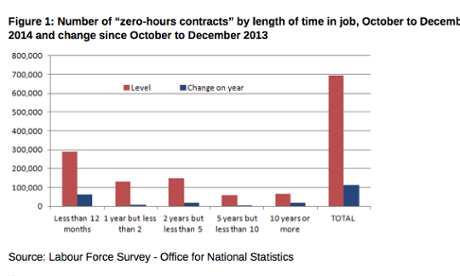
And here is a chart from the ONS report (pdf) about the use of zero hours contracts.
Updated
Here is more from the ONS report on zero hours contracts (pdf).
The latest estimate of the number of people who are employed on “zero-hours contracts” in their main employment, from the LFS, which is a survey of individuals in households, is 697,000 for October to December 2014, representing 2.3% of people in employment. It should be noted that responses to the LFS can be affected by whether or not respondents recognise the term “zero-hours contract”. This figure is higher than that for October to December 2013 (586,000 or 1.9% of people in employment), but it is not possible to say how much of this increase is due to greater recognition of the term “zero-hours contracts” rather than new contracts.
People on “zero-hours contracts” are more likely to be women, in full-time education or in young or older age groups when compared with other people in employment. On average, someone on a “zero-hours contract” usually works 25 hours a week. Around a third of people on a “zero-hours contract” want more hours, with most wanting them in their current job.
The Resolution Foundation, a thinktank specialising in measures that could help low earners, says today’s ONS figures show why the government needs to act to stop zero hours contracts becoming the norm in some employment areas. This is from Conor D’Arcy, policy analyst at the foundation.
Zero hours contracts are a potent symbol of the recent downturn. They signal both the flexibility that has helped keep unemployment down but also the deep insecurity that has blighted many jobs.
The continued growth of zero hours contracts during the recovery suggests that they are more than just a recession-related phenomenon. While many employers may have started to use zero-hours contracts during the downturn, it looks like most are sticking with them.
Growing awareness of zero-hours contracts among survey respondents may explain part of the increase but the longer these figures continue rising, the stronger the argument looks that they are here to stay.
While many workers don’t mind being on a zero-hours contract, further policy action is needed to prevent them from becoming the standard form of employment in some low-paid sectors, such as social care.
And here’s Frances O’Grady, the TUC general secretary, on the zero hours contracts figures.
Zero hours contracts sum up what has gone wrong in the modern workplace.
They shift almost all power from the worker and give it to their boss. Anyone on such a contract has no guarantee of any work from one day to another. Put a foot wrong and you can find yourself with little or no work.
Employers often argue that they offer flexibility but try telling that to zero hours workers who can’t get a mortgage or pay their rent.
In many sectors, especially social care, zero hours contracts are used to drive down costs regardless of the impact on services and the workforce.
The TUC says zero hours workers earn £300 a week less, on average, than staff on permanent contracts, while two in five are paid less than £111 a week and do not qualify for statutory sick pay.
Short-term and insecure working patterns mean many zero hours workers do not work continuously with one employer for two years. As a result, many miss out on statutory redundancy pay, the right to return to their job after maternity leave and protection from unfair dismissal, says the TUC.
Here’s Vince Cable, the business secretary, on the zero hours contracts figures.
Zero-hours contracts are valued by many employers and individuals who want flexibility in the hours they work, such as students, people with caring responsibilities and those who want to partially retire.
However, historically there has also been some abuse in these types of contracts. That is why I am taking legislation through parliament at the moment to ban exclusivity clauses in zero-hours contracts which prevent people looking for additional work to boost their income. We want to make sure that people who are on zero-hours contracts get a fair deal.
Today’s figures show that there has been an increase in the number of people who say they are on a zero-hours contract. One of the reasons for this rise is that people are becoming more aware of their contractual status with their employer.
This is something I welcome and would urge people to clarify their position with their employer so that they are fully aware of their rights.

Updated
Helen Pidd, the Guardian’s northern editor, says Manchester council’s chief executive is describing the reports about Manchester getting control of £6bn of health spending as “premature”.
Howard Bernstein, Mcr chief exec, tells me reports of the city region getting control of £6bn health budget are "premature" & "speculative".
— Helen Pidd (@helenpidd) February 25, 2015
Zero hours contracts up to 1.8m, ONS says
The Office for National Statistics has published figures showing that the number of zero hours contracts has gone up from 1.4m to 1.8m. This is from the Press Association.
The new total for last August is 400,000 more than a previously published estimate in January 2014, said the Office for National Statistics (ONS).
The number of people saying they were employed on zero-hours contracts in their main job was 697,000 in the quarter to December, up from 586,000 in the same period in 2013.
The figures mean that some people are on more than one contract with no guarantee of a minimum number of hours.
The TUC said the figures summed up what has gone wrong in the modern workplace.
Around a third of people on zero-hours contracts want more hours, said the ONS report.
People on zero-hours contracts are more likely to be women or working part-time, on an average of 25 hours a week.
Here’s the ONS summary. It says we should be cautious about directly comparing the 1.8m figure with the 1.4m figure.
The estimate from the second ONS survey of businesses indicates that there are around 1.8 million contracts that do not guarantee a minimum number of hours, where work was carried out in the fortnight beginning 11 August 2014. This figure should not be directly compared with the previously published estimate (1.4 million for the fortnight beginning 20 January 2014) to imply an increase in the number. It covers a different time of year and so differences in the number of such contracts reported may reflect seasonal factors.
Here’s the full ONS report (pdf).
Lord Heseltine says being an MP is not a full-time job
On Newsnight last night Lord Heseltine, the Conservartive former deputy prime minister, said that being an MP was not a full-time job and that people like Sir Malcolm Rifkind should be allowed second jobs.
The fundamental question, I think, is - is an MP expected to be a full-time employee of his or her constituency? And my own view is that it is not a full-time job. There’s a huge commitment in it and you work all hours and all days, but there is plenty of time in which you can do other things providing it’s within the rules that are laid down.
There are many people who would regard themselves as well-paid at the parliamentary salary level. They made a choice to come into the House of Commons knowing what the salary and what the review arrangements are, so that’s up to them.
But there will be other people who will say, ‘I’m not myself prepared to accept a life at that level of income because it would mean I had to forego for my family income that I am perfectly capable of earning in combination with a job as a backbench MP’.
I think that an MP’s salary is not designed to be the total income of all MPs and that’s why I believe that it should be possible for them to earn outside.
Wednesday's Daily Mirror front page: We will save the NHS..with astrology #tomorrowspaperstoday #bbcpapers pic.twitter.com/6xEpTc4NzN
— Nick Sutton (@suttonnick) February 24, 2015
Now that Manchester is getting control of its health budget, it might want to invest in astrology - if it is following the advice of the Conservative MP David Tredinnick.
The Daily Mirror is splashing on his comments about how astrology could have “a role to play in healthcare”. This is what he told Astrological Journal.
I do believe that astrology and complementary medicine would help take the huge pressure off doctors. Ninety per cent of pregnant French women use homeopathy. Astrology is a useful diagnostic tool enabling us to see strengths and weaknesses via the birth chart. And, yes, I have helped fellow MPs. I do foresee that one day astrology will have a role to play in healthcare.
Astrology offers self-understanding to people. People who oppose what I say are usually bullies who have never studied astrology. Astrology was until modern times part of the tradition of medicine ... People such as Professor Brian Cox, who called astrology ‘rubbish’, have simply not studied the subject.
There are 71 days to go until the general election.
Here’s today’s “election fact” from the Press Association.
For more than 200 years newly-appointed ministers were required to vacate their seats and seek re-election as they were taking an office of profit under the Crown. In many cases they were returned unopposed but those who were not could face embarrassing consequences. Winston Churchill, having defected from Tory to Liberal, won Manchester North West at the 1906 general election. When he was appointed President of the Board of Trade in 1908 vengeful Conservatives opposed him in the by-election - and won. He then had to move to Dundee about which he said: “It is a life seat and cheap and easy beyond all experience.” He lost it 16 years later. The regulations on ministerial by-elections were in force between 1707 and 1926.
The story about health spending being devolved to Manchester was broken by the Manchester Evening News last night. Here’s its story.
The Manchester Evening News also runs a live blog. I’m a bit alarmed to see that they start even earlier than me.
Phillip Blond, head of the ResPublica thinktank, was on the Today programme welcoming the plan to devolve health spending in Manchester.
Integrating health and social care by integrating council and NHS provision is an idea whose time has finally come @res_publica #nhs
— Phillip Blond (@Phillip_Blond) February 25, 2015
Imagine doctors being able to prescribe home insulation & refer people to local welfare to work programs @res_publica #Devo Manc
— Phillip Blond (@Phillip_Blond) February 25, 2015
Blond said ResPublica promoted the idea in its report last year, Devo Max - Devo Manc.
The Sun says that George Osborne has told David Cameron that, under his plans, defence spending will fall below 2% of GDP - the minimum target set by Nato.
EXCL: Britain will break a key NATO spending pledge within two years - and should, George Osborne has told PM http://t.co/kD9Mwe0NgO
— Tom Newton Dunn (@tnewtondunn) February 25, 2015
On the Today programme Rory Stewart, the Conservative chair of the Commons defence committee, said this would be a mistake.
Our view, the view of the defence committee, is that that would be a big mistake because that commitment [the 2% target] came out of a Nato summit that was directed against what’s happening in the Ukraine. It really happened in the context of demonstrating to Putin that the whole of Nato, that’s not just Britain and the United States but all the other countries, were committed to spending 2% on defence. Putin’s an opportunist, he’s looking for signs of weakness, he’s testing the alliance so it’s very important symbolically that we hold to that 2% commitment.
And this is what Richard Humphries, assistant director of the King’s Fund, a health thinktank, told the BBC’s Today programme about the Manchester devolution plan. He said it would be a reform “on a breathtaking scale” but that it could pose serious risks.
If the plan is to take the money away from CCGs [clinical commissioning groups] and NHS England and to give it to local government, that, on the range of options to achieve integration, is on the nuclear end of the spectrum and raises all sorts of questions and risks.
Depending on the detail - and the detail is really crucial and we don’t have that yet - you could either see this as a triumph for local democracy or creating real risks of yet another reorganisation of the NHS when it’s barely recovered from the last one.
Humphries also said that, with the NHS “heading for the financial rocks”, there were concerns about accountability and financial risk.
If the plan is to give the money to local government, the words ‘chalice’ and ‘poisoned’ perhaps spring to mind.
Manchester to take control of £6bn health spending
Here is more from the Press Association on the plan to devolve power over health spending worth £6bn to Manchester.
Full control of £6bn a year of health spending is to be handed to Greater Manchester as part of a significant extension of devolved powers, it was reported.
A proposed deal with the Treasury - which the Manchester Evening News said was due to be formally unveiled by chancellor George Osborne this week - would transfer the spending of NHS cash to 10 local councils from April 2016.
The region has already accepted the creation of a powerful “metro mayor” in return for taking over responsibility for transport, skills and housebuilding and the right to recoup some cash generated by growth.
The Greater Manchester Combined Authority (GMCA) eventually hopes for full devolution of all 22 billion of public spending in the city.
But any move to combine health budgets - at present controlled by NHS England - with councils’ existing social care duties had been thought to be some way down the line.
The newspaper said it had seen a draft memorandum of understanding which included the creation of a new board to distribute funding and take decisions in areas such as personnel, regulation, information-sharing and NHS buildings.
It would work closely with existing clinical commissioning groups (CCGs) of GPs.
Osborne has hailed extended powers for cities as a key part of efforts to create a “northern powerhouse” to rival London economically.
The post of police and crime commissioner for Greater Manchester Police - established by the coalition government - will also be scrapped in favour of the new mayor.
According to the BBC, George Osborne will announce on Friday that Greater Manchester is to be given control of a £6bn health and social care budget.
The details are not entirely clear yet, but this would amount to a significant act of decentralisation. Council leaders, and eventually the elected mayor planned for Greater Manchester, would control the money.
In the Guardian recently Simon Jenkins wrote a long feature explaining how Manchester persuaded Osborne to grant it more powers, and how Osborne sees this as his proudest achievement.
Here are today’s YouGov polling figures. YouGov poll for the Sun.
Update: Cons lead at 2 - Latest YouGov / Sun results 24th Feb - Con 35%, Lab 33%, LD 6%, UKIP 14%, GRN 7%; APP -18 http://t.co/89WuWyvaTW
— YouGov (@YouGov) February 25, 2015
But there are quite different figures in a Survation poll for the Daily Mirror.
NEW VI @DailyMirror (chg vs Jan) LAB 34 (+3) CON 28 (-3) UKIP 19 (-4) LD 10 (+3) SNP 4 (NC) GRE 4 (+1) OTH 1 (NC) http://t.co/w5BIeutTzG
— Survation. (@Survation) February 24, 2015
It’s Wednesday, and that means one thing: the outstanding leaders of our age, debating each other at the heart of one of Britain’s great institutions, in front of the most intelligent and sophisticated audience in London.
But that’s enough about the hustings at Guardian HQ for the candidates hoping to be the next editor-in-chief. First we’ve got to get through PMQs.
Here’s the agenda for the day.
8.30am: Iain Duncan Smith, the work and pensions secretary, gives a speech on pensions.
9.30am: Vince Cable, the business secretary, gives evidence to the Commons business committee.
9.30am: The Office for National Statistics publishes a report on zero hours contracts.
12pm: David Cameron and Ed Miliband face each other at PMQs.
Around 12.40pm: MPs begin a debate on a Labour motion on bankers’ bonuses. Later, after 4pm, they will debate a Labour call for MPs to be banned from having paid directorships or consultancies.
2.15pm: Stuart Gullier, the HSBC chief executive, and Douglas Flint, the HSBC chairman, give evidence to the Commons Treasury committee about the HSBC tax dodging scandal. Later Lin Homer, the HM Revenue & Customs chief executive, is giving evidence.
If you want to follow me on Twitter, I’m on @AndrewSparrow