The image of a Liberal and a Tory leader entering 10 Downing Street together, identical in dress apart from the colours of their ties, posed like the world's best-tailored conjoined twins, is more something out of the imagination of Sir John Tenniel, illustrator of Alice in Wonderland, than out of the traditions of political portraiture. Victorians, anyway, would have found it utterly surreal and grotesque: an inversion of reality, a trip behind the looking glass.
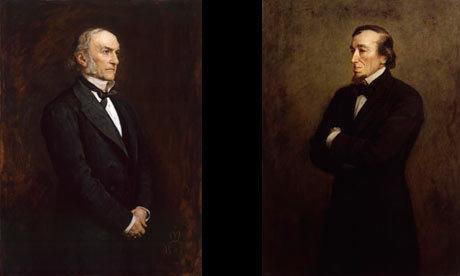
On the National Portrait Gallery's 19th-century floor, two powerful and sombre portraits stand out. They are the figures of the great rival political leaders, Benjamin Disraeli and Willam Gladstone, painted by John Everett Millais, as if standing at the despatch box. A hundred and thirty years ago when these pictures were done, the idea of a Liberal and Conservative coalition would have seemed impossible. They were opposites. The differences between Gladstone's Liberals and Disraeli's Conservatives were fierce, as was the personal animosity between the two men.
Where Cameron and Clegg, public schoolboys both, seem natural working partners, the deeply serious, moral Gladstone was the emotional antithesis of the novelist and Romantic poseur Disraeli. Their parties too were genuinely different: Liberalism stood for free trade and, increasingly, on Gladstone's conscientious watch, Irish home rule. Disraeli combatted this novel political force – the Liberal party was not a natural evolution from the old aristocratic Whig faction – with the potent ideas of a socially compassionate Conservatism and a great British empire.
No one expected the Liberal party to be all but effaced in the 20th century by the rise of the Labour movement. Historically, the sudden rebirth of Liberal high politics in 2010 is a return to the 19th century, but bizarrely remixed.
The two parties of the Victorian age sit hand in hand in government, embracing Britain's suit-and-tie wearing classes from Eurosceptic to Europhile. Who is left out? Only the working-class party. To Victorians this would look like a Lewis Carroll fantasy – a steampunk counterfactual that can only end in exploding boilers and squashed top hats and the mirror crack'd from side to side.