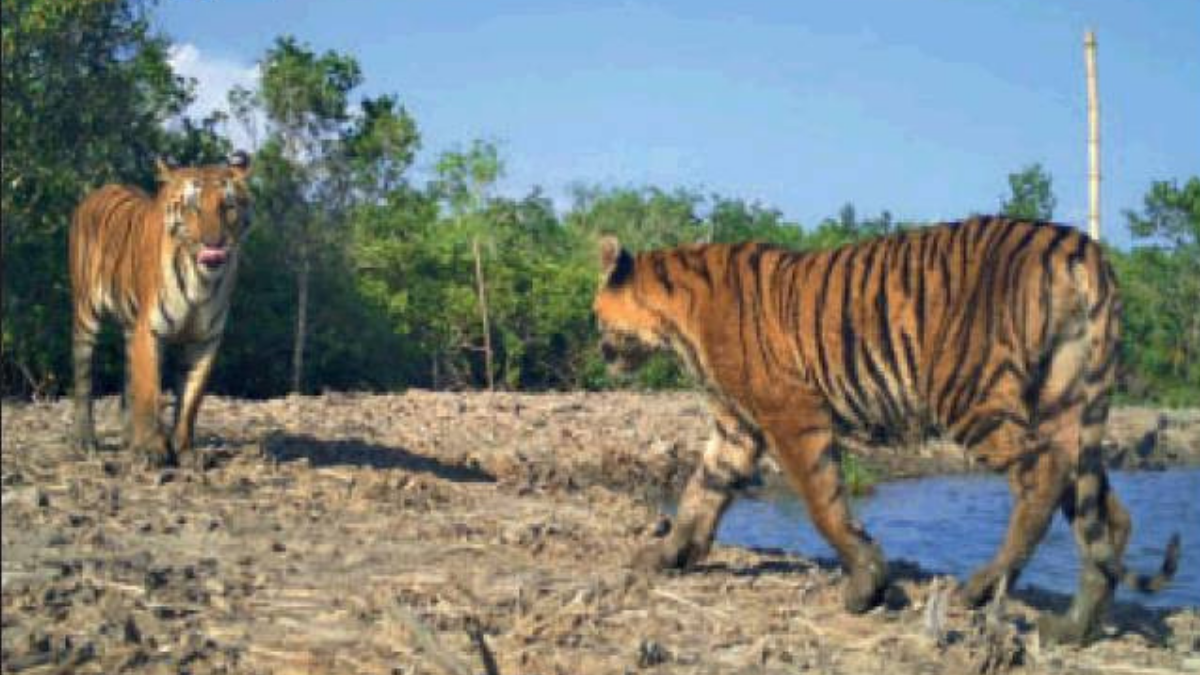
KOLKATA: The tiger population in the Indian Sunderbans has remained stable in the past one year. A day before the Global Tiger Day on July 29, state forest minister Jyotipriya Mullick released the report, saying that the mangroves is home to 96 tigers, as per the camera trap exercise undertaken by the state forest department between December 2020 and February 2021 — also known as the Phase IV estimation.
Similar exercise last year had also pegged the number at 96. As per the latest estimation, while the tiger reserve area is home to 74 tigers, the area outside it, called the South 24 Parganas forest division, has 22 big cats. Last year, 73 tigers were clicked inside the tiger reserve area while 23 outside it. Of the 74 big cats in the tiger reserve area, 12 were found in Sajnekhali Wildlife sanctuary area, 17 in Basirhat range, 21 in National Park East and 24 in National Park West range. Of the 22 tigers in South 24 Pgns division, 4 were found in Matla range, 11 in Raidighi and 7 clicked in Ramganga range.
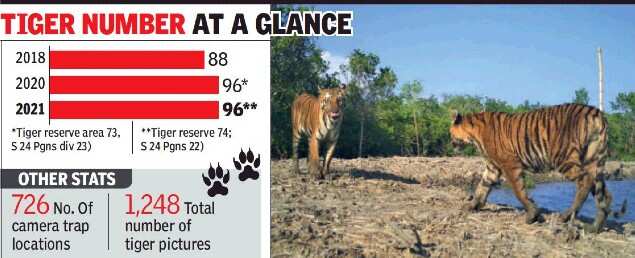
While the All India Tiger Estimation, which was last done in 2018 and had pegged the presence of 88 tigers in the Sunderbans, is conducted every four years by the Centre, the Phase IV monitoring is conducted by the state to monitor the population for the next four years till the next All-India estimation. The Phase IV monitoring also aims to find out the minimum number of tigers.
This time, 1,395 cameras (close to 700 pairs) were placed across the Sunderbans compared to 1,200 used during the same exercise in 2019-2020. Of this, WWF-India gave 400 cameras. “The entire mangrove forest was divided into 2 sq km grids, each with two camera traps,” said chief wildlife warden VK Yadav, adding that 4 cubs clicked in Basirhat and National Park East ranges were not taken into account while arriving at the final number. He said that this is the minimum number that have been photographed and that the actual number may be higher. “In order to get more accurate details we want to divide the entire mangrove forest of 4,500 sq km into 1 sq km grid and place two cameras at each grid. For this, we are planning to procure 800 more trap cameras,” he added.
State wildlife advisory board member Biswajit Roy Chowdhury said that the yearly exercise is important as far as monitoring of the tiger population is concerned. “The results show that the tiger population in the Sunderbans has remained stable,” he added.
Meanwhile, Yadav said the department would soon set up a mangrove research centre in Sajnekhali. “It will be used for research on mangroves that will eventually help in our plantation activities,” Yadav said, adding that a control room will be set up in Sajnekhali that will collect details regarding protection and monitoring activities.