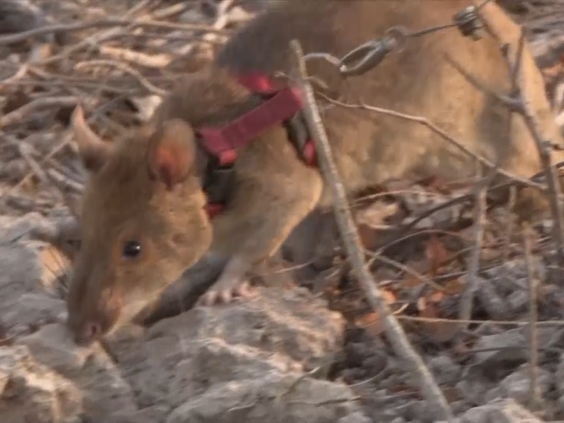
Cambodia, the country with the highest ratio of mine amputees per capita in the world, has started using ‘hero rats’ to sniff out unexploded landmines.
The intelligent animals, which possess some of the most sensitive noses in the animal kingdom, have already proven to be a faster and safer means of locating the hidden weapons.
Their participation is largely risk free as their average weight of around one kilo is too light to detonate the mines that rely on pressure activation.
The method is more efficient than metal detectors, with the rats trained to only sniff out TNT rather than any metal object.
As Theap Bunthourn, operations coordinator for the project says, "If you take 200 square meters of land, the rats can clear it in 20 to 25 minutes whereas if we used the manual method it would take two or three days to clear the same area."
Cambodia is still reportedly one of the most heavily land mined countries in the world after decades of civil war. Six million mines are believed to still be in the ground, with over 67,000 people being killed or injured since 1979.
The animals are put to work six days a week in three hour shifts, darting between two handlers standing five metres apart while attached to a harness.
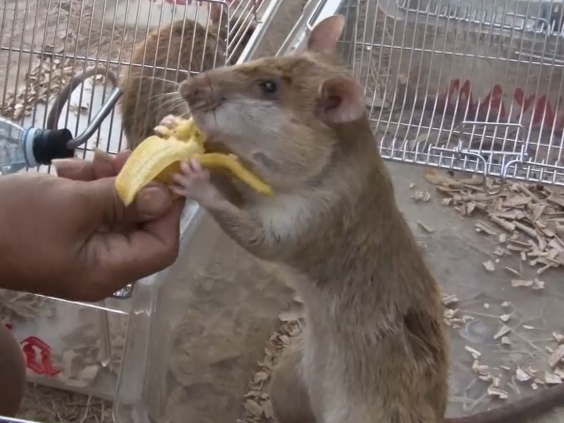
In their downtime, the rats are kept in individual cages and receive regular exercise.
The rats were recruited from Africa by the Cambodian Mines Action Group (CMAG) alongside the Anti-Personnel Land Mines Detection Product (APOPO).
In Mozambique they proved very effective, locating more than 13,000 landmines while no accidents were recorded.
A fact that should bode well for their work in Cambodia, as Mark Shukuru, who helped transport the Tanzanian-born rats to Asia, says:
"For the time being in Africa still we're going on with our operation in Angola and there is no miss - no accidents up until now, so we think that the experience that we got in Africa can be shifted from Africa to Asia - here in Cambodia now, where we are also doing operations."
Critics claim that the rodents are not as safe as manual methods, with the animals unable to search in dense vegetation and only capable of short shifts in the heat.