It feels good to be alive and a Pom in Johannesburg today. The middle of the front row of the Charles Fortune Media Centre, at the very top of the Unity Stand, feels like the best seat in the house to watch Australia struggle against a most impressive South Africa outfit.
It's a rapidly filling house, too. In the top left corner of the scoreboard they have a running total of the number of spectators. It read 8,514 at lunch and tipped over the 10,000 mark 50 minutes after the interval, and the match so far has lived up to its top billing.
We watched some top-quality fast bowling this morning on a pitch which offered bounce and seam movement. There was some swing, too, when the clouds drifted over – so batting was a difficult business.
Ricky Ponting, the Australia captain, must have been tempted to bowl when he won the toss. His opposite number, Graeme Smith, looked happy enough to have lost the call.
South Africa are playing the same XI that beat the Aussies 2–1 in Australia in December and January. They are an experienced and hard-nosed bunch and Australia look a little callow beside them. This is their least experienced team for 20 years and the first time they have had three debutants for 25.
This morning they awarded first Test caps to the batsmen Philip Hughes and Marcus North, and the fast bowler Ben Hilfenhaus. Poor Bryce McGain! He is the only other uncapped player in the squad and he has missed out again.
Nicknamed "Magoo" by his team-mates, he went on Australia's tour of India in October but returned with a shoulder injury before he had the chance to make his Test debut. And after missing his initial flight here he has twice gone down with a stomach complaint. Up until a few days ago Australia planned to play him here.
At least he was able to sit back and, like the rest of us, watch some terrific cricket. The drama was heightened by the thunder and lightning around the ground and the sight of heavy rain on the veldt.
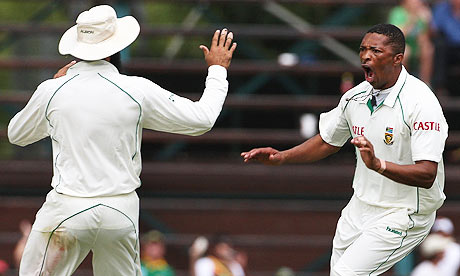
When England beat Australia in 2005, the key to their success was their quartet of very different fast bowlers and South Africa placed the tourists' batsmen under the same unrelenting pressure with some consistent and aggressive bowling from Dale Steyn, Makhaya Ntini, Morne Morkel and Jacques Kallis.
Hughes looked nervous as he flapped at only his fourth ball in Test cricket. Simon Katich fell to a blinding gully catch by Neil McKenzie and Mike Hussey failed again, caught at second slip off Morkel.
The only thing that spoiled a great morning for South Africa was Smith dropping a sitter at slip offered by Ponting off Steyn just before lunch.
Australia fought back well after lunch, with Ponting and Michael Clarke adding 113 for the third wicket. South Africa bowled too short, something you should never do to Ponting, and they missed Kallis, who was off the field until just before tea with a stiff lower back.
But when Ntini bowled Ponting off his pads with one that cut back as the batsman offered no stroke and Clarke was caught behind flailing at a wide one, Australia looked in trouble once more at 194 for five.
While the attention this morning was concentrated on the young Australian debutants, it swung in the direction of someone a little older during the tea interval.
Graeme Pollock, the great South African left-hander, was inducted into the International Cricket Council's Hall of Fame as part of the Catch the Spirit week in the country, aimed at promoting the organisation's centenary celebrations.
Of those Test players who have played 20 innings or more, only Don Bradman (99.94) had a better average than Pollock's 60.97. He was the first batsman to use a really heavy bat. He scored a wonderful century against England at Trent Bridge in 1965 which I watched on an old black and white – a nice piece of walnut furniture with a fuzzy snowstorm in the middle.
But I still remember that innings so vividly that on occasions I have believed that I was in Nottingham that day. It is easier to forget some matches you have actually attended. But this one at the Wanderers is not one of them.