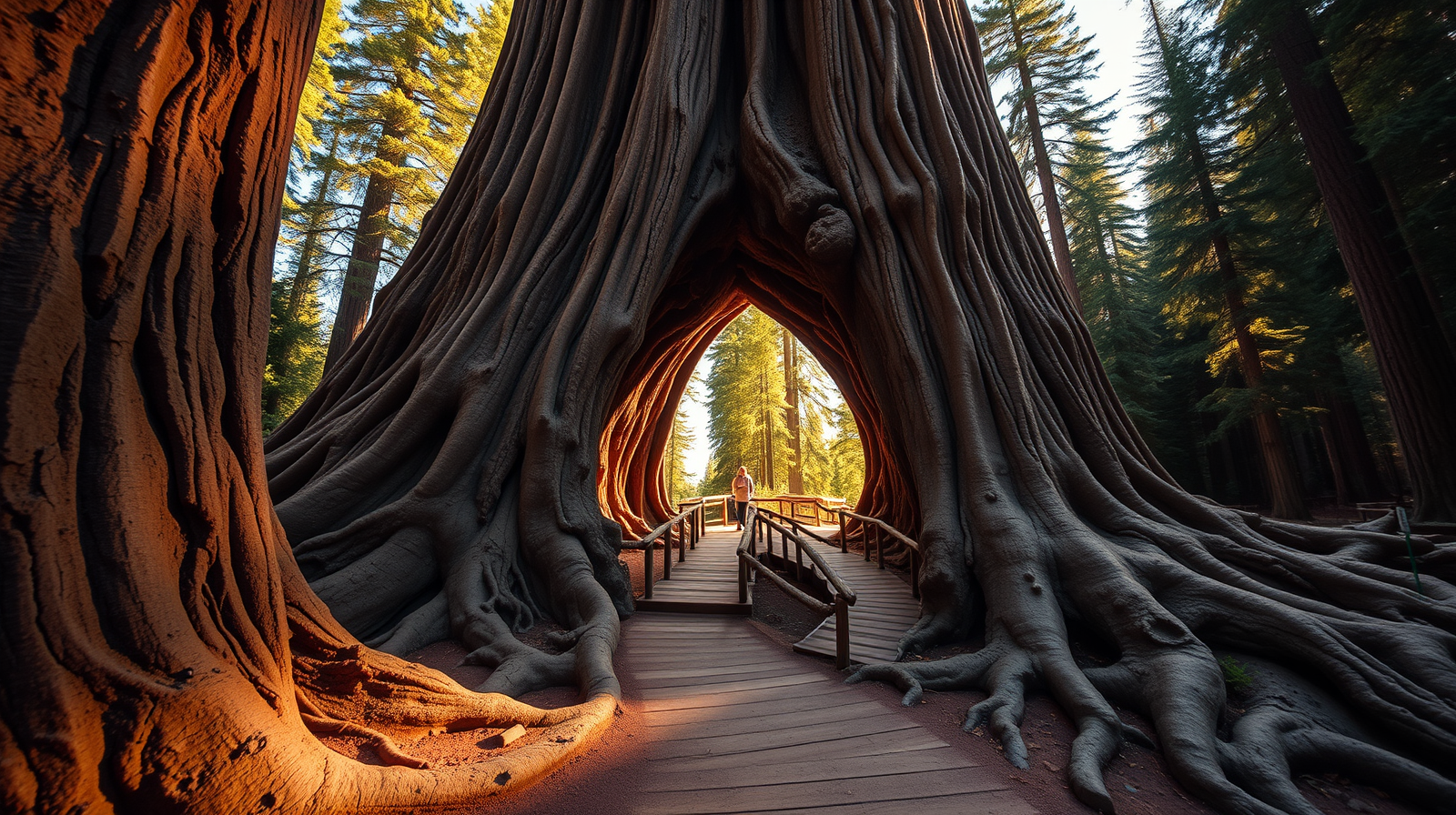
On a quiet stretch of US Highway 101 in Mendocino County, Northern California, a giant redwood tree has been doubling as a house for over a century. The World Famous Tree House in Piercy stands over 250 feet tall, is estimated to be approximately 4,000 years old, and contains a natural hollow at its base measuring roughly 21 by 27 feet across with a ceiling soaring 50 feet above the floor. The hollow was created centuries ago by a lightning-triggered fire that burned out the tree's core, yet left the tree alive, something the coast redwood's exceptional biology makes surprisingly possible. In 1933, Robert Ripley featured it in his syndicated Believe It or Not column as the world's tallest one-room house. It reopened to visitors in August 2025 after a long closure forced by the COVID-19 pandemic.
How a lightning strike created the World Famous Tree House without killing the tree
Get breaking news anytime, anywhere. Download the TOI app now!
The cavity at the heart of the Piercy redwood was not built by human hands. According to Roadside America's documentation of the attraction , a lightning strike centuries ago ignited the centre of the tree, burning out its interior from the base upward. Under most circumstances, a fire that guts a tree of this size would kill it. The coast redwood, however, is one of the most fire-resistant organisms on the planet. As the Sempervirens Fund explains in its research on redwood fire resilience , the thick, deeply furrowed bark of a mature coast redwood can grow a foot or more in thickness and is saturated with tannins, a natural chemical compound that acts as a flame retardant and also protects the tree against fungi, disease, and insect attack. With no resin or pitch to fuel the blaze, the fire burned itself out, and the tree continued to grow around the wound, leaving a hollow core and a living canopy still reaching toward the sky.
Why the coast redwood can keep growing even when hollowed out
The biology that allowed the Piercy tree to survive and continue thriving after losing its centre is better understood today than at any point in history. According to USDA Forest Service research on Sequoia sempervirens , the coast redwood's vascular system, which carries water and nutrients up and down the trunk, runs through a relatively thin layer of living tissue called the sapwood just beneath the bark rather than through the heartwood at the tree's centre. Burning or removing the heartwood damages structural integrity over time but does not immediately interrupt the tree's capacity to photosynthesise, move water, and grow. A 2021 post-wildfire study of old-growth coast redwood stands found that Sequoia sempervirens showed a post-fire survival rate of 95 percent, the highest of any species in the study, underscoring just how resilient a mature redwood is against fire events that would kill most other tree species.
How the tree became a tourist attraction and later the world's tallest home
The transformation from a naturally hollowed tree into a formal attraction began in the early 1920s, when an entrepreneur recognised the commercial potential of the cavity and installed doors and windows to create a room accessible to the public, making it one of the earliest roadside attractions along what would become the Redwood Highway. In 1925, Minnie Stoddard Lilley and her husband, William, purchased the property. When construction of the new Redwood Highway began in 1929, convicts working on the road lived temporarily inside the hollowed tree itself. Once the highway was complete, the first gift shop was opened inside the tree's base. A fraternal order subsequently organised meetings inside the space and gave the tree its first official name, the Fraternal Monarch. In 1933, Robert Ripley featured it in his nationally syndicated Believe It or Not column, declaring it the world's tallest one-room house and cementing the name it carries today.
What visitors find inside the World Famous Tree House
Today the attraction sits at 74800 US Highway 101, on the western side of the road, roughly midway between Piercy and Leggett. According to Islands Magazine's coverage of its 2025 reopening , visitors enter through an attached gift shop stocked with redwood crafts and souvenirs and pay a small fee to pass through a second entrance into the redwood itself. Inside, the cavernous interior is dimly lit and stocked with antique quarter-operated dioramas depicting scenes from an earlier era of American roadside culture, lending the experience a layer of nostalgia that complements the ancient scale of the tree itself. Current owner Angela Blackwell has said the tree remains healthy and is still actively growing, a fact that seems almost implausible for an organism that has been partially hollowed into a tourist attraction for over a century.
Why the World Famous Tree House belongs to a vanishing tradition of redwood roadside attractions
The Piercy tree house is one of several drive-through, walk-through, and live-in redwood attractions that became fixtures of Northern California road trip culture throughout the 20th century. The nearby Chandelier Drive-Thru Tree in Leggett, the World Famous Grandfather Tree in Piercy, and the Immortal Tree in Redcrest belong to the same tradition of roadside Americana built around the coast redwood's extraordinary size and longevity. Many of these attractions declined over the decades as road travel patterns shifted and novelty expectations changed. The Piercy tree house's closure during the COVID-19 pandemic and its eventual 2025 reopening illustrate the fragility of that tradition. What the tree itself demonstrates, having survived a lightning fire, centuries of exposure, convict occupation, a century of tourists, and a global pandemic, is considerably more durable.
A tree that has outlasted empires, absorbed a lightning strike, housed road workers, and welcomed tourists for a century is still growing. That quiet persistence, requiring no audience and no acknowledgment, is perhaps the most remarkable thing the redwood has to show anyone who steps inside.