Welcome to Ballot Bulletin: Ballotpedia's Weekly Election Policy Digest. Every Tuesday, we deliver the latest updates on election policy around the country, including nationwide trends and recent legislative activity.
In this week’s edition, we cover 87 bills state legislatures acted on last week and look at California’s election results timeline and how states count absentee/mail-in ballots.
The state of election legislation in the U.S.
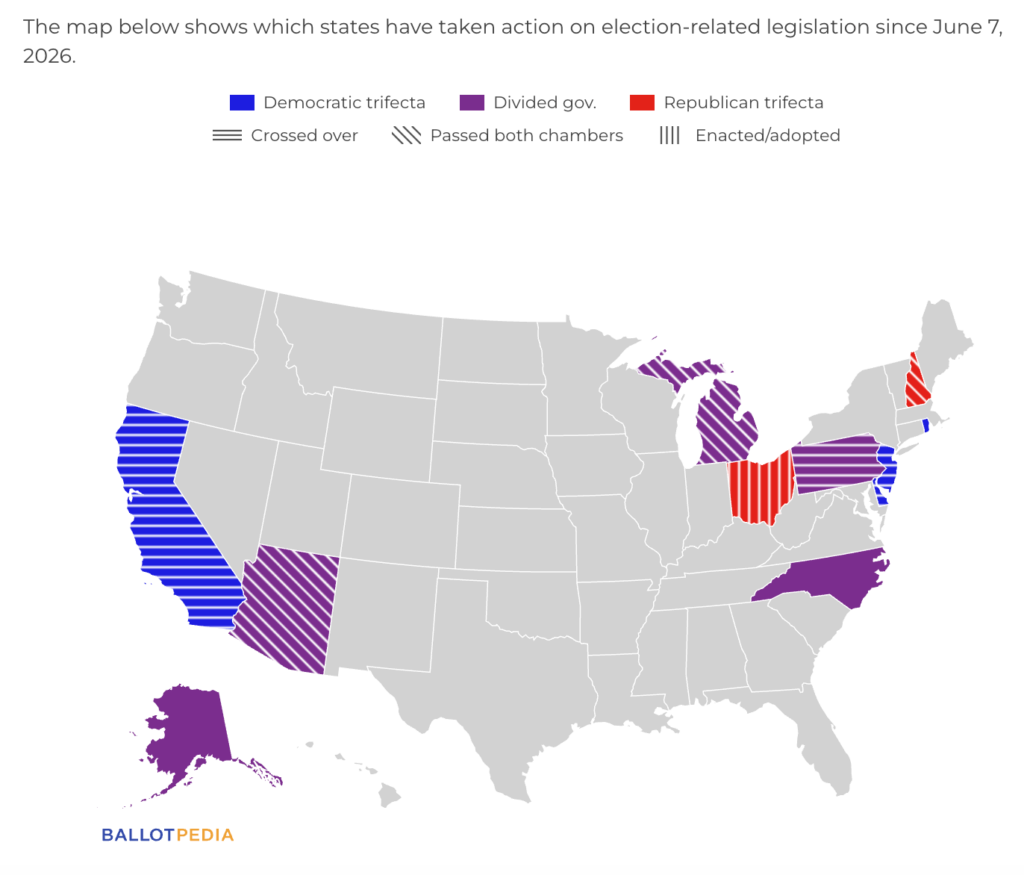
Lawmakers in 11 states acted on 87 election-related bills last week. Eleven state legislatures are in regular or special sessions. Last week, three bills were enacted, 26 bills passed both chambers of a state legislature, and no bills were vetoed.
Of the bills acted on last week, 37 (42.5%) are in states with Democratic trifectas, 10 (11.5%) are in states with Republican trifectas, and 40 (46%) are in states with divided government. The most active bill categories last week were campaign finance (35), election types and stages (19), and ballot measures (15).
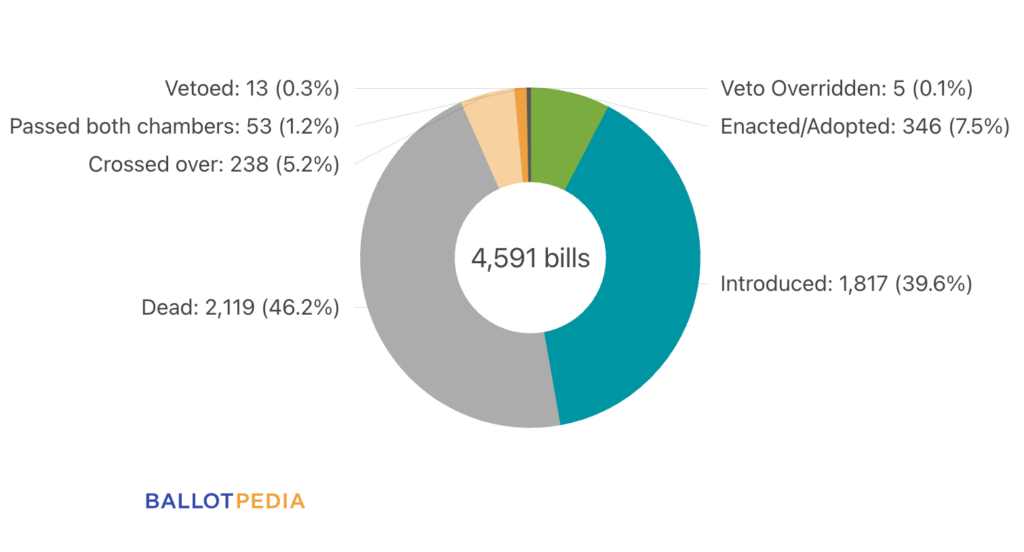
We are currently tracking 4,591 election-related bills across the country. The chart below breaks down the status of those bills by where they stand in the legislative process:
Enacted bills
Three bills were enacted or adopted last week:
Bills passing both chambers
On June 11, the Rhode Island Senate passed H 7090, sending the bill to Gov. Daniel McKee (D). The bill requires the primary election for delegates to the national convention for each political party to be held on the first Tuesday in March 2028 and every fourth year afterwards (rather than the fourth Tuesday in April).
Twenty-five other bills passed both chambers last week:
- Arizona (Divided government)
- Michigan (Divided government)
- New Hampshire (Republican trifecta)
- Rhode Island (Democratic trifecta)
To see a full list of bills awaiting gubernatorial action, click here.
Vetoed bills
No bills were vetoed this week.
To see a list of all bills vetoed this session, click here.
All bills
The chart below shows all bills Ballotpedia is currently tracking, broken down by partisan sponsor
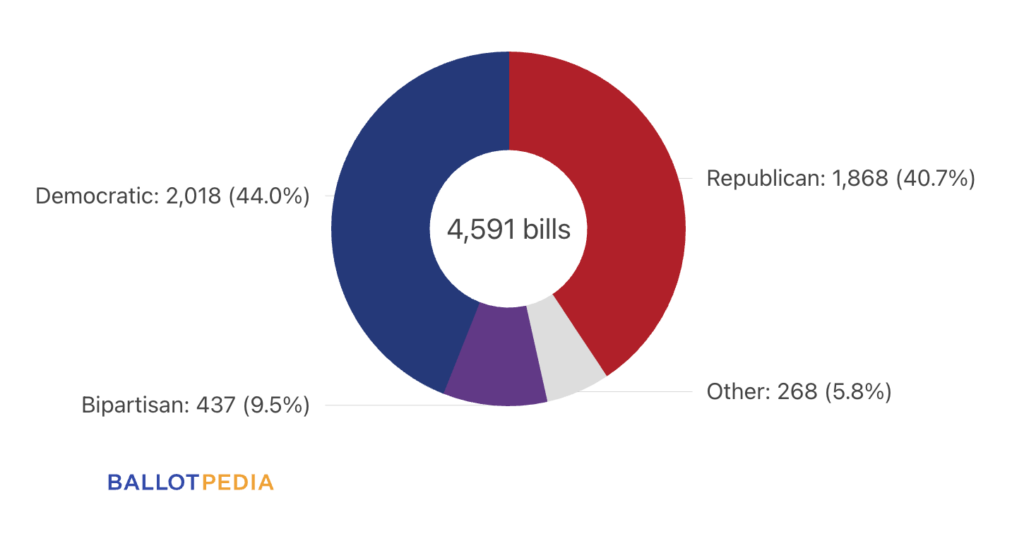
We are currently following 4,591 election-related bills, including bills carried over from the previous year.
-
Trifecta status
- Democratic: 1,963 (42.8%)
- Republican: 1,655 (36%)
- Divided: 973 (21.2%)
-
Partisan sponsorship
- Democratic: 2,018 (44%)
- Republican: 1,868 (40.7%)
- Bipartisan: 437 (9.5%)
- Other: 268 (5.8%)
In the news
On June 16, Washington, D.C., will hold its first election using ranked-choice voting (RCV) in primary elections for mayor, city council, U.S. House delegate, and other races.
In 2024, D.C. voters approved a ballot measure 73%-27% that authorized the use of RCV starting in 2026. Three states — Alaska, Hawaii, and Maine — use RCV for at least some statewide or federal elections. Localities in 13 states where RCV is not used in any statewide elections use or are scheduled to use RCV. For more information on ranked-choice voting in the United States, click here.
Here are other news stories from across the country:
- On June 10 , the Florida Supreme Court denied an emergency petition from the Equal Ground Education Fund against the state’s new congressional maps , as covered in last week’s edition of the Ballot Bulletin . In its order , the court said it did not have the jurisdiction to intervene in an ongoing appeal with the First District Court of Appeals . In a dissent, Justice Jorge Labarga said the court has the proper jurisdiction to review the matter expeditiously and that “the upcoming 2026 congressional elections affecting the representation of millions of Floridians meet that threshold.”
- On June 10 , the first hearing in United States v. DeMarinis took place in the U.S. District Court for the District of Maryland . On Dec. 1, 2025, the Department of Justice filed a complaint against Maryland State Administrator of Elections Jared DeMarinis challenging Maryland’s refusal to provide the federal government with unredacted voter rolls. Federal judges in Arizona, California, Massachusetts, Michigan, Oregon, Rhode Island, and Wisconsin rejected similar lawsuits from the DOJ seeking unredacted voter files.
- On June 12, the state of California submitted a reply in the Western Division of the U.S. District Court for the Central District of California supporting a motion to dismiss the complaint in Tangipa v. Newsom . In November 2025, a group of voters in California filed a complaint saying that the congressional redistricting measure approved by voters 64.4%-35.6% in November 2025’s Proposition 50 election enables unconstitutional race-based maps. In its reply, the state said that the U.S. Supreme Court ’s recent decision in Louisiana v. Callais places a special burden on the plaintiffs to demonstrate a clear race-based motivation, rather than a partisan motivation, for the new districts. A hearing is scheduled for Aug. 19, 2026.
Policy spotlight: California’s election results timeline and how states count absentee/mail-in ballots
The story below is adapted from a recent Daily Brew story by Lara Bonatesta.
June 16 marks 14 days after California’s primary election, and votes are still being counted. In the days after the primary, some public officials have criticized how long California has taken to count ballots, while others have defended it.
On June 9, U.S. Rep. Ro Khanna (D) wrote on X, “We need to figure out in California how we can get the vote counted faster and results tabulated so it does not drag on. … Right now the system is eroding trust and spawning conspiracy theories.”
California Secretary of State Shirley Weber (D) said, “Accuracy comes before speed.” Weber continued, “California is the nation’s largest voting state, with millions of ballots to process and count. Taking the time to do this work correctly protects voters’ rights and ensures the integrity of our elections.”
There are four key points in the vote counting process that can affect how quickly states complete their counts. Along with where California falls among the 50 states, they are:
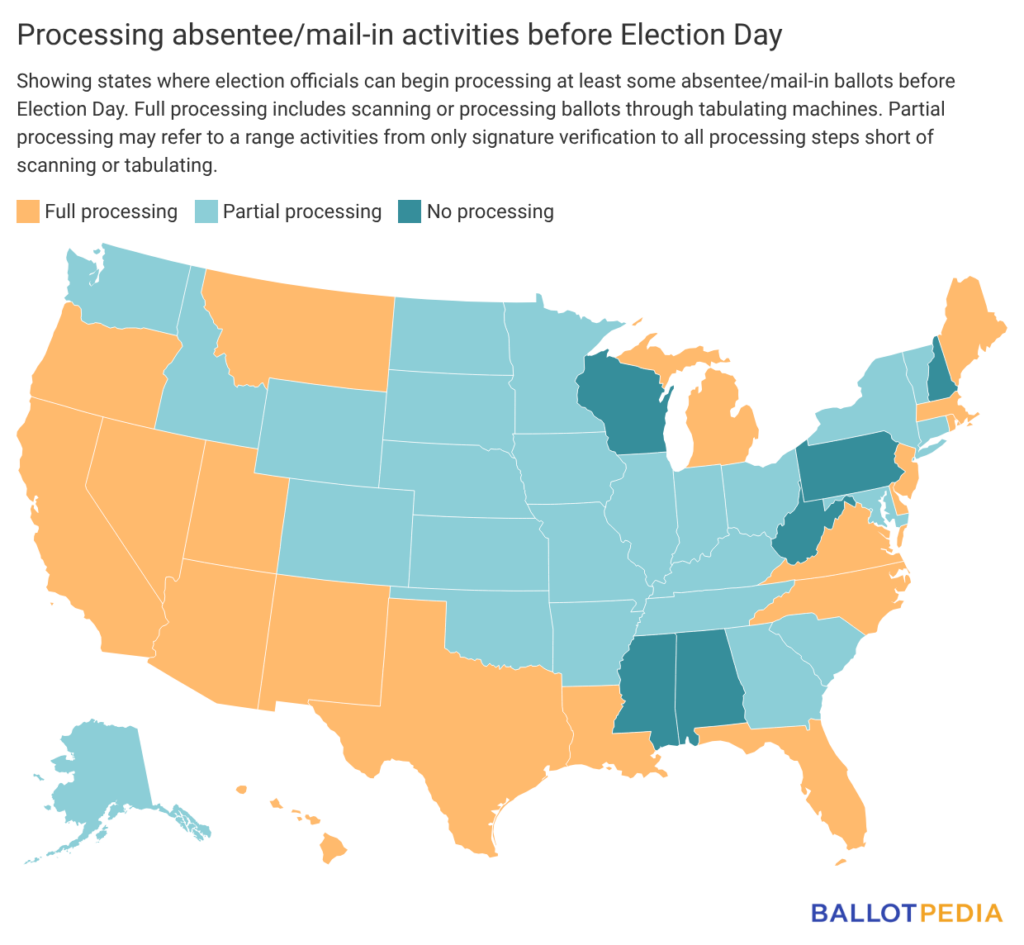
- When a state can begin processing absentee/mail-in ballots. California is one of 19 states that allow full absentee/mail-in vote processing before election day.
- When a state can begin counting absentee/mail-in ballots. California is one of 15 states where officials cannot begin counting ballots until polls close.
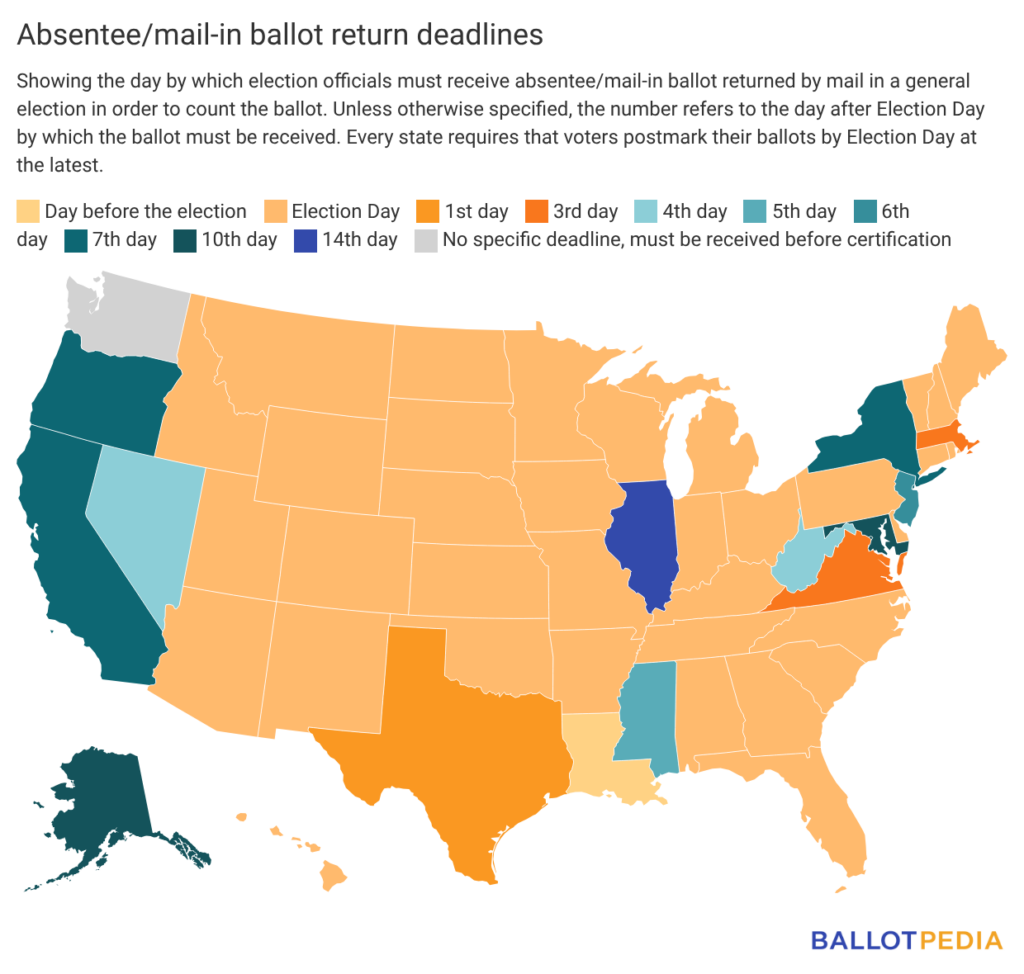
- The day by which officials must receive an absentee/mail-in ballot for it to count. California is one of 14 states that allow post-election ballot receipt, specifically through the seventh day after election day.
- When a state is legally required to finish counting absentee/mail-in ballots. California is one of eight states with a specific deadline, requiring election officials to count most ballots by the 13th day after an election (with an exception for ballots received more than four days after the election.)
Processing
Processing involves taking the administrative steps required to prepare ballots for tabulation. Which activities are allowed during processing also vary by state.
Vermont allows officials to begin processing 45 days before the election. Six states do not permit election officials to begin processing ballots until election day. Twenty-five states allow the partial processing of absentee/mail-in ballots before the election.
Counting
States vary in when they can begin counting ballots.
Sixteen states allow counting to begin before election day, and an additional 19 permit it before polls close on election day. Those states have laws prohibiting the disclosure of election results before the polls close. Fifteen states require counting to begin after polls close on election day.
Return deadlines
Regardless of when state laws permit election officials to process or count ballots, the work depends on when they receive completed ballots. Louisiana requires absentee/mail-in ballots to be received the day before election day. Thirty-five states require that election officials receive absentee/mail-in ballots on election day.
Fourteen states allow a post-election window for ballots postmarked by election day to be counted. Texas requires ballots to be received by the day after the election, while Washington counts ballots received up until the certification deadline.
The legality of a Mississippi law allowing absentee ballots postmarked by but received after election day is an issue in Watson v. Republican National Committee, a case argued before the U.S. Supreme Court on March 23, 2026.
Deadline to finish counting
Eight states also have a specific deadline by which election officials must finish counting absentee/mail-in ballots or otherwise certify the review of absentee/mail-in ballots.
Arkansas requires absentee/mail-in ballots to be counted before polls close on election day. Alaska requires absentee ballots to be counted no later than the 15th day following election day.
Eight states do not have a completion deadline, but require election officials to continue counting on a predetermined schedule until all ballots are counted. The remaining states do not specify a deadline or schedule for completing the counting of absentee/mail-in ballots.
So far this year, five states have passed bills on the return of absentee/mail-in ballots. That includes Mississippi HB 908, which would repeal the state’s five-day grace period if the Supreme Court rules it unlawful.
Fourteen states have passed 17 bills on the administration of absentee/mail-in voting so far this year. That includes South Dakota SB 171, which allows an absentee ballot counting board to begin meeting on the day before the election.
For more information on absentee and mail-in voting timelines, click here.