LOS ANGELES _ With a devastating recession behind them and politicians offering upbeat visions of what lies ahead, California voters streaming to the polls Tuesday will narrow the 2018 governor's race down to two candidates in a race likely to affect their well-being and bank accounts.
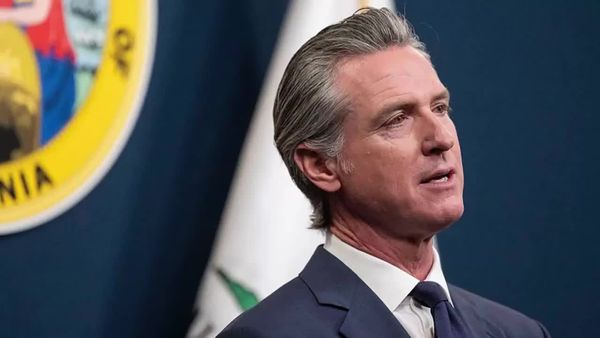
As the favorite of the California Democratic Party's core liberal base, Lt. Gov. Gavin Newsom enters the primary election as the clear front-runner, with polls showing either fellow Democrat Antonio Villaraigosa or Republican multimillionaire John Cox in the best position to secure a second-place finish and proceed to the November election.
Cox has poured nearly $5 million into his bid for governor, but his political fortunes grew considerably when President Donald Trump fired off a tweet endorsing him in the final weeks of the campaign.
After a five-year hiatus from political office, Villaraigosa hopes to recapture the magic that led to his two terms as mayor of Los Angeles, and needs to stitch together support from enough Latinos, moderates and lower-income Californians to finish in the top two.
In left-leaning California, Newsom is likely to breeze to victory in a November face-off against Cox, who has hitched his campaign to the far-right policies of the Trump administration. If Villaraigosa survives the primary, California will be primed to witness a dogged fight for the heart and soul of the Democratic Party.
The election is the biggest test of California's primary system, which advances the two candidates who receive the most votes _ regardless of party _ to the November election. Approved by voters in 2010, the top-two primary was envisioned as a way to elect candidates who better reflected California's electorate, rather than the far-left and far-right nominees emerging from hyperpartisan party primaries.
In the run-up to Election Day, Newsom's campaign made a brazen effort to tilt the primary to its advantage by attacking Cox in ads and on the campaign trail as Trump's handpicked favorite and a rabid gun-rights supporter. The tactic was seen as a transparent attempt to elevate Cox among California conservatives so he would have enough Republican support to finish in the top two, squeezing out a more formidable Democrat. In left-leaning California, no Republican has won a statewide race since 2006.
The top-two primary "totally changed the strategy of candidates," said political scientist Melinda Jackson of San Jose State University.
Newsom also benefited from several advantages in the campaign. He first entered the race in February 2015, more than a year before any of the other major candidates, and has topped the field in fundraising with $35.9 million. And he hails from the San Francisco Bay Area, which tends to back homegrown politicians and routinely sees higher voter turnout compared to Southern California.
The candidates running for governor and their allies spent more than $75 million on efforts to persuade voters before Tuesday's primary. Though it was not the most expensive in California history, it broke records of gubernatorial primary spending by independent expenditure groups. As of Sunday, these groups had spent more than $34.4 million. The bulk of that money came from the nearly $22.7 million wealthy charter school backers spent in an effort to boost Villaraigosa.
They spent about $16.5 million on ads directly promoting Villaraigosa. But they also spent more than $4 million less than a week before Election Day hammering Newsom, as well as $1.9 million opposing Cox, whom Villaraigosa is battling for second place, and less than $250,000 boosting conservative Republican Assemblyman Travis Allen of Huntington Beach in an effort to divide the GOP vote.
Though Newsom decried the financial onslaught by Villaraigosa's wealthy supporters, he was the beneficiary of millions of dollars in labor spending.
Newsom has presented himself to voters as a bold visionary, unafraid to tackle the most confounding issues facing California. He has promised to pursue a state-supported single-payer health care system if he's elected in November.
"My whole life _ we've faced down skeptics. Defeatist Democrats who suggest we need to 'pick our battles,'" Newsom said at the California Democratic Party convention in February. "To me, this is more than a political campaign. It's about Democrats acting like Democrats _ in a battle for America's soul against a president without one."
He has also dangled the promise of representing a new era of political activism after eight quiet, fiscally restrained years under Democratic Gov. Jerry Brown, though he has been careful not to directly criticize the four-term governor, who served in two political eras and remains popular among Californians.
Newsom has long eyed the governor's office and has effectively been running since he launched a short-lived gubernatorial bid in 2009, later acquiescing to Brown and running for lieutenant governor instead. The early start allowed Newsom to sew up endorsements and lock down prominent donors, leading to his domination in the polls and fundraising since entering the race.
Cox jumped into California's race for governor as a virtual unknown, a wealthy venture capitalist with a scant resume in public service and an unquenched thirst for the spotlight of political campaigns. He rose to the top of a GOP field distinguished by the lack of a prominent California Republican.
By tapping into his personal wealth, Cox has been able to rise above his closest Republican challenger, Allen. While Allen had the support of tea party activists and Trump supporters, he failed to raise enough money to wage a competitive campaign.
A lawyer and accountant, Cox championed the Republican-led effort to repeal the recently approved gas-tax increase and joined with conservatives in criticizing the so-called sanctuary state policy embraced by Brown and Democratic legislators.
From the outset, Cox has painted himself as a political outsider with the well-earned business sense to oust the "cronies" in Sacramento. He blamed California's Democratic leadership for the state's high poverty rates, high taxes, failing schools and crumbling, traffic-choked roads.
"A vote for me is a vote to make sure that people have better schools, they have better roads, that we don't waste money in government, that we have a lower tax burden. A vote for me is a lower gasoline tax as well," Cox said during a campaign stop in Rancho Bernardo last week.
But it was the president's endorsement that really energized the Cox campaign. Trump's nod was largely seen as a pragmatic attempt to ensure a Republican was on the top of the ticket in November, which could increase GOP turnout and aid Republicans in a quest to hang on to their congressional districts in California.
The endorsement also shielded Cox after he came under fire from the right for admitting he voted for Libertarian Gary Johnson in the 2016 presidential election. Cox now says he backs the president "100 percent."
Villaraigosa has crafted a campaign focused on rebuilding the middle class and assisting Californians who have been left behind in California's economy.
Before jumping into the race in November 2016, Villaraigosa spent months on a listening tour that crisscrossed the Inland Empire and Central Valley. Home to large Latino populations, the two areas, along with Los Angeles County, make up the political territory Villaraigosa needs to win to perform well in the election.
He flirted with a run for governor in 2010, shortly after the beginning of his second term as mayor. Villaraigosa ultimately decided he couldn't "leave this city in the middle of a crisis" as Los Angeles struggled to recover from the economic ravages of the Great Recession.
But the allure of the top statewide office never faded. For Villaraigosa, whose eight years as mayor came to a quiet end in 2013, the greatest challenge was to reclaim the political electricity that enveloped him in 2005, when the former Assembly speaker and Los Angeles councilman made history by becoming L.A.'s first Latino mayor since 1872.
Villaraigosa has strong support from law enforcement, thanks to a dramatic drop in violent crime in Los Angeles while he was mayor, and an unyielding commitment to growing the Los Angeles Police Department. But he ran afoul of teachers' and public employee unions after his failed attempt to take over city schools and laying off hundreds of city workers during the height of the recession.
Opinion polls before the primary indicated two other prominent Democrats in the running for governor have failed to gain traction with California voters.
State Treasurer John Chiang entered the race with promise, demonstrating an ability to raise millions of dollars and positioning himself as the workhorse competing against two show horses, Newsom and Villaraigosa.
Delaine Eastin, California's former superintendent of public instruction, has run a campaign focused on education. Eastin, the only woman among the top candidates in the race, has received attention for her progressive platform and previous record as a statewide elected official, and has become known for delivering some of the most memorable lines during debates.