One of southern California’s most influential water wholesalers appears primed to reduce the amount of water available to agencies that serve 19 million Californians in six southern California counties, including Los Angeles.
Southern California’s Metropolitan Water District will vote on Tuesday on whether to reduce water available to its 26 member agencies by 15%, a move likely to trickle down in increased water costs to ratepayers across the counties the consortium represents.
The move would increase the pressure to conserve on the 26 agencies that make up the Metropolitan Water District. All urban Californians are being asked to reduce urban water use by up to 25%, a mandatory reduction ordered this month by governor Jerry Brown.
That mandatory reduction will be enforced by the state’s water board, which will fine agencies for using too much water. If this move from the Metropolitan Water District passes, it could present more costly fines for water agencies that fail to conserve.
“I actually think the right thing to do is a [conserve 20%],” said committee member Paul Koretz, “but representing LA, I don’t think we could hit [20%] because we’re already doing so much, and we’ll get fined,” he said, arguing for the board to take less drastic cuts of 15%.
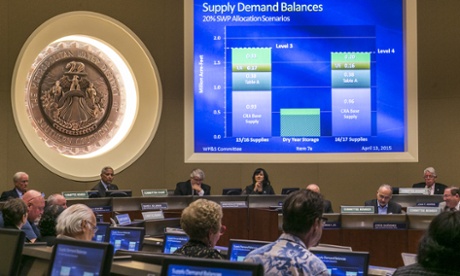
On Monday, the board’s water stewardship committee debated whether to force agencies to conserve 15% or 20% for more than two hours. A full board vote is scheduled Tuesday afternoon.
Koretz’s tone appeared to represent what many on the committee believed. Members said demand had “hardened” in many districts – suggesting that users can’t or won’t reduce water use any further. Some felt uneasy setting themselves, and their ratepayers, up for huge penalties.
“If we take too much water too fast without giving their corporation time to adjust it could have a brutal impact on individuals,” said Larry Dick, a member from Orange County, a wealthy suburb of Los Angeles.
He used the pool industry as an example: “If we start ruling out the use of swimming pools or the building of swimming pools, people are going to be looking for jobs who used to be in that industry.”
Factored into the committee’s plan to divide 1.8 million acre feet among the 26 districts, was a goal for member agencies to over-achieve by 100,000 acre feet each year, transfers of another 80,000 acre feet, and an average annual drawdown of reserves of 280,000 acre feet per year. If all goes according to plan, that would leave the district with 829,000 acre feet in reserves, a limited amount of which is available each year.
“Ladies and gentlemen, hope is not a valid water supply decision,” said Keith Lewinger, a member representing San Diego, arguing for the committee to pass 20% reductions. In two years, Lewinger said, the committee’s plan would draw down dry-year reserve water, “pretty darn close to zero storage.”
The picture was indeed grim. Normal suppliers of southern California’s water, including in the Sierra Nevada mountains in the state’s northeast corner and the Colorado River Basin, have received below average rain and snow totals for years.
Though the Metropolitan Water District only forecasted out two years for the purposes of the discussion, those two years alone would significantly draw down the district’s reserve water, leaving the district without enough reserves to meet current demand if Mother Nature doesn’t bring relief.
Still, many members said the 15% measure would be less impactful than the governor’s overriding call to reduce urban water use 25%. Many cited both the need to conserve water, and the hope that the water board would not call on them to reduce water use dramatically, even as it was apparent that the resources were over-committed for current demand.
“Orange County has reduced its water use 25% in the last 20 years,” said committee member Linda Ackerman, “I think a [15% reduction] for the public is going to be a big eye opener.”
Koretz expressed similar sentiments, saying, “I hope we’re not too greatly penalized for doing the good work we’ve done up to this point.”