When Skechers started building a colossal distribution center in Moreno Valley, Calif., six years ago, backers promised a wave of new jobs.
Instead, by the time the company moved into the new warehouse, it had closed five facilities in Ontario, Calif., that employed 1,200 people and cut its workforce by more than half.
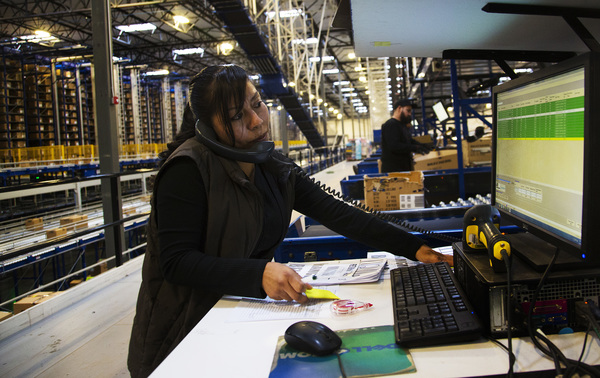
There are now only about 550 people working at one cavernous warehouse. Many of them sit behind computer screens, monitoring the activities of the facility's true workhorses: robotic machines.
In the past five years, online shopping has provided tens of thousands of new warehouse jobs in California. Most of them paid decent wages for menial tasks � putting things in boxes and sending them out.
But automated machines and software have taken up more and more space in the region's warehouses, and taking over jobs that were once done by humans. Today, fewer jobs are being added, though some of them pay more.
Amazon has built 20 new fulfillment centers outfitted with robotics in the past three years, four in California. Since 2014, the company has added 50,000 warehouse workers nationwide _ and more than 30,000 robots.
Robots are muscling their way into almost every occupation, but they pose a direct and immediate threat to people working in storage, industry experts say.
For the nation's 879,800 warehouse workers, profound change is already here.
"The modern warehouse tends to be creating fewer jobs. ... Automation is replacing the lowest-end jobs," said Chris Thornberg of Beacon Economics, a Los Angeles consulting firm.
That shift mirrors the path taken by American manufacturing, in which fewer jobs go to more qualified people.
Automation makes companies more productive and richer, which is why machines now do most carmaking, Uber is developing self-driving cars and farmers use robots to plant, harvest and pack crops.
That math does not bode well for most people, especially those who work with their hands.
Warehouses have been a bright spot for lower-skilled Californians. But hiring leveled off in 2016, even though new warehouses kept opening.
There were 2,800 more people working in warehouses in October compared with 12 months earlier, a 3 percent increase. That compares with an increase of 12,200, or 14 percent, in the year that ended in October 2015, and 9,800, or 13 percent, in the 12 months that ended in October 2014.
Meanwhile, 81 new warehouse and storage locations have opened up in California over the past year, an increase of 4.7 percent.
Manual laborers were in short supply on a recent Monday at the giant Skechers distribution center in Riverside.
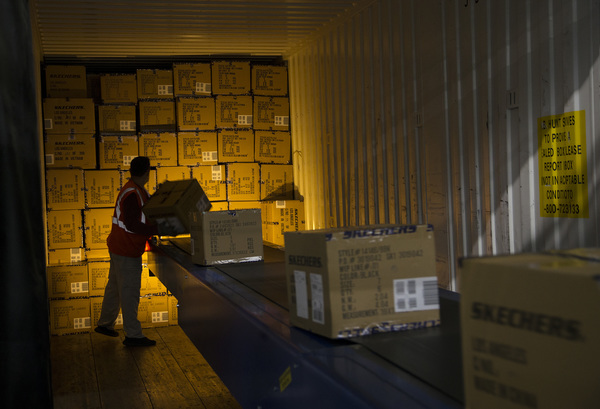
Two men stood in the middle of a shipping container filled with boxes of shoes, throwing the boxes onto a conveyor belt that stretched into the container.
These cobalt conveyors are the main event at this warehouse. There are more than 11 miles of them in total, snaking through stacks of boxes, layered on top of each other.
Boxes first pass over a scale, beneath the belt, which weighs them, and then travel through camera scanners that record their dimensions. They then get scanned again so that a pop-up wheel can shove each carton into the same chute. A person then loads those boxes onto a pallet, which later is transferred to storage.
The process used to take 10 workers and several hours to complete. Now, it requires three people and takes less than an hour.
"You have to become more efficient. It's the only way to upgrade. You can't always be looking for cheap labor," said David Weinberg, chief financial officer of Manhattan Beach-based Skechers.
"There is some manual labor, but there are certainly more skilled jobs, managing power equipment, handling traffic and on computers," he said.
Weinberg says Skechers has never been more productive. Far fewer employees handle twice as many pairs of shoes as they once did, and salaries have gone up on average _ mainly because there are fewer people earning the minimum wage, Weinberg said.
Lourdes Gonzalez is a good example of how work, and compensation, have changed for the remaining warehouse employees.
Gonzalez started in 1992 as a packer in an old Skechers facility in Compton, where she earned minimum wage and walked through 50-plus aisles of shoes to fill orders written on pieces of paper.
"Now, everything we do is through the system," Gonzalez said, seated in front of several monitors packed into a small room above the floor of the warehouse.
She spends her entire day overseeing the flow of orders through the building. One minute she is staring at a live map showing traffic flow and any jams on the conveyor belts, and the next she is studying a spreadsheet that shows how far along workers are in processing orders on deck.
Gonzalez earns more than $20 an hour for this work, and covers her three children on her company-provided health insurance.
"I love my job," Gonzalez said. "It's fascinating."
Warehouse workers in California earn about $42,100 a year on average �� about $20,000 less than the average pay in the state overall, according to the Bureau of Labor Statistics data. That includes pay for higher-level managers.
Many of them get their paychecks from Amazon, a company that still depends on masses of manual laborers even though it owns the most advanced robots in the industry.
In 2012, the company bought Kiva Systems, the maker of a 320-pound robot that moves shelving units to workers when they need to retrieve items for an order. The robot scans a grid on the floor that contains hundreds of bar codes, which tell it where it is in relation to other bots, and where the product it needs to pick up is located.
Two years ago, Amazon had 15,000 of the Kiva bots in its U.S. facilities. Today, it has more than 45,000, according to a company spokeswoman.
Amazon has also put hulking robot arms in its facilities, which lift up 3,000-pound pallets, loaded with merchandise, 24 feet onto a robotic driving unit, which moves the products to workers to either store or send out.
The influx of bots has started to affect hiring. Amazon has begun making room for more highly trained and well-paid technicians to ensure that the machines are charged and connected to the network that controls them, and to fix any mechanical problems.
Somewhat paradoxically, though, Amazon's obsession with speedier delivery sustains its appetite for people who can do rote work.
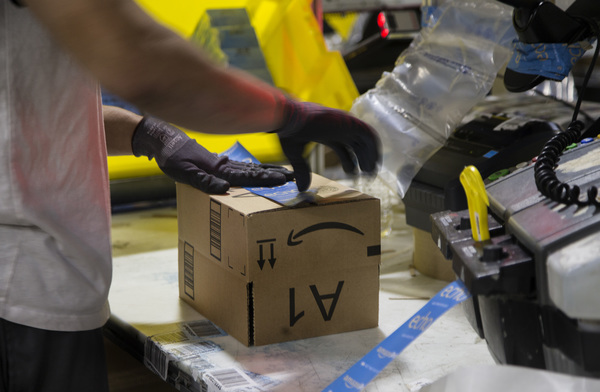
So, for now, Amazon is still hugely reliant on people such as Carlos Madrid, whose hand-eye coordination is indispensable. In a San Bernardino fulfillment center on Cyber Monday, Madrid stuffed a Tommy Hilfiger watch, then breast-pump accessories, then cleaning supplies into boxes, sealing them with tape and sending them to customers.
"It's absolutely insane; it's like Santa's workshop," he said.
For the moment, that is about the extent of machine involvement at this facility, which employs 2,500 people and was Amazon's first California warehouse when it opened in 2012.
Even the newer facilities that use more robots vary in terms of how many people they employ. One that opened in San Bernardino this year has about 1,000 workers; a fulfillment center in Tracy has 3,500.
That may change, experts say, as robots get smarter and infiltrate new corners of storage and shipping.
"There are a lot of people doing traditional warehouse work, but that will change," says John Husing, chief economist for the Inland Empire Economic Partnership. "Everything is being automated."