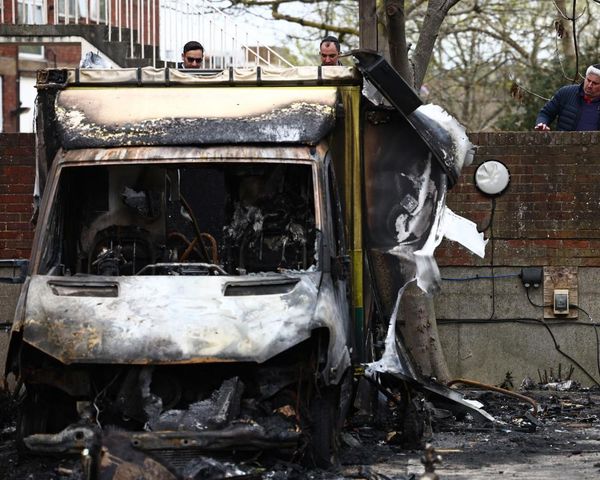
Boy, 12, and grandmother die in Oregon wildfire
A 12-year-old boy and his grandmother were found dead after the Santiam fire burned through parts of Marion county, according to the local sheriff.
The Enchanted Forest, a local family-owned theme park, identified the victims as 12-year-old Wyatt Tofte – the great-grandson of the park’s founder - and his grandmother Peggy Mosso.
Evening summary
Thanks for sticking with us through an eerie, hazy day!
- A boy and his grandmother died in Oregon after the Santiam fire burned through the area where rescue teams found them.
- Wildfires continued to grow up and down the West Coast, forcing widespread evacuations, blanketing entire regions in smoke, raining down ash down elsewhere and creating eerie colors in the sky.
- With memories of a destroyed Paradise still fresh on everyone’s mind - the 2018 Camp fire was not that long ago - Berry Creek, another small nearby community, is believed to be all but obliterated as well, this year by the North Complex fire.
Updated
Berry Creek, a small community with a population of about 1,500 outside Plumas national forest in California, has been ravaged by the North Complex fire.
The #BearFire torching behind Berry Creek’s welcome sign #CaliforniaFires pic.twitter.com/HeOVpMOIr1
— Dylan Bouscher (@DylanBouscher) September 9, 2020
I’ve been in Berry Creek since 3:30 a.m. The town is leveled. A firefighter said they rescued a hundred people from the #BearFire, including burn victims. pic.twitter.com/dDP3kmU19t
— Carin Dorghalli (@CarinDorghalli) September 9, 2020
My immigrant father owns Village Market, the only store in Berry Creek. It burned in the #BearFire. He put everything into the business so my brothers and I could have all the opportunities in the world. He often worked 80-hour weeks. We have insurance, but our hearts still hurt. pic.twitter.com/kQBHX8mTT9
— Carin Dorghalli (@CarinDorghalli) September 9, 2020
A huge issue in rural communities is that oftentimes, well-water systems require electricity to run. When Pacific Gas and Electric cut power to large swaths of the population in preventive power shutoffs, they also rob rural homeowners of their ability to defend their homes.
Brothers Jerry and Ed Murie wanted to stay to defend their home in Berry Creek, but they had no running water because PG&E shut off the power. They fled through a “wall of flames” last night. “We’ve been completely screwed, man, by the higher forces,” Jerry said. pic.twitter.com/lOt6JKHhrq
— Alexei Koseff (@akoseff) September 9, 2020
Updated
The El Dorado Fire continues to rage in southern California, forcing evacuations and burning through 11,479 acres.
#ElDoradoFire crossed hwy 38 to the north side near Mountain Home Village. pic.twitter.com/1928NPkg9c
— firevalleyphoto (@firevalleyphoto) September 9, 2020
#ElDoradoFire - UPDATE - Immediate Evacuation Order Angelus Oaks and the community of Seven Oaks. Evacuate via Hwy 38 North toward Big Bear
— Yucaipa Police (@YucaipaPD) September 9, 2020
For the interactive map visit ➡️ https://t.co/mzvkitDJ1w@CityofYucaipa @CALFIREBDU @SanBernardinoNF @SBCOUNTYFIRE pic.twitter.com/1YbDScKxKf
The El Dorado Fire was sparked by a gender-reveal party. Reminder that even the pioneer of gender-reveal parties is over gender-reveal parties.
The North Complex fire threatens the town of Paradise, a community far too familiar with wildfire destruction. In 2018, the Camp fire, the deadliest and most destructive fire in California history, wiped out the the town and killed 85.
This is the view from a PG&E AlertWildfire network camera ~2 miles east of Paradise, as of two minutes ago. pic.twitter.com/quMwvQIf77
— Mike McGough (@Mike_McGough) September 9, 2020
My brilliant colleague Dani Anguiano reports that about 3,000 people live in Paradise today. “Affordability, trauma and concerns about the future of Paradise and the other Ridge communities have shaped decisions about where to go,” she writes.
Read more here:
Updated
The Creek fire, the fast-moving blaze in central California that required emergency military airlift evacuation earlier this week, continues to grow at 163,138 acres and 0% containment.
How many generations of Fresno kids have gone sledding on this hill? Hurts to see the Coyote Nordic trailhead scorched like this. #CreekFire pic.twitter.com/u1IRAAvpLX
— Marek Warszawski (@MarekTheBee) September 9, 2020
Damage inspection teams are still assessing the situation but so far know that of the 360 structures destroyed by the wildfire, there were 60 single family residences and 278 mixed commercial and residential buildings.
A few burned out properties at #Creekfire yesterday morning, then extreme fire activity all night/this morn at the #Bearfire near #Oroville. Shot through the night. Extremely tired. It's still burning. Fire crews spread extremely thin.
— Josh Edelson (@JoshEdelson) September 9, 2020
More pix here: https://t.co/jJdxVEo9OD pic.twitter.com/Xjup18EU8e
Updated
Washington: 330,000 acres burned in a day
Yesterday, 330,000 acres burned in WA.
— Governor Jay Inslee (@GovInslee) September 8, 2020
That’s more than 12 of the last 18 entire fire seasons.
In a single day. pic.twitter.com/Op7UEfhTNA
Satellite imagery from this morning shows Washington wildfire perimeters and smoke that continues to be blown by winds 🛰📸 @NASA @NOAA #WAfires #WAwx pic.twitter.com/IoAWIORiT4
— BLM Oregon & Washington (@BLMOregon) September 9, 2020
Within days of igniting last month, the SCU Lightning Complex Fire, burning to the east of the San Francisco Bay Area, and the LNU Lightning Complex Fire, burning in wine country, quickly grew to the second- and third-largest wildfires in state history.
Their compatriot, the August Complex fire burning in Mendocino national forest, has since knocked them both out and is now No 2 on the list of largest wildfires in state history. As of three hours ago, it has burned through 421,889 acres across five counties and is 24% contained.
The #AugustComplex has grown significantly in size taking 2nd spot on the Top 20 Largest Wildland Fires in CA. #SCULightningComplex is now the 3rd largest fire and the #LNULightningComplex is the 4th largest fires in California history. https://t.co/HfvwmE5gKL. pic.twitter.com/u6iLQTBWTZ
— CAL FIRE (@CAL_FIRE) September 9, 2020
The SCU Lightning Complex fire, at 396,624 acres and 96% containment, now sits at No 3 and the LNU Lightning Complex fire, at 363,220 acres and 92% containment, now sits at No 4.
Updated
Oregon: 45 fires burn through 419,994 acres
By last count in Oregon, firefighters are battling 45 separate wildfires that have burned through a total of 419,994 acres.
That number changed from just an hour ago, when Kate Brown, Oregon’s governor, tweeted that there were 35 fires burning 300,000+ acres.
Authorities are repeatedly warning the public that the situation is changing rapidly.
Here is an updated snapshot of our wildfire dashboard you can refer to for the latest fire activity. Please note this information is changing rapidly:https://t.co/SlEo7CRqAV
— OregonOEM (@OregonOEM) September 9, 2020
With seven new fires in Oregon last night, this is a resource to keep up with the current situation. pic.twitter.com/It5aGrcuw6
The evolution of the Oregon & N. California fires over the last 12 hours.
— CIRA (@CIRA_CSU) September 9, 2020
As seen in a Fire Temperature product via GOES-West: https://t.co/krNFAkXfYj. pic.twitter.com/wzJXQWZirF
Hey all, Vivian Ho taking over the liveblog for the afternoon. Here are some more eerie orange skies over California:
'Unprecedented' fires burn hundreds of homes in Washington and Oregon
Hundreds of homes have been destroyed and thousands of people evacuated as fires raged across the Pacific Northwest this week, per the Associated Press.
Fueled by winds gusting up to 50 mph (80 kph), catastrophic wildfires blew Wednesday across a large swath of Washington state and Oregon that rarely experiences such intense fire activity because of the Pacific Northwest’s cool and wet climate. Oregon’s governor said hundreds of homes had been destroyed.
No fatalities from the region’s fires had been confirmed by Wednesday afternoon, but the Oregon governor, Kate Brown, said some communities were substantially hit, with “hundreds of homes lost”. In many places residents had just minutes to evacuate their homes as firefighters struggled to contain and douse the blazes. Three prisons were evacuated late Tuesday.
“This could be the greatest loss of human life and property due to wildfire in our state’s history,” Brown told reporters.
The scenes were similar to California’s terrifying wildfire drama, where residents have fled fires raging unchecked throughout the state. Like those in California, the fires in the Pacific Northwest are unprecedented.
Sheriff’s deputies, traveling with chainsaws in their patrol cars to cut fallen trees blocking roads, went door to door in rural communities 40 miles (64km) south of Portland, Oregon’s largest city, telling people to evacuate. Since Tuesday, as many as 16,000 people have been told to abandon their homes.
“These winds are so incredible and are spreading so fast, we don’t have a lot of time,” said Craig Roberts, the Clackamas county sheriff.
In Oregon, at least four major fires were burning in Clackamas county, a suburban county that’s a bedroom community of Portland. The entire county of nearly 420,000 people was put on notice to be ready to evacuate late Tuesday amid winds gusting up to 30mph (48kph).
Another major fire in southern Oregon prompted evacuation orders in much of Medford, a city of about 80,000 residents.
And several huge blazes burning in Marion county, south0east of the state’s capitol city of Salem, merged overnight – turning the sky blood red in the middle of the day. Thousands of people were braced to flee if evacuation orders emerged.
“It was pitch black dark out there – all you could see was red,” said Wendy Phelps-Chapman, activity director at the Marian Estates independent senior living center in Sublimity, Oregon, which evacuated its 160 residents on Tuesday.
The Pacific Northwest is no stranger to wildfires, but most of the biggest ones until now have been in the eastern or southern parts of the region – where the weather is considerably hotter and drier and the vegetation more fire-prone than it is in the region’s western portion.
“We do not have a context for this amount of fire on the landscape,” said Doug Grafe, the chief of Fire Protection at the Oregon Department of Forestry. “Seeing them run down the canyons the way they have – carrying tens of miles in one period of an afternoon and not slowing down in the evening – (there is) absolutely no context for that in this environment.”
Washington state is also seeing an unprecedented fire season. Governor Jay Inslee said more than 330,000 acres (133,546 hectares) burned during a 24-hour period – an area larger than the acreage that normally burns during entire fire seasons that lasts from spring into the fall.
One small town on the eastern side of Washington was nearly completely decimated by the fires, with 80% of the town’s structures destroyed. Among the buildings that burned in Malden, a farming town, were the town’s fire station, post office, City Hall and library.
“It’s an unprecedented and heart-breaking event,” Inslee told reporters.
He blamed hot weather, high winds and low humidity for the explosive growth of the fires. Climate change has had a major effect on the prevalence and severity of fires on the west coast.
Updated
The Forest Service announced on Wednesday it is closing ten additional national forests in the state of California citing “historic fire conditions” meaning all 18 national forests in the state are now closed.
NEW: The Forest Service has announced that it is closing an additional 10 forests today, meaning all 18 national forests in California are closed, including Tahoe National Forest @KQEDnews pic.twitter.com/9IckGhOO8N
— Kate Wolffe (@katewolffe) September 9, 2020
The closures, which include Eldorado National Forest, Lassen National Forest, and Tahoe National Forest, will go into effect at 5 pm PST today. The department said it will re-evaluate these closures daily as conditions change.
People across California, including in the San Francisco Bay Area, woke up on Wednesday morning to raining ash and pale-orange morning light filtering through apocalyptic, fire-choked skies.
The orange-tinted skies are due to light being filtered through smoke from fires across the state as California continues its worst fire season on record, according to regional air pollution control organization the Bay Area Air District.
“These smoke particles scatter blue light and only allow yellow-orange-red light to reach the surface, causing skies to look orange,” the organization said on Twitter.
Driving across the Golden Gate Bridge at 9:20 IN THE MORNING. pic.twitter.com/nyiY0vWxf5
— Liz Kreutz (@ABCLiz) September 9, 2020
Usually our sky is blue because gases and particles in the Earth’s atmosphere scatter white light from the sun and blue light, with its shorter wavelengths, is scattered more widely.
But when smoke particles and other pollution enter the atmosphere, much of the blue light is absorbed before it can reach our eyes, allowing only yellow, red, and orange light to reach the surface. Similarly, sunsets are red because the white light of the sun must pass through more atmosphere to reach you as it dips in the sky.
San Francisco 09.09.20 pic.twitter.com/QdqUtKiqOT
— Zneha (@mithrilmaker) September 9, 2020
When the air is thick with smoke most of the light is scattered or absorbed before reaching the surface. It may get worse throughout the day, according to the National Weather Service.
“As the winds weaken aloft, gravity will take over as the primary vertical transport of the smoke,” it said. “Suspended smoke will descend closer to the surface and could lead to darker skies and worsening air quality today.”
The skies appeared orange not only in San Francisco but as far north as Eureka, California.
10:30am skies over Nob Hill in San Francisco.
— Zneha (@mithrilmaker) September 9, 2020
Stay safe everyone! pic.twitter.com/H4pLL6XSco
Residents of the Bay Area reported oversleeping because the sky was as dark as night throughout the morning. Local police forces recommended drivers keep headlights on all day and bridges and street lights remained alight as the sun failed to rise this morning.
The Bay Area national weather service tweeted that its models have been unable to keep up with the unprecedented circumstances, meaning its temperature and visibility predictions are likely to be inaccurate.
It’s after 9AM and there’s still no sign of the sun. Heavy smoke from the wildfires is creating extremely low light conditions this morning throughout the San Francisco Bay Area. Please use your vehicle’s headlights while driving and slow down due to the decreased visibility. pic.twitter.com/DctuDRqtze
— CHP Golden Gate (@CHP_GoldenGate) September 9, 2020
Despite the scary-looking skies, the actual quality of the air close to the ground was surprisingly good on Wednesday. That is because high winds are keeping the smoke at a high altitude of around 2,000 to 4,000 feet above ground, according to the National Weather Service, preventing it from from settling at the surface. San Francisco is additionally protected by its famous fog, which is creating a layer of protection between the ground and the smoke.
According to ABC7 News, locals should be sheltering in place as much as possible until air quality improves - which could be some time, as the Bay Area is surrounded on all sides by fires. One expert said there likely will not be blue skies until Friday at least.
Updated
PG&E has issued an “all clear” for areas impacted by power outages over the weekend, meaning more than 100,000 customers could soon have their power restored.
The utility shut down electricity in 22 counties amid strong winds that created increased fire danger in much of northern California this week. “These Diablo winds are strong enough to break tree limbs, blow them into power lines and cause rapid fire spread,” PG&E said.
Customers in Napa and Sonoma counties have been without power since the long weekend. Many area schools had to suspend classes that have gone online due to the Covid-19 pandemic. Power should begin to restore for most of these customers by the end of the day on Wednesday.
Updated
Additional fire updates were released on Wednesday by Cal Fire and other officials:
- El Dorado fire in San Bernardino county is now 19% contained.
- Dolan fire in Monterey county is now 20% contained.
- Bobcat fire in the Angeles national forest is 0% contained.
- Creek Fire in the Sierra national forest is 0% contained.
CREEK FIRE: Chilling photos show a charred home and vehicle, and a gas station left melted by the massive Creek Fire in Fresno County. The blaze has grown to over 140,000 acres. pic.twitter.com/GiStSChYsI
— ABC30 Fresno (@ABC30) September 8, 2020
Updated
In some rare good news for California firefighting efforts, the Santa Ana winds that threatened to spread several fires in the Los Angeles area were not as strong as anticipated on Wednesday.
Winds, what winds? Even @MarkKriski @KTLA said the winds didn't develop as they thought they would. Current view of the #ElDoradoFire (first 2 images) and #BobcatFire I'm sure it'll change as soon as I post this. pic.twitter.com/lyBk8oah0x
— Dave "Be Prepared" Toussaint (@engineco16) September 9, 2020
After days of high winds worsening wildfires across California, the National Weather Service said the dry winds expected in the Los Angeles area were weaker than forecasted.
Both the El Dorado fire in San Bernardino county and the Bobcat fire north-east of Los Angeles were threatened by the wind forecast, and a number of communities were on standby to evacuate if the winds spread the blazes further.
Still, the fires are far from over. The Bobcat fire spread an additional 1,800 acres during the day Tuesday, to cover a total of 10,344 acres and is currently 0% contained. The El Dorado fire has burnt 11,479 acres and is now 19% contained.
Updated
Hello readers, Kari Paul here in Oakland, California, taking over the fire blog for the next few hours. Stay tuned for more updates on the fires burning across the state and beyond.
Updated
About 2.3m acres (nearly a million hectares) have been burned so far in California as uncontrolled fires driven by high winds and unprecedented temperatures rage across the west coast of the US. The state governor, Gavin Newsom, has said he has “no patience for climate change deniers” as the experience of the past few days was proof
Updated
In an effort to prevent more fires, energy utilities in California began cutting power on Monday night.
On Monday, Pacific Gas and Electric (PG&E) cut power to 172,000 homes and businesses in 22 counties in northern California because of strong winds and dry conditions in the forecast, the Guardian’s Vivian Ho, wrote last night.
Hundreds of Southern California Edison and Los Angeles department of water and power customers were still without power on Wednesday morning, according to the LA Daily News.
California’s governor, Gavin Newsom, said on Tuesday the state put “tens of millions of dollars in the budget in anticipation” of this year’s shutoffs.
The Sacramento Bee has a report on when people can expect to get their power back.
The Washington department of natural resources’ commissioner of public lands, Hilary Franz, is expected to visit Malden on Wednesday after a wildfire destroyed 80% of the small town’s structures.
On Tuesday, Governor Jay Inslee said the town’s destruction was one of the most “traumatic events” from the Babb/Malden Fire, which has grown to 17,781 acres as of Wednesday morning.
The Whitman county sheriff’s office said Malden residents will be allowed back into their homes today to assess the damage. Resident of the nearby town of Pine City, which was also in the wildfires path, will also be allowed to visit the community.
Local Washington television station, KREM, reports:
Crews have gained the upper hand on local fires that continue to burn in the area, making it safe enough for residents to come back. The sheriff’s office asked that non-residents and non-essential personnel stay out of the area for the next few days.
Scott and Heather Carlton lived in a historic 1929 home in Pine City. At about 2pm on Monday, Scott saw smoke coming from Malden.
“Didn’t think much off it,” Scott Carlton said. “But half-hour later, fire officials came in on speakers saying evacuate now.”
The family grabbed a few belongings and their two poodles.
“Less than 24 hours ago we had a beautiful house here,” Carlton said. “Now it’s gone.
“A lifetime of my family memories are all gone. I had photos and furniture and other artifacts from family history is totally gone,” he added.
Updated
Scenes from the west coast, where fires have scored more than 2.5m acres across Washington, Oregon and California. High winds and temperatures continue to drive dozens of wildfires across the states.
Oroville, California - the Bear fire

Salem, Oregon - evacuation center

Malden, Washington

Updated
The Sacramento Bee reports that the mega-drought in California appears to have intensified at least one of the state’s fires this year, even though the drought ended in 2017.
The Creek fire has burned more than 140,000 acres in central California, east of Fresno, and wildfire scientists and forestry experts told the newspaper that this could be “a frightening template for other wildfires”.
While the cause of the Creek Fire remains under investigation, Scott Stephens, a wildfire scientist at UC Berkeley, said there’s little doubt that climate change helped set the stage for the fire. Hot weather exacerbated the effects of the drought, drying out vegetation and leaving the forest vulnerable.
It’s the millions of dead trees, he said, that have made the Creek Fire such a remarkable event.
He said a wildfire generally burns hottest at its leading edge. Trees that were already dead tend to smolder – “like a burning cigarette”, the Berkeley scientist said – but don’t contribute much to the heat.
The Creek Fire is turning out differently. He said the heavy volume of dead trees – some lying on the ground, some still upright – is adding enormously to the overall fuel content, making the interior of the fire burn just as intensely as the edge.
“The large amount of dead and downed fuels … create extreme weather and fire behavior,” he said. “The energy produced off that is extraordinary … large amounts of woody material burning simultaneously.”
Updated
The Guardian’s Dani Anguiano has a deeply reported piece this morning about the aftermath of 2018’s Camp fire in California, and the struggle of tens of thousands of former residents to return to the affected region.
Jesse Keenan, a climate adaptation expert at Tulane University, told Anguiano the struggle to return home and rebuild after devastating wildfires is going to be a repeating pattern with the climate crisis. “That’s what the future is going to look like,” Keenan said. Anguiano writes:
Nurse Matt Rosendin and his family were among those to eventually settle in Chico after they lost their 1950s-era home in Paradise. “It overlooked the canyon and it was like it was all ours,” Rosendin recalled about his property.
After a difficult evacuation, during which Rosendin spent hours unsure if his wife had escaped the fast-moving fire, the couple sought shelter at his in-laws’ an hour south. They later moved to a rental home in Willows, 50 minutes from Paradise, before buying a home in Chico in April 2020.
“One of my goals was to, as quickly as I could, get some stability and normalcy again,” Rosendin, a father of three, said. “There is no stability up there. It’s starting to come back but there were so many more questions than answers – what’s the town gonna look like? Is the water safe? Could we get insurance? … I just wanted to get back to a normal life.”
Hello and welcome to the Guardian’s wildfire live blog.
High winds and temperatures continue to drive dozens of wildfires on the west coast, where a small town in Washington was almost entirely burned and communities in Oregon and California were also under threat.
Fire has scorched more than 2.2m acres in California, a record for this point in the year, the California department of forestry and fire protection said on Tuesday.
With the weather conditions and wildfires, California’s Governor Gavin Newsom declared a state of emergency over the weekend. On Tuesday, he said California could get through multiple crises at once. “This is a resilient state,” Newsom said. “We have a remarkable capacity to meet these challenges head on.”
In Washington, a firestorm destroyed 80% of the structures in the 200-person town of Malden, 300 miles east of Seattle.
Governor Jay Inslee said on Tuesday that 300,000 acres have burned and the state “had more acres burned yesterday than we’ve had in 12 entire fire seasons.
We’ll be posting updates through the day.






.png?w=600)