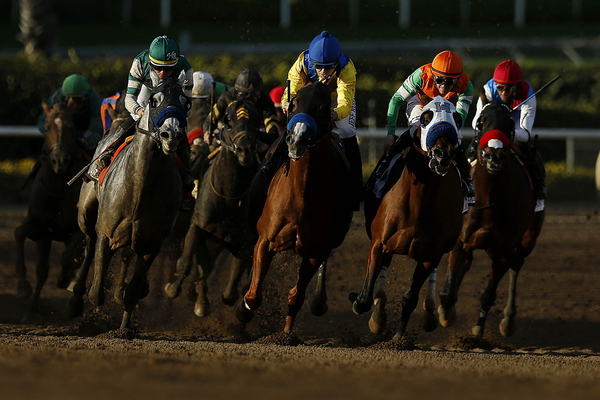
ARCADIA, Calif. _ A group of jockeys gathered in the paddock garden at Santa Anita on Sunday morning, awaiting their mounts for the next session of workouts. A single subject dominated conversation _ new whip rules that take effect this week at California tracks.
The centuries-old style of striking a horse with a full-arm motion was banned earlier this year by the California Horse Racing Board, replaced by rules dictating an underhanded motion and a limit of six strikes in a race.
The riders gathered at Santa Anita on Sunday morning expressed a mix of concern and trepidation over how they will adjust to the new methods and how strict track stewards will be regarding financial penalties and suspensions for violations.
"It's going to be difficult for everyone," Hall of Famer Victor Espinoza said.
"We've ridden the same way for so many years, all of us. We're trying to figure out how we're going to do it. We have so many rules for the jockeys. It's intense, in a way."
Flavien Prat, the leading rider at Del Mar and Santa Anita meetings earlier this year, is not in favor of the new rules, but acknowledged the general public is sensitive to whip use.
"I understand the perception is not good," he said. "What I don't like is we went from no limitations and now, all of a sudden, you go from one extreme to another. From what I've read, we have to be happy with that because they want to take it away anyway."
Prat, 28, said the underhanded style is not something that can easily be developed and that the restriction on the number of strikes could be difficult to follow in an intensely run race.
"You can practice," Prat said. "It's not as natural.
"It's hard to count when you're trying to win. What will be frustrating is if you hit early in the race. I guess everyone will have to adapt."
Even apprentice jockey Alexis Centeno, who began riding in California earlier this year, is apprehensive about the required adjustments.
"It changes your style," he said Sunday morning.
Journeyman Eswan Flores, 27, won his first race in 2011 and said riders will adapt reluctantly to change.
"It's not going to be good for us," Flores said Sunday. "Everyone is going to be in the same boat. I don't see why we can't continue doing it the way it's going. We're not abusing the whip."
The racing board approved rules restricting use of the whip in June, having discussed various regulatory proposals since the spring of 2019. The new rules underwent legal review by the state's Office of Administrative Law after the June meeting and took effect Thursday.
Under the new rules, riders can strike a horse twice and must pause to give a horse a chance to respond before using the whip again. Riders can show or wave the whip to a horse without making contact.
Violations will result in a minimum suspension of three days and a maximum fine of $1,000 "absent mitigating circumstances," according to the text of the ruling. The rule states riders should not be penalized if a whip is used "for the safety of the horse or rider."
In a recent statement, the racing board said the new rules are designed "to further protect horses without compromising the safety of horses and riders." The racing board has recommended that track stewards utilize the "mitigating circumstances" clause during an unspecified period of transition beginning this week to allow riders to adapt.
When the rule was approved at the June meeting, representatives of the Jockeys' Guild asked the racing board to delay implementation until other regulatory agencies across North America could enact similar policies. The suggestion was immediately rebuffed by chairman Greg Ferraro.
"Everyone wants to kick it down the road," Ferraro said at the time. "This board has a mandate from the governor to make reforms in racing that contribute to the welfare of the horse. It's time to stop procrastinating and pass a rule."
California has taken a proactive approach to restrictions on whip use in recent years.
In 2015, California enacted a rule stating a jockey could strike a horse only three times before pausing to allow the horse to respond. There were numerous financial penalties for violations by jockeys in the weeks after the rule was implemented.
The new rules are the toughest in the United States. Ontario enacted a similar rule earlier this year restricting whip use to an underhanded motion at all tracks in the province. That followed a temporary policy that went into effect at Woodbine last October.
Later this month, some California jockeys will ride under the new rules on the opening weekend of the Del Mar meeting on Oct. 31 and Nov. 1, travel for the Breeders' Cup races on Nov. 6-7 at Keeneland _ where such rules are not in place _ and return to Del Mar and California's rules.
Hall of Famer Mike Smith, 55, is the senior member in the jockeys' room. After winning Sunday's final race, Smith said the new rules will take time for adjustment.
"We're up for a change and we're up for trying," Smith said. "How many years has racing been going on to all of a sudden go to doing this? It's going to be difficult, but we'll give it our best."
He compared riding a racehorse to driving an Indy car.
"Not everyone can drive an Indy car," he said. "They're very powerful machines.
"They're very strong," Smith said of racehorses. "There are so many variables and so many reasons you need the riding crop. When you ask them to run, there is an art to it on how you hold a horse together and keep them balanced.
"Underhand is so difficult," Smith added. "Some can do it okay. I can do it just okay right-handed, but not at all left. And I'm completely left-handed. It will be a big trial, and we'll see what we can do."