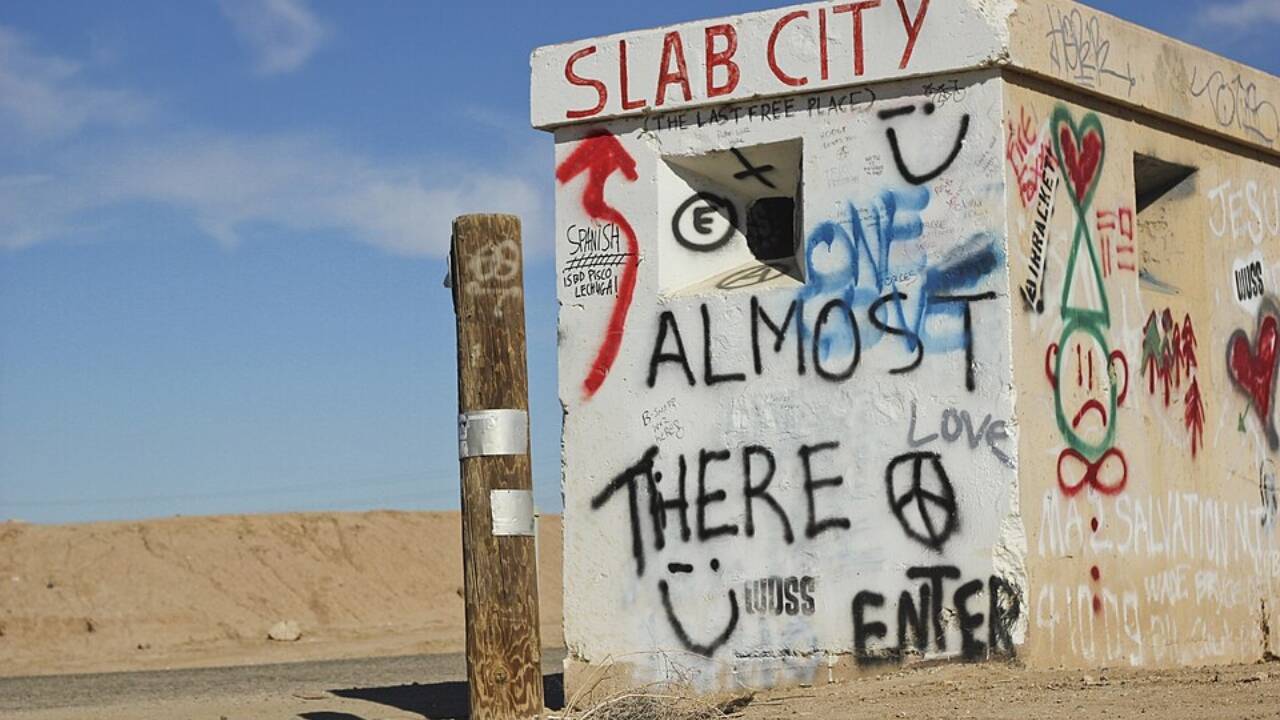
Across the United States, most towns have electricity, running water and local government, but deep in California’s desert lies a place that hundreds call home despite lacking those basics. Hidden in California’s Colorado Desert, around 50 miles north of the U.S.-Mexico border, Slab City has become one of the country’s most unusual settlements. The off-grid community, spread across the concrete foundations of a former U.S. Marine Corps training base abandoned after World War II, attracts artists, retirees, survivalists, seasonal visitors and people seeking an alternative to mainstream society. According to Smithsonian Magazine , residents often describe the city as “the last free place,” though others see it as a symbol of both freedom and hardship.
Get breaking news anytime, anywhere. Download the TOI app now!
A community born from the ruins of a wartime military camp
According to Smithsonian Magazine, the site originally served as Camp Dunlap, a U.S. Marine Corps artillery training base commissioned in 1942. During the Second World War, the camp contained roads, paved streets, utilities, water and sewage systems, recreational facilities and dozens of military buildings used to train troops for desert warfare. The base was deactivated after the war in 1945, dismantled over the following years and was eventually returned to the State of California with the remnants of concrete foundations that later inspired the name ‘Slab City.’
The California State Lands Commission says the land remains state-owned, is part of California’s School Lands portfolio and has long been occupied informally rather than incorporated as a conventional municipality. Notably, beginning in the mid-1960s, veterans, drifters and recreational vehicle owners slowly settled on the abandoned concrete slabs, constructing makeshift homes from trailers, salvaged timber and recycled materials.
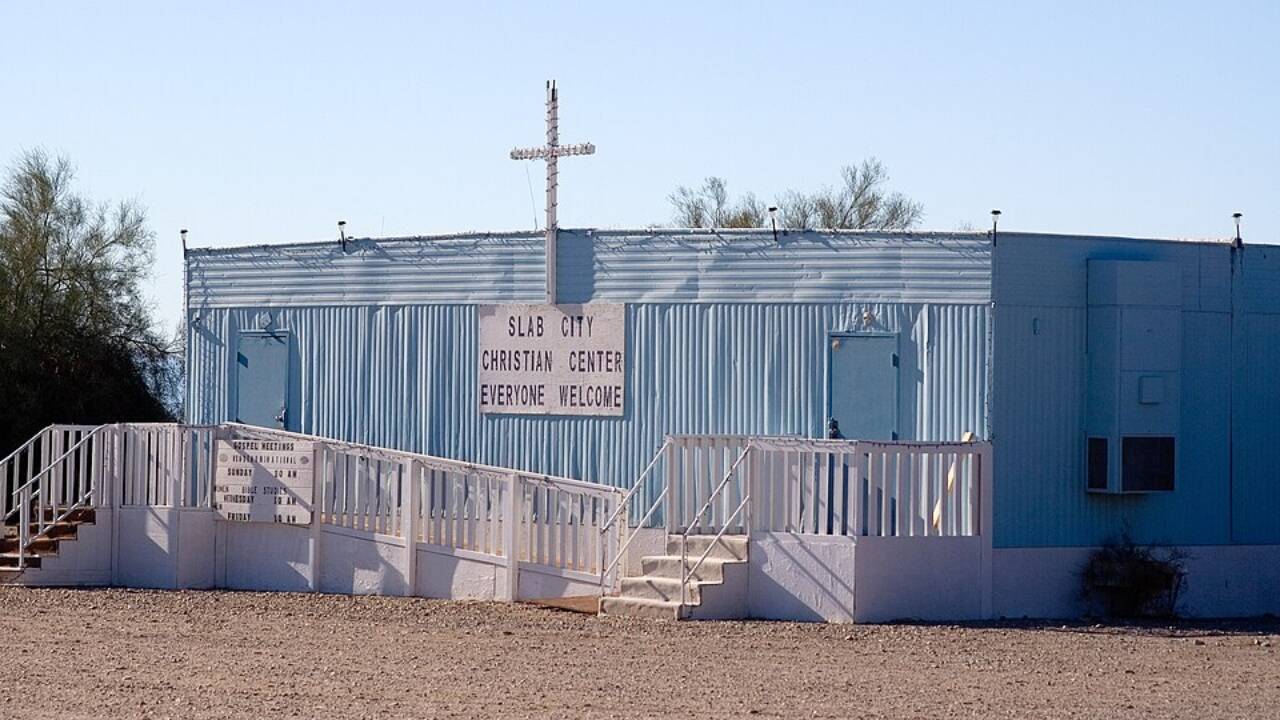
Architect Charlie Hailey and photographer Donovan Wylie, whose work formed the basis of Slab City: Dispatches from the Last Free Place, describe the settlement as more than an isolated desert encampment. Smithsonian Magazine reported that Hailey and Wylie found traces of the former military grid still shaping everyday life, with the surviving roads and concrete slabs continuing to define neighbourhood layouts and provide ready-made foundations in the harsh desert landscape.
A life in the ruins of a wartime military camp
Life in Slab City demands constant improvisation, with the community living there functioning without municipal electricity, piped drinking water, sewer systems or regular waste collection. Thus, many residents rely on solar panels, generators, hauled water and improvised sanitation facilities to meet their daily needs. As Slab City lies outside an incorporated municipality, it has no local government collecting municipal taxes or providing civic services, thus leaving the residents largely responsible for maintaining their own homes and shared spaces in the city.
However, despite its rugged reputation, Slab City has developed a distinctive cultural identity. Notably, the settlement is home to colourful landmarks like Salvation Mountain, artist Leonard Knight’s adobe-and-paint creation, and East Jesus, an outdoor art installation assembled from recycled materials. Smithsonian Magazine’s article has mentioned that the community includes artists, musicians, retirees, seasonal ‘snowbirds,’ migrant workers and people living on society’s margins. The community’s population changes throughout the year, with some residents staying only during the cooler months and others remaining year-round.
Slab City continues to be a fascinating area for researchers because it challenges conventional ideas about cities and governance. Hailey, quoted by Smithsonian Magazine, describes Slab City as simultaneously “off-grid” and “in-grid,” a place that rejects many modern institutions while still occupying the orderly street layout left behind by the military.