LOS ANGELES — Coronavirus is again on the rise in California, and the big question is: How bad it will get?
With the holidays approaching, state officials have already rolled back reopenings in some counties as case numbers surge.
Officials now fear more hospitalizations and deaths, and they are debating whether more intense measures will be needed to slow the infection rate.
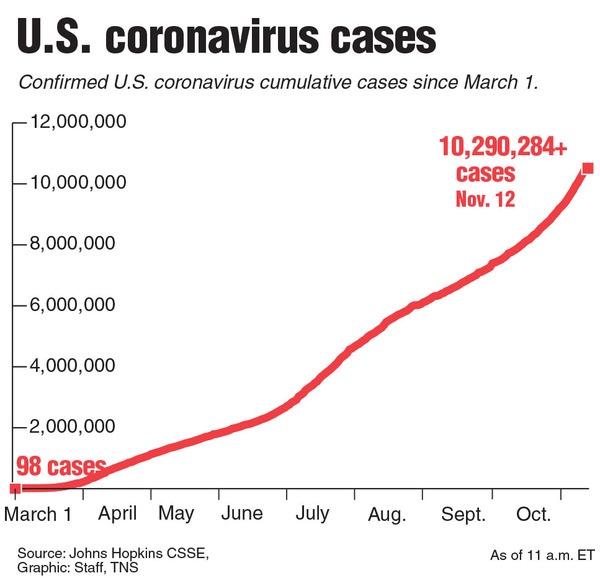
California is approaching 1 million cases, although the spread remains slower in the state than in other hot spots across the country.
Q. What is the next indicator?
A. The state has averaged 6,377 new cases per day over the last week, Times data show, including 8,307 on Tuesday. That rate — far higher than a month ago — puts California on pace to surpass the 1-million mark by Thursday.
Officials say they are particularly concerned about what may come next.
Hospitalizations and deaths are lagging indicators of coronavirus spread and can reflect exposure to the virus that occurred weeks earlier.
Those who have been infected during the latest spike "won't become patients in hospitals for another two to three weeks," according to California Health and Human Services Secretary Dr. Mark Ghaly.
There were 3,224 COVID-19 patients hospitalized in California as of Tuesday — an increase of roughly 38% from two weeks ago, according to the latest state data. The number of infected patients in intensive care, 889, is up 34% from two weeks ago.
Q. What are experts saying?
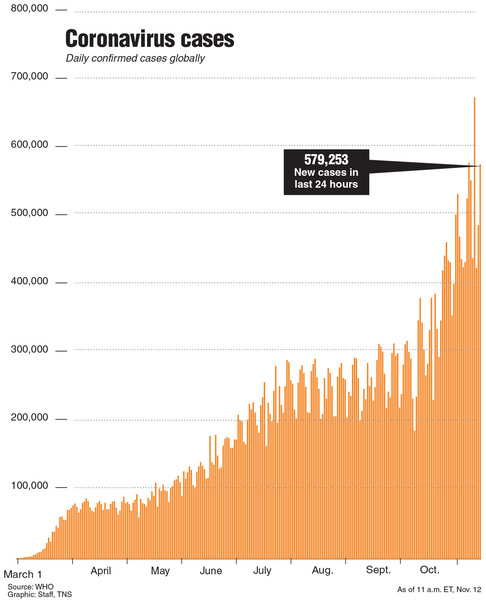
A. A UC Berkeley infectious disease expert said he believes the coronavirus is likely to swamp California in December and parts of the state economy will have to be shut down.
Dr. John Swartzberg said in an interview that the virus is spreading through travel from states where it is out of control, and California will not be spared.
"Within a month after Thanksgiving, the number of cases is going to be up significantly," Swartzberg said. "California is going to be very worried, and we will start to see things close down."
He said requiring quarantines for travelers to and from states with high infection rates would probably discourage travel, but there might be a backlash from Californians already angry at the number of restrictions.
Swartzberg likened humans to fuel and the virus to fire.
"As long as there is fuel around, the virus is going to get there," he said. "The virus doesn't know whether it is Nevada, California or Wisconsin. ... You are going to see this virus go everywhere, and there is plenty of fuel in California."
He said the state may have to start enforcing its mask mandate with fines.
He cited a theory published in a medical journal that said people may not fully respond to the threat of the disease until they know someone who has died. By the article's count, that may not happen until March 1, when 500,000 Americans may have died of COVID-19.
"By that point, everybody will know somebody who died," Swartzberg said, citing the August report by Dr. Ahmad Mourad in the Annals of Internal Medicine.
Q. What about the holidays?
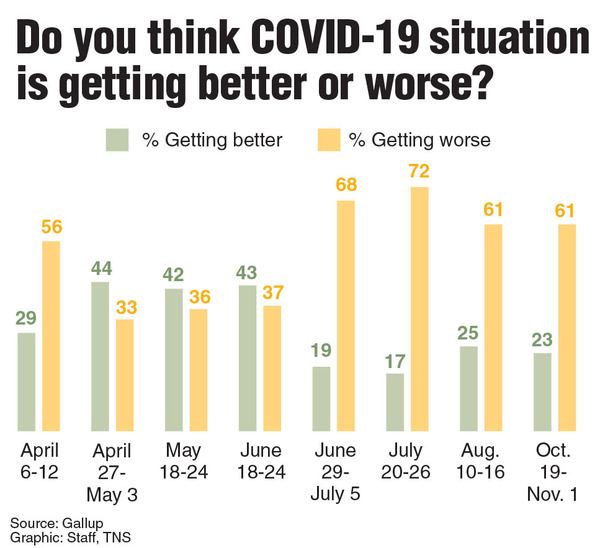
A. As temperatures fall and the holiday season approaches, experts have warned residents not to put themselves in high-risk situations where the virus can more easily spread.
Of particular concern are lengthy indoor activities in which people don't wear masks or observe physical distancing.
Participating in gatherings with those outside your household — even family members or trusted friends — can heighten the risk for coronavirus transmission, officials warn.
"Just because they're close to us personally doesn't mean that they have a lower risk of either passing COVID onto you or having COVID come from you to them," Ghaly said. "So we want to be very careful, not just with those we don't know from outside of our household, but even those that we know quite well."
Q. What does this mean for the economy?
A. As case counts continue to shoot upward, officials on Tuesday announced that 11 counties had moved back to more restrictive tiers in California's coronavirus reopening system.
Among them were San Diego, Sacramento and Stanislaus counties, all of which moved into the purple tier, the strictest category.
Many businesses, such as restaurants, gyms and movie theaters, will now have to move their operations outdoors — an unwelcome and potentially untenable limitation for sectors that have already been walloped by coronavirus-related restrictions.
With the three new additions to the purple tier, nearly one-quarter of California counties find themselves living under the most stringent coronavirus-related regulations. The others are Los Angeles, Riverside, San Bernardino, Imperial, Monterey, Tulare, Madera, Sonoma, Tehama and Shasta counties.
A sharp rise in cases in San Francisco prompted officials there Tuesday to ramp up restrictions, meaning that indoor dining will be suspended, capacity at gyms and theaters will be reduced and the city's high schools will have to wait to reopen.