In the cloud forests high in the central Peruvian Andes, a group of local farmers are drying their coffee beans in solar-powered plastic tents instead of the age-old method of drying them on tarpaulin sheets spread out along the roadside, where they can easily be contaminated by insects, pollution from passing cars, and humidity.
Inside a community hall in the town of San Juan de Uchubamba, David Torres Bisetti, a coffee roaster and cafe owner from Lima, is holding a workshop, introducing these farmers to the taste of their own coffee for the very first time, and explaining the finer points of aroma and acidity.
More than a quarter of people in these remote mountain communities are extremely poor but, since 2012, 180 coffee farming families in the Jauja and Concepción areas near to Chanchamayo province in Peru’s central Junín region – known as one of the main places where coffee is produced – have been supported to transform the way they work. After producing coffee in the traditional way for generations, they are joining together to form a co-operative to improve the quality of their product – and with it their life prospects.
The project that supports them is called Cafe Curibamba, an initiative funded by multinational power company Enel, via its local subsidiary Edegel.
Rosario Arrisueño, head of sustainability at Enel Peru, explains that improving coffee production through Cafe Curibamba is one way the company is bringing development and benefits to remote communities near the power plants. It is also building health centres and schools and improving the water supply. Such work is driven by the company’s goal of “sharing value” – in other words finding ways to improve the lives of people local to its power projects.
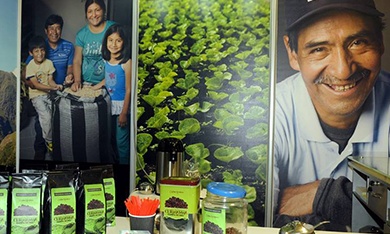
“The Curibamba coffee project is allowing the residents of the communities surrounding the hydro project to see the Edegel company as a strategic partner that can help them to promote local economic development,” she says. “For the coffee farmers we are connecting them with markets they could never before have imagined and they are receiving technical training and support they had never before had because the state’s involvement here has been negligible.”
The life of the traditional Peruvian coffee farmer, cultivating his plants on small plots of land on lush green mountainsides high in the Andes, has never been easy. The plants are expensive to buy and it typically takes five years for them to bear fruit, leaving farmers at the mercy of volatile world coffee prices.
But they are also now at the mercy of climate change, which is threatening coffee crops in virtually every major coffee-producing region of the world, according to the International Coffee Organization. Rising temperatures have contributed to the spread of fungi, such as coffee leaf rust, with devastating impact on yields, and prices for Arabica, the high-quality beans grown in Peru, can fluctuate wildly, under pressure from cheaper and hardier Robusta coffee, grown primarily in Vietnam.
Enel funded Italian development assistance charity AVSI to set up the Cafe Curibamba project in 2013. Arrisueño says its aim is to train farmers in improved cultivation techniques and provide them with modern infrastructure to process the fruit into beans of the highest quality, so they can command a higher price from speciality coffee buyers.
“Although the terrain, the altitude and the weather is suitable to produce excellent quality coffee, farmers in this area had never received technical assistance and their management techniques were very basic and didn’t help the quality of the fruit,” she says.
The project took over 35 hectares of new land and planted 175,000 coffee trees of the hardier Caturra variety of Arabica, with the farmers in the cooperative assuming 30% of the cost of the investment. They also began holding training workshops once a month to teach farmers up to date organic farming techniques to fertilise, prune, and combat pests such as the pernicious leaf rust, which blighted a third of Peru’s coffee last year, and led the government to declare a state of emergency in 11 regions, including Junín.
New tubs to ferment and wash the fruit, connected to a septic tank to treat the highly polluting waste water, and solar heated greenhouses to dry the fruit free from humidity and contamination were introduced to maximise the quality of the beans.
Benjamin Gangloff, a coffee importer from Arizona in the US, discovered the Curibamba farmers in 2013 when Cafe Curibamba took part in the Mistura food festival, where farmers from all over Peru show their products. After enjoying the coffee, Gangloff contacted Bisetti’s cafe. He recently braved torrential rains and washed out roads to make his second trip to Curibamba, and see how the cooperative is getting on since he visited last year.
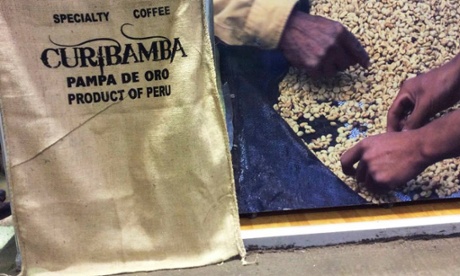
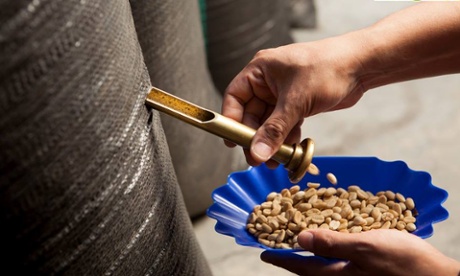
Gangloff was impressed by what he saw – and tasted. The coffee he bought from the co-op last year had achieved a quality score of 81-82.5 – good, but a bit on the low side in the competitive speciality coffee market, he said. This year most scored over 83 and some scored as high as 84.5, which is very good indeed, he says – and means he can pay the farmers twice the amount they would get from local coffee buyers. “The coffee quality is good because the farmers are paying attention,” he says. “They really are learning from this project.”
Arrisueño says it had been difficult forming the co-operative because the farmers – who like most coffee farmers in Peru are mostly well into their 50s – were set in their ways and resistant to working with people who had previously been their rivals. But a breakthrough came when, in order to get hold of free fertilisers and fungicides provided by government to combat coffee rust, they had to raise money together to rent a lorry, she says.
While involvement in the co-op began slowly, its numbers have grown as news has spread of the higher incomes possible. The project’s success has also lured back into coffee production some farmers who had left it to cultivate passionfruit – a crop that takes a shorter time to grow, but whose price is volatile and which also leads to deforestation.
Gangloff says it was gratifying to see how excited the farmers at the workshop were to hear that their coffee was being enjoyed by coffee drinkers in the US – and that it will be featured at this year’s Milan Expo exhibition.
It is hoped the project can also help to reignite interest in coffee farming as a career. With young people abandoning the family coffee farms in droves, unwilling to take on the hard life of their parents, there is a danger that coffee growing will die out with the current generation.
“Part of our mission in doing direct marketing from the farmers is to make coffee profitable to individual growers,” says Gangloff. “We need to make coffee sexier for young farmers. This is where the future must be.”
Content on this page is paid for and provided by Enel, a sponsor of the Guardian Global Development Professionals Network.