The government approved at a Cabinet meeting Friday an ordinance revision to remove South Korea from the so-called white list of trading partners qualified for simplified export procedures. At the same time, it decided to rename the white list as "Group A" nations.
The revised ordinance will be officially announced Wednesday and will be enforced from Aug. 28. The action is likely to worsen the already deteriorated relationship between Japan and South Korea.
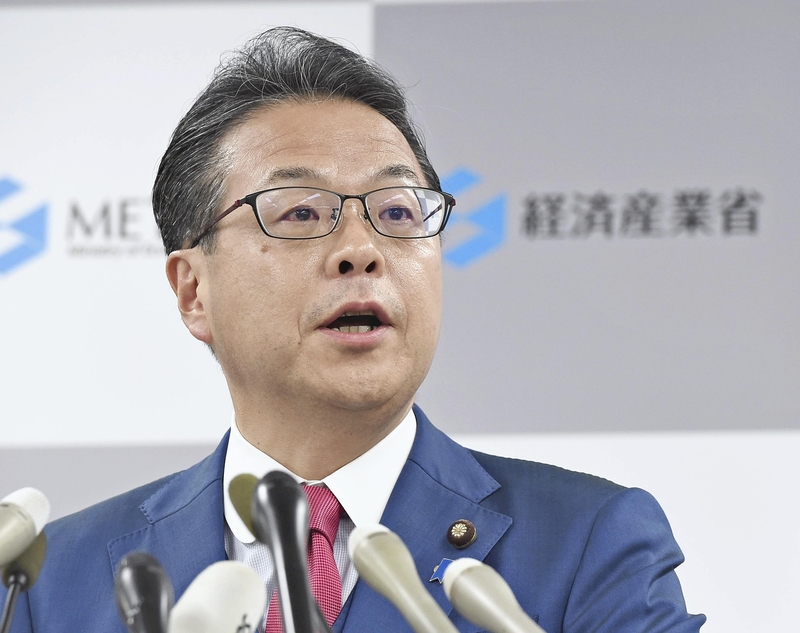
Economy, Trade and Industry Minister Hiroshige Seko said after the Cabinet meeting Friday, "It is a necessary review, to operate the export control system for national security."
He also said that the government would strive to conduct rigorous inspections in its role as an export control authority.
In addition to South Korea, 27 countries, including the United States and Britain, have been designated in the list to receive preferential treatment. The Japanese government has deemed that a trade control system is in place and is operating properly with those countries. It is the first time that a country will be removed from the list.
The economy ministry used to call countries eligible for preferential treatment "white country," but the government announced Friday that it would change the name to "Group A."
In principle, Japanese companies are allowed to exempt from the individual licensing process for three years under so-called the blanket license system even when exporting restricted items that may be converted to military use to those trusted countries under preferential treatment. If South Korea is excluded from the list, such comprehensive permits will not be available and individual permits will be required for each export contract in principle.
In addition, items other than those regulated under the law will be subject to the "catch-all system" under which the Economy, Trade and Industry Ministry will be able to request permission for individual items if they are deemed to have been used for military purposes. For example, if a screw used in a car is likely to be used in a military car, it can be requested to be approved before export. Countries eligible for preferential treatment were not covered by the system.
However, even if South Korea is excluded, if Japanese companies meet certain requirements, such as strict export controls, they can use other comprehensive licenses for countries that are not eligible for preferential treatment. As a result, some observers believe the export restrictions will have only a limited impact on Japan-South Korea trade.
South Korea is bracing for Japan's decision to drop it from a "white list" of countries that enjoy minimum trade restrictions, which could come as soon as Friday, Seoul's foreign minister said, as companies prepared for the possible fallout.
Japan reined in exports of high-tech materials to South Korea as ties worsened this month, fueled by a compensation row over South Koreans forced to work in Japan's factories when it occupied the Korean Peninsula from 1910 to 1945.
Media in Japan have said its Cabinet could meet as soon as Friday to decide on stripping South Korea of the trade status, a move that Seoul has called a very grave matter that would undermine the two nations' economic and security partnership.
The South Korean government is "preparing for various possible options" if Japan drops Korea from its list, Foreign Minister Kang Kyung-wha told parliament on Tuesday.
Without detailing the options, she added that if Japan made its decision this week, she expected it to be implemented by late August.
"If we are removed from the white list, we are concerned that relations between the two countries would worsen to uncontrollable levels," Kang added.
Japanese officials were reviewing public comments and steadily working on procedures, but a date had not been set for a Cabinet decision, trade minister Hiroshige Seko told a news conference Monday.
Kang said she was highly likely to meet Japanese counterpart Taro Kono and U.S. Secretary of State Mike Pompeo at a forum of the Association of Southeast Asian Nations in Bangkok this week, with working-level talks aimed to finalize details.
Asked by lawmakers if the United States had agreed to mediate between its biggest Asian allies, Kang said only that Washington had listened to the positions of both, but it "wouldn't be easy" for the country to openly mediate.
Some of South Korea's largest industries are preparing for the dispute to intensify.
From September, Asiana Airlines Inc. plans to switch to smaller planes for some of its Japan routes, in the face of declining demand amid the row.
Top carrier Korean Air Lines Co. said it would suspend flights between the South Korean city of Busan and Sapporo from Sept. 3, citing lean demand.
The government is planning to approve at a Cabinet meeting on Friday the removal of South Korea from the so-called white list of trusted trading partners qualified for simplified export procedures, government sources said Saturday.
The ordinance to revise the white list is slated to go into effect in late August.
It is the first time that a country will be removed from the list.
A total of 27 countries such as the United States and Britain are currently designated as trusted trading partners. South Korea joined the list in 2004.
Once the East Asian neighbor is taken off the list, companies seeking to export goods to South Korea will no longer receive preferential treatment in the form of simplified application procedures. Specifically, exporters for goods with potential military use will be required to apply for approval on an individual trade deal basis.
"It is a necessary measure from the perspective of conducting effective export management," Chief Cabinet Secretary Yoshihide Suga said at a press conference on Friday.
The move follows Japan's decision earlier this month to tighten controls on exports to South Korea for three types of semiconductor materials on the grounds that some exported materials had been handled inappropriately in the country. Japan-South Korea relations have been deteriorating since last autumn, due to disagreements over wartime labor and other issues.
The Japanese government solicited public comments on the possible removal of South Korea from the white list through Wednesday.
The South Korean government has been calling on Japan to scrap the removal plan, saying that the move is politically motivated. Seoul is considering filing a complaint against Japan with the World Trade Organization once it confirms economic damage resulting from the measure.
関連紙面: 20190729F0TDY03S000000
Read more from The Japan News at https://japannews.yomiuri.co.jp/