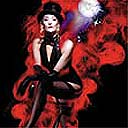
Chichester's Cabaret has had its problems. Its original director, Lucy Bailey, quit after her proposed staging of Two Ladies as a troilistic bathtub romp was internally censored. Any fears, however, that the baby might have been thrown out with the dirty bathwater are banished by Roger Redfarn's finished production, which hits the right note of exuberant seediness.
Inevitably no main-house production can achieve the devastating intimacy of Sam Mendes's 1993 Donmar Warehouse revival; that made us guiltily complicit Weimar voyeurs. What we get instead at Chichester is a garish George Grosz-style spectacle. In The Kit Kat Club itself at least half the satin-knickered, fishnet-stockinged dancers turn out on closer inspection to be men. At one point, in an apparent echo of Broadway's The Producers, we are confronted by a line of high-kicking, precision-drilled Nazi chorus girls. Even the contentious Two Ladies is effectively staged on a vaulting horse with the lubriciously mounted Emcee sandwiched between two female gymnasts.
The tone of this revival is, in fact, decisively set by Julian Bleach's Emcee. Fresh from a similar role in Shockheaded Peter, Bleach presents us with a bilious, green-tinged figure with a death's-head stare and a voice as grating as a rusty saw: it is the most frightening interpretation of the role I have seen, and free from any hint of welcoming ingratiation. But if Bleach's Emcee has the right epicene coldness, Alexandra Jay's Sally Bowles is no more than professionally competent. As you would expect from someone who alternated with Martine McCutcheon in My Fair Lady, Jay sings well. But she suggests hockey-sticks-in-the-hallway rather than the affected Chelsea airhead that is the musical's Sally Bowles.
In a sense the original Kander and Ebb stage musical has been spoilt by the 1972 film: Sally now gets to sing a ridiculously rhetorical, affirmation-of-life number, Maybe This Time, written specially for Liza Minnelli in the movie. But the virtue of this production is that it takes us back to basics and reminds us that the seedy cabaret is a metaphor for an increasingly fascist Germany.
Two moments also produce an authentic chill. One is when the guests at an elderly couple's engagement party reprise, with bright-eyed fervour, the brownshirt anthem Tomorrow Belongs to Me. And the other is when Sarah Badel's Fraulein Schneider, in finally rejecting Brian Greene's aged Jewish fiance, announces "If the Nazis come, I will survive." In its equivocal mixture of endurance and acquiescence, that says as much about the spirit of Berlin in 1930 as all the show's vaunted sexual decadence.
· Until October 5. Box office: 01243 781312.