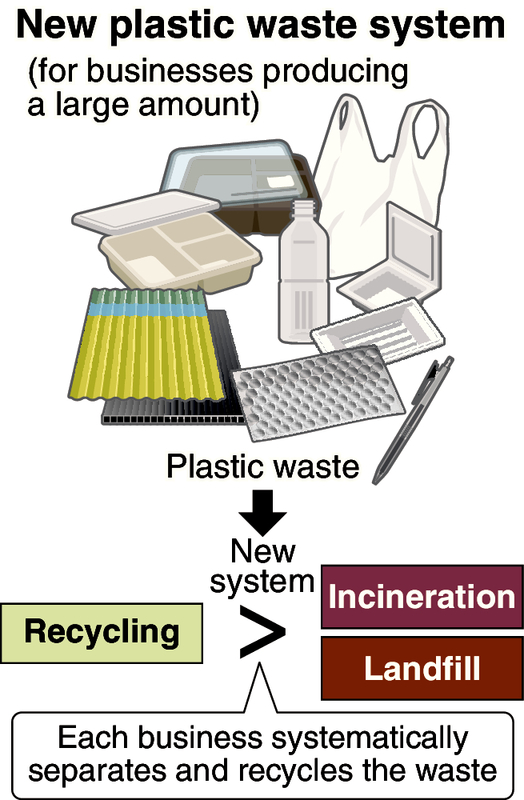
The government has decided to oblige businesses that produce a large amount of plastic waste at offices and factories, including packaging and building materials, to recycle them. Most plastic waste currently generated by businesses is incinerated, but the government aims to improve low recycling rates by making businesses separate the refuse and recycle it.
The decision was presented Tuesday at a meeting of an advisory panel of experts from the Environment Ministry and the Economy, Trade and Industry Ministry. The two ministries will compile a plan for the new system by the end of this fiscal year and will study submitting a bill to an ordinary Diet session next year. The system is expected to start in or after fiscal 2022.
Plastic waste from offices, factories and other businesses varies widely, including packaging, building material, office supplies and food containers. Most of the waste is incinerated together with other combustible waste, and only a few companies outsource the disposal to recycling companies.
Under the new system, the government will oblige businesses to systematically separate and recycle waste to improve recycling rates. In addition to the existing plastic bottle and combustible waste categories, businesses will be required to separate the waste into a plastic refuse category and hand it over to waste disposal companies engaged in recycling. Independent stores and businesses with a low quantity of plastic waste will be obliged only to make efforts to introduce the system.
The government will also set guidelines for companies that manufacture plastic products, such as detergent bottles, plastic bottles and office supplies, to design environmentally friendly products. Specifically, the companies will be obliged to use less harmful plastic by introducing lighter packaging or using plant-derived biomass plastic with a smaller environmental impact.
Recycling of plastic waste has been sluggish because it costs more than incineration or burial in landfills. According to the Plastic Waste Management Institute in Tokyo, the nation's total plastic waste was 8.91 million tons in 2018. This includes both industrial waste from factories and household or office waste.
Of the total, 4.62 million tons, or 52%, was waste from businesses. Business waste accounts for an even more considerable portion of the total when such office waste as food containers is included.
The recycling rate for all plastic waste is less than 30%.
In July, the government announced a plan to ask municipalities across the country to collect all household plastic waste together, starting fiscal 2022. By regulating plastic waste from both households and businesses, the government hopes to promote recycling.
Read more from The Japan News at https://japannews.yomiuri.co.jp/