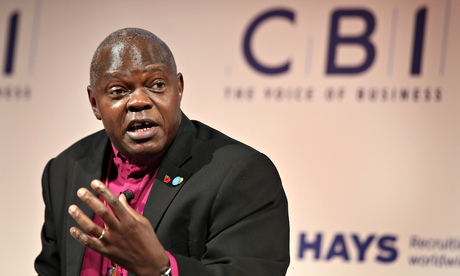
Employers who can afford to pay the living wage “should just get on with it”, Archbishop of York Dr John Sentamu said in a passionate plea to businesses to end Britain’s income inequality.
Sentamu, who chaired the Living Wage Commission, chided those who have not brought in the voluntary pay threshold, which is calculated to provide a basic but decent standard of living. He also called on government to set a better example on pay and to grasp the benefits of ending working poverty rather than merely spending billions topping up low incomes.
“Work must pay, but not pay poverty wages,” he told business leaders.
“The economic recovery provides the perfect opportunity for us to ensure many more people are paid a living wage.”
Speaking to the CBI business lobby group’s annual conference, Sentamu conceded some employers, such as shoe shops and other services companies, could not afford to pay the living wage, set at £9.15 in London and £7.85 outside the capital. But they were the minority and the rest should set an example by paying it.
“Most businesses, sorry to say, they can afford to pay the living wage and they should just get on with it.,” Sentamu said.
The archbishop highlighted growing income inequality and the cost it was having for society as well as the public finances.
“Billions of pounds are spent each year topping up the incomes of low paid workers at a time when public finances are very, very tight indeed. Demand is sucked out of the economy by the lack of spending power for over a fifth of the workforce. And where inequality grows we all become diminished. It makes us all much poorer,” he said.
“Some light has begun to shine through,” he said, referring to the rise in employer accredited with the Living Wage Foundation to more than 1,000.
But he continued: “There is still a long way to go … Income inequality is a stain on all our consciences. There is a strong role for government and business to support the living wage. UK government is a major employer and just as importantly it can take the lead on low pay. Business can also demonstrate the benefits of paying their employees justly.”
He also called in government to set taxes so “that those who are doing the right thing are not being penalised”.
Sentamu flagged up research by consultants KPMG last week which showed more than a fifth of workers were paid below the living wage and that the number had actually risen on a year earlier. The report also showed women, the young and part-time workers were more likely to be trapped in low pay.
Addressing what he saw as rising income inequality, Sentamu described “flaws in the practice of free market economies”.
“While the system gives individuals the power of choice and allows for innovation ands experimentation a major limitation of the free market economy is that it has no mechanism to reduce the disparity between the haves and have-nots,” he said.
“Britain is at risk of becoming a place where the haves and have-nots live in separate parallel worlds.”
The archbishop, whose commission this year urged the government to adopt the living wage as an “explicit goal” to help lift 1 million workers out of low-paid jobs, said merely helping those on low incomes would not solve a deeper problem of inequality.
He used the example of someone drowning. It was of course right to wade into the river and help that person, Sentamu said. But he added: “We have got to go upstream and find the people pushing them in and say stop it.”