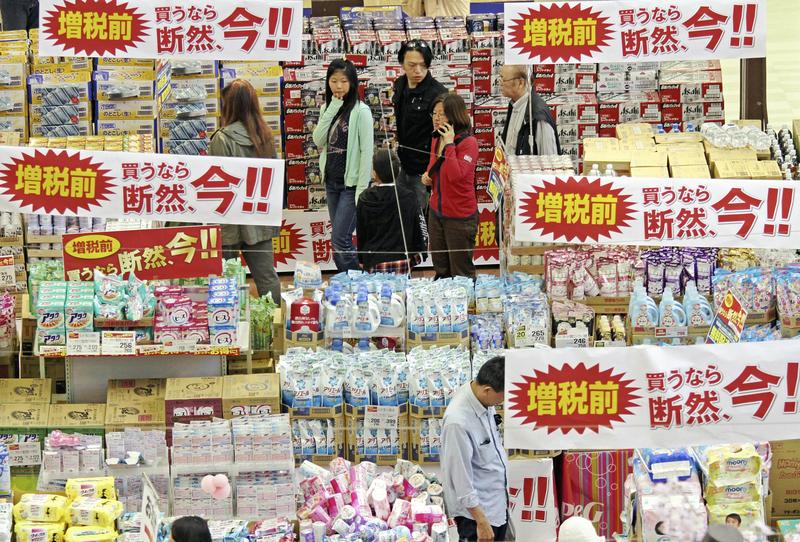
It is now one year until the planned hike in the consumption tax rate to 10 percent, which is set to go into effect on Oct. 1, 2019.
Yet work remains to be done on a reduced tax rate (see below) to be introduced simultaneously, and measures to prevent an economic slowdown. Public and private sector efforts to prepare for the tax hike are expected to accelerate.
Sense of urgency
"I hope steady progress in modifying cash registers and other areas will be made as next October approaches," Tsuguhiko Hoshino, director general of the Tax Bureau at the Finance Ministry, told a meeting of the Japan Chain Stores Association on Sept. 21 in a Tokyo hotel.
Hoshino was urging executives of major supermarket chains and other businesses to accelerate their efforts so reduced tax rates can be implemented smoothly. The association opposes the reduced tax rates, saying they will create "troublesome paperwork" and other issues.
The ministry is becoming increasingly worried that if major supermarkets are unprepared for the tax hike, it could cause confusion among consumers.
Funding social welfare
The consumption tax hike is designed to provide funds for social welfare costs, which are ballooning as the population ages. The October 2019 tax hike was included in a package of tax reform legislation passed in 2016.
The fiscal 2018 budget (general account) included 33 trillion yen for social welfare programs, about one-third of total spending. About the same amount in government bonds -- about 34 trillion yen -- was also issued.
Social welfare spending, primarily on medical and nursing care, is certain to continue to rise, particularly when the baby boomers start to reach the later stages of old age around 2022.
The hike to 10 percent is expected to bring in an additional 5 trillion yen in tax revenue. With social welfare spending continuing to rise, many analysts believe the tax hike is more necessary than ever.
'As planned'
In these circumstances, Prime Minister Shinzo Abe said repeatedly during the Liberal Democratic Party's presidential election in September that he intended for the consumption tax rate to be raised "as planned."
Since the hike to 8 percent in April 2014, Abe has twice delayed raising the rate to 10 percent, citing economic fragility and other reasons. The Japanese economy is currently doing well, with good corporate performance and rising stock prices.
Going ahead with a tax hike despite signs of a slowdown could do great damage to the economy, which would not accomplish anything. Politically speaking, there is a House of Councillors election in the summer of 2019 to consider.
"The prime minister can always play the 'delay again' card. He may continue to watch the political and economic trends up to the last minute," a government source said.
Worries over spending slump
The Bank of Japan estimates that raising the consumption tax rate to 10 percent will increase the burden on household budgets by 2.2 trillion yen in real terms, which is about one-fourth of the burden of about 8 trillion yen that followed the increase from 5 percent to 8 percent in April 2014.
Part of this is because the rate hike is smaller, but reduced tax rates are also expected to have a major impact. Half of the increased tax revenue is expected to be returned to the public as free tuition and other forms, which would reduce the burden on households with children.
While the impact of this tax hike is expected to be smaller than the last, the government is trying to learn from 2014 by putting in place robust economic measures.
"We want to respond in a sufficient way that will prevent consumption from falling," Abe has emphasized.
In addition to subsidies for home buyers and reduced taxes on housing loans, plans are in the works for subsidies on automobile purchases and other measures.
To stimulate consumption of high-priced items, the government wants to include its economic package in the draft budget and tax reforms for fiscal 2019, which are to be decided around the end of the year.
The government is also considering lifting the ban on advertisements for things like "tax refund sales" to reduce last-minute demand before the tax hike and a subsequent slump afterward. In the past, sales have been restricted out of fears that major retailers and others would push the increased tax burden onto their suppliers.
-- Reduced tax rate
To be introduced along with the increase in the consumption tax rate to 10 percent. Food and beverages, and subscriptions to newspapers published at least twice a week will continue to be taxed at 8 percent. Alcohol and dining out will not be included, though food served at nursing homes, daycare centers and other such places will be. Similar systems have been introduced elsewhere, mainly in Europe, and have been shown to ease the burden of tax hikes on family budgets and ease slumps in consumption.
Read more from The Japan News at https://japannews.yomiuri.co.jp/