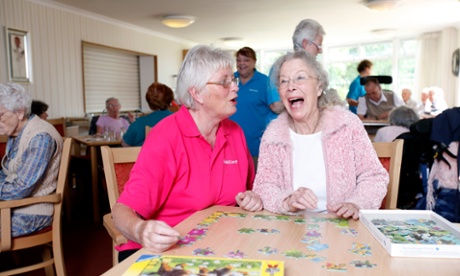
Think of a person with dementia. Which words spring to mind? Perhaps forgetfulness, worry or old age? If so, you’ve made the same assumptions as many of the volunteers at a Dementia Friends session.
Penny Ellis, a tele-healthcare development consultant at healthcare company Tunstall, asks the same question at the sessions she runs. Tunstall is among the businesses waking up to the growing impact of dementia. The disease costs England-based business £6.2bn a year and the figure is set to rise. By 2025, 1 million people will be living with dementia in the UK.
“Businesses ignore dementia at their peril,” says George McNamara, head of policy at the Alzheimer’s Society. They will increasingly encounter dementia through their employees, their employees’ families and their customers. He points out that 40,000 people living with dementia in the UK are under 65, and will be using services for many more years. Meanwhile 670,000 people are caring for family members with dementia – those that become carers for ageing parents often do so at the peak of their career, when their experience and skills are most valuable.
Dementia Friends sessions, backed by the Alzheimer’s Society, encourage people to rethink their assumptions about living with dementia. At Tunstall the sessions are run by Ellis and external affairs director Ali Rogan. So far they’ve seen positive results. “People [who’ve become Dementia Friends] tell us they actually treat people in the community differently now,” says Rogan. “Rather than walking by somebody they think looks confused or lost, they would now stop and ask that person if they need any help.”
Is your business dementia-friendly?
But businesses’ efforts need to go beyond the voluntary. McNamara says they must ensure that services and products, and the way they are designed and delivered, are dementia-friendly. “It’s going to be absolutely crucial for their survival in some cases,” he adds. Some initiatives kicked off during a Dementia Awareness Week last month, including the first city-wide steps towards a dementia-friendly shopping environment.
Supported by local organisations such as Liverpool One, the Liverpool Dementia Action Alliance held a Dementia Friendly Business event involving talks and workshops for managers and staff of the city’s shops and services.
“We don’t fully understand how to interact with people who have the condition, or how we can change either our physical environment to make it as friendly as possible,” said Chris Bliss, the estate director of Liverpool One, which owns a third of the city’s retail space.
He hopes the event will help to alleviate ignorance in business. “Keeping it at a practical level, having a day’s focus where you can see dementia from the eyes of people living with it is extrememly helpful.” The sessions looked at offering better customer service and creating a better environment for those living with dementia.
While established businesses can become more dementia-friendly, new enterprises dedicated to helping people with dementia and their carers can also be valuable. The Mede, a dementia-respite business, was opened by registered nurse Sally Rutledge seven years ago when her father-in-law was suffering from Alzheimer’s and her mother-in-law was exhausted from looking after him. “I was trying to find somewhere they could go on holiday and where there was support in place, but there wasn’t anything available.”
Rutledge explains that when carers need respite often their only option is to book their family member into a nursing home, where places are limited. She helped to fill that gap with three bungalows in a picturesque suburb of Exeter. The bungalows include a self-catering holiday home for people with dementia and their carers, and a day-care home for people in the local community, manned by qualified staff.
Keeping the books balanced has been difficult at The Mede, partly because Rutledge wants to keep prices as low as possible. While she was delighted that The Mede was a finalist in the Alzheimer’s Society’s Dementia Friendly Awards last year, her guests’ positive feedback is most satisfying.
Suzy Webster, whose mother has dementia, has taken holidays at The Mede with her family. “It was actually quite life-changing for us, to spend time as a family. Creating memories with mum is so important,” she says. She explains that there’s so little help out there, and The Mede offers something unique.
Creating a dementia-friendly workplace is part of the Alzheimer’s Society’s advice on how businesses can help carers. Tunstall provides a best practice example with its carers’ policy, which offers flexible working and special leave. “It means if a carer needs to take a phone call [from or about a sick relative] there is no stigma – they don’t need to worry colleagues will think they’re neglecting their duties,” says Ellis. Tunstall, which also supported the Alzheimer’s Society in writing the Dementia-friendly technology charter, is planning to lead a business-to-business event in Doncaster to share best practice.
Encouraging a better understanding of dementia, supporting working carers, and developing services that ease the difficulties of the disease are all tangible ways that businesses can begin to tackle the effects of dementia. McNamara says: “Many businesses and organisations have committed to becoming dementia-friendly, and they’ve reported back to us how beneficial that has been. It has enabled them to retain employment, skills and expertise. It’s a win-win situation.”
The social impact hub is funded by Anglo American. All content is editorially independent except for pieces labelled “brought to you by”. Find out more here.
Join the community of sustainability professionals and experts. Become a GSB member to get more stories like this direct to your inbox.