And finally, here’s Helena Smith’s take on today’s developments:
Greece’s former finance minister, Yanis Varoufakis, has been thrust back in the spotlight as he vigorously defended plans to launch a parallel payment system in the event of the country being ejected from the euro.
Saying it would have been “remiss” of him not to have a “plan B” if negotiations with the country’s creditors had collapsed, the outspoken politician admitted that a small team under his control had devised a parallel payment system. The secret scheme would have eased the way to the return of the nation’s former currency, the drachma.
“Greece’s ministry of finance would have been remiss had it made no attempt to draw up contingency plans,” he said in a statement.
But Varoufakis, who resigned this month to facilitate talks between Athens’ left-led government and its creditors, denied that the group had worked as a rogue element outside government policy or beyond the confines of the law......
And that’s a good time to stop for the night. Thanks, as ever, for reading and commenting. Goodnight! GW
The leader of Syriza’s far-left bloc, Panayotis Lafazanis, has given a defiant speech tonight:
SYRIZA's Lafazanis speaking at Left Platform event in Athens, in front of banner declaring "'No' was not defeated. We're continuing" #Greece
— Nick Malkoutzis (@NickMalkoutzis) July 27, 2015
Syriza dissenter Lafazanis: No vote in referendum will not be forgotten #Greece pic.twitter.com/4UIhLCpmel
— Derek Gatopoulos (@dgatopoulos) July 27, 2015
Here’s our story about the big news of the morning - the biggest one-day rout on the Chinese stock market in eight years.
It’s still worth listening to the whole Varoufakis tape. But if you’d rather read it, just take a trip to the FT for the transcript:
In case anyone is still interested, I've transcribed the entire @OMFIF call w/@yanisvaroufakis and posted it here: http://t.co/VvVCHK3UAq
— Peter Spiegel (@SpiegelPeter) July 27, 2015
#Euro area recovering but stronger growth needed to boost jobs. Read report (PDF) http://t.co/v1g1rRyo1j
— IMF (@IMFNews) July 27, 2015
IMF health check
In its latest economic check-up released today, the Fund has diagnosed the eurozone’s outlook as distinctly gloomy. Read the full story here …
Tsipras calls for Syriza conference
Hello again. Alexis Tsipras has now made his appeal to party unity, as Helena flagged up earlier.
And he did indeed call for a broad party conference to formulate strategy.
Enikos has the details:
“Our strategy should be clarified with calmness and maturity through the party procedures,” he told the party’s political committee.
“So we should plan for a conference as soon as possible, as envisaged by (the party’s) charter.”
This conference would allow Syriza to rally set a new agenda, and adjust to the reality of the bailout deal agreed this month. And possibly announce an election in November....
Opinions varied on whether Tsipras pulled off the ‘effortlessly stylish’ look:
Tsipras arrives at Syriza's central committee meeting today, proving he is every inch as cool as Yanis pic.twitter.com/PLvXdIUNHt
— Mehreen (@MehreenKhn) July 27, 2015
I realise this isn't remotely important, but Tsipras has really bad sunglasses pic.twitter.com/tr2vvDwmeO
— Jess Brammar (@jessbrammar) July 27, 2015
Updated
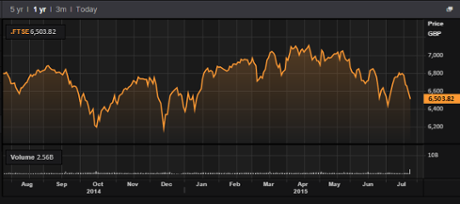
Today’s selloff means the FTSE 100 has lost all its gains this year.
The blue chip index ended 2014 at 6566 points, and rallied to a lifetime high of 7103 points in late April this year
But the Footsie has fallen over 8% since, pulled down by the Greek crisis, speculation of a US interest rate rise, fears that China’s economy is slowing, and the drop in commodities prices.
Update: As that graph shows, this is the second time this year that the index has fallen below the break-even mark
Updated
Europe’s stock markets have continued to slide today, as China’s stock market rout overnight reverberates through global trading floor.
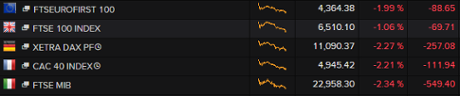
European shares heading for biggest five-day drop of 2015 http://t.co/wKdOgCa7IR pic.twitter.com/K1UOYgVpWT
— Bloomberg Markets (@markets) July 27, 2015
I can’t quite believe this is true. But there are reports that Greece’s creditors are being rebadged as the Quadriga, to reflect the fact that the ESM is joining the Troika.
In classical times, the quadriga was a four-horse chariot used for racing -- or even driven by the goddess Nike.
You may have seen one in Berlin....
Quadriga might turn out to be an imperfect name for the institutions. Because you know who else has a Quadriga? pic.twitter.com/8r4OuObj5g
— Mathieu von Rohr (@mathieuvonrohr) July 27, 2015
I'm backing Quatro
— Danny Kemp (@dannyctkemp) July 27, 2015
Greece’s opposition parties were quick to criticise Varoufakis over his work on a parallel payment system, and are seeking answers.
The Financial Times has the details:
The centre-right opposition New Democracy party demanded that the government “come up with convincing answers for the Greek people . . . to shed light on this dark narrative”.
To Potami, a small centre-left party, said the former finance minister’s plan was “reminiscent of a bad thriller”.
Varoufakis plot sparks opposition fury http://t.co/aszubxvosq
— FT World News (@ftworldnews) July 27, 2015
Slovakia's finance minister savages Varoufakis's 'two-faced' behaviour
Having endured endless eurozone meetings over the Greek crisis this year, Slovakia’s finance minister is unamused by today’s disclosures from Yanis Varoufakis:
Unveiled plans by #Greece ex-FinMin Varoufakis to return to drachma during ongoing talks with us show how unpredictable he was as a partner
— Peter Kažimír (@KazimirPeter) July 27, 2015
We need to make sure that such two-faced 'games' will be avoided when debating&drafting the third bailout package for #Greece #ECB #eurozone
— Peter Kažimír (@KazimirPeter) July 27, 2015
Updated
And here’s the official statement from James Galbraith, the US economist who worked with Varoufakis on his continency plan:
I spent five months from early February through early July in close association with the Greek Finance Minister, Yanis Varoufakis, and was part of the Working Group that did contingency planning for potential attempts to asphyxiate the Greek government, including aggressive moves to force the country out of the euro.
Since a great deal of public confusion has now arisen over this effort, the following should be stated:
- At no time was the Working Group engaged in advocating exit or any policy choice. The job was strictly to study the operational issues that would arise if Greece were forced to issue scrip or if it were forced out of the euro.
- The group operated under the axiom that the government was fully committed to negotiating within the euro, and took extreme precautions not to jeopardize that commitment by allowing any hint of our work to reach the outside world. There were no leaks whatever, until the existence of the group was disclosed by the former Finance Minister himself, in response to criticism that his ministry had made no contingency plans when it was known that forces within the Eurozone were planning the forced exit of Greece.
- The existence of preliminary plans could not play any role in the Greek negotiating position, since their circulation (before there was a need to implement them) would have destabilized government policy.
- Apart from one late, inconclusive telephone conversation between MP Costas Lapavitsas and myself, we had no coordination with the Left Platform and our Working Group’s ideas had little in common with theirs.
- Our work ended for practical purposes in early May, with a long memorandum outlining major issues and scenaria that we studied.
- My work in this area was unpaid and unofficial, based on my friendship with Yanis Varoufakis and on my respect for the cause of the Greek people.
Point 4 appears to refer to the revelation that Syriza’s Left Platform hatched a plan to return to the drachma, after last month’s Euro summit where the bailout plan was agreed.
Varoufakis issues statement defending contingency plan

Yanis Varoufakis has just released a statement defending his work creating a parallel payment system during his time as finance minister.
The statement, from “the Office of Yanis Varoufakis”, insists that he was fully authorised to carry out the work.
It also criticises the media for their “far-fetched” articles, and denies the claim that he ever planned to hijack all taxpayers tax file numbers [which he does not actually say on the leaked Tapes].
Here’s the full statement:
During the Greek government’s negotiations with the Eurogroup, Minister Varoufakis oversaw a Working Group with a remit to prepare contingency plans against the creditors’ efforts to undermine the Greek government and in view of forces at work within the Eurozone to have Greece expelled from the euro. The Working Group was convened by the Minister, at the behest of the Prime Minister, and was coordinated by Professor James K. Galbraith [who has issued his own statement]
It is worth nothing (he means noting) that, prior to Mr Varoufakis’ comfirmation of the existence of the said Working Group, the Minister was criticized widely for having neglected to make such contingency plans. The Bank of Greece, the ECB, treasuries of EU member-states, banks, international organisations etc. had all drawn up such plans since 2012. Greece’s Ministry of Finance would have been remiss had it made no attempt to draw up contingency plans.
Ever since Mr Varoufakis announced the existence of the Working Group, the media have indulged in far-fetched articles that damage the quality of public debate. The Ministry of Finance’s Working Group worked exclusively within the framework of government policy and its recommendations were always aimed at serving the public interest, at respecting the laws of the land, and at keeping the country in the Eurozone.
Regarding the recent article by “Kathimerini” newspaper entitled “Plan B involving highjacking and hacking”, Kathimerini’s failure to contact Mr Varoufakis for comment and its reporter’s erroneous references to “highjacking tax file numbers of all taxpayers” sowed confusion and contributed to the media-induced disinformation. The article refers to the Ministry’s project as described by Minister Varoufakis in his 6th July farewell speech during the handover ceremony in the Ministry of Finance. In that speech Mr Varoufakis clearly stated: “The General Secretariat of Information Systems had begun investigating means by which Taxisnet (Nb. the Ministry’s Tax Web Interface) could become something more than it currently is, to become a payments system for third parties, a system that improves efficiency and minimises the arrears of the state to citizens and vice versa.”
That project was not part of the Working Group’s remit, was presented in full by Minister Varoufakis to Cabinet, and should, in Minister Varoufakis’ view, be implemented independently of the negotiations with Greece’s creditors, as it will contribute considerable efficiency gains in transactions between the state and taxpayers as well as between taxpayers.
In conclusion, during the five months of negotiations that gripped Europe and changed the debate throughout the Continent, the Ministry of Finance did everything possible to serve the public interest against many odds. The current media campaign to besmirch these efforts will fail to dent the legacy of a crucial five month struggle for democracy and common sense.
Statement by Yanis Varoufakis on the FinMin’s Plan B Working Group & the parallel payment system http://t.co/9JTWNyq8JK
— Yanis Varoufakis (@yanisvaroufakis) July 27, 2015
Updated
Another point about the Varoufakis Tapes -- this call took place under Chatham House rules, which means that the details can’t be reported by the participants.
However, Greek newspaper Kathimerini published large details of the transcript yesterday, prompting OMFIF to released the full recording today. It’s not clear how Kathimerini got hold of the tapes.

Greek insiders: Alexis Tsipras considering November 8 election

Over in Athens prime minister Alexis Tsipras marks six months in office today with his party divided and almost every promise he ever made overturned.
Our correspondent Helena Smith reports
Alexis Tsipras’ political dexterity will be tested again this afternoon when he presides over a critical meeting of his Syriza’s party’s political secretariat. It will not be easy. The coalition of the radical left (if that is what Syriza can now be called) is in shellshock over Tsipras’ embrace of the neo-liberal policies he had once so stridently opposed, in return for talks on a third bailout.`
The argument that no plausible alternative exists is not washing with hardliners who will be in attendance. Indicative of that stance, the Left Platform’s website, ISKRA (so named for the paper set up in exile by Vladimir Lenin) has declared “the battle continues” with hardliners drawing their line in the sand.
Tellingly, at the same time that Tsipras attempts to win over his doubting comrades, the Left Platform’s leader Panagiotis Lafazanis will be addressing supporters at a separate rally (in celebration of ISKRA’s fifth anniversary) under the banner:
“No has not been defeated. We are continuing.”
Tsipras is in effect overseeing a minority government, given that a third of his MPs are no longer prepared to endorse EU-IMF mandated reforms. Pressure is now building on Syriza’s dissidents to step down.
Over the weekend, several of his closest allies, including minister of state Nikos Pappas, threw down the gauntlet saying the time had come for the rebels to either back the government or leave. Speaking on behalf of the hardliners, Lafazanis has repeatedly ruled out resigning saying that it is they who have remained faithful to the party’s pre-electoral commitments.
“In no way do I seek the break-up of Syriza, I am a founding member of Syriza,” Lafazanis told media outlets on Sunday.
“What I want is for the new memorandum [outlining the tough terms of further financial assistance] to be cancelled and for Syriza to not be transformed into a memorandum force like New Democracy and Pasok. I will support the government in the implementation of the radical programme with which it was elected.”
Tsipras is expected this afternoon to ram home the message that with Greece’s exit from the euro zone presaging assured catastrophe, a third bailout is the only option. “We will demand a central committee party convention,” said one well-placed source who now aligns with the hardliners.
“Tsipras won’t want that because the central committee [Syriza’s governing body] is against the measures but that is what we will do.”
Insiders say Tsipras has a road-map of sorts – one that starts with the new loan agreement being negotiated by August 18, Syriza calling an urgent party conference (which would deal with dissidents) at the end of September and elections being held on November 8.
A new election could give young leader a new mandate to enforce controversial reforms.
But much, in the meantime, will rest on the prime minister retaining control of his party. If he loses it altogether anything could happen.
One important point on the Varoufakis Tapes - this call with top fund managers at OMFIF took place on 16 July.
That’s 10 days after he resigned, and three days after EU summit where Greece caved in and accepted unprecedented and sweeping austerity measures, easing fears that it could leave the single currency.
Updated
The IMF has confirmed that technical talks over Greece’s new bailout are getting underway.
A Fund spokesperson says:
“A technical team will start work in Athens on Monday to take stock of recent developments.”
The mission chiefs, though, may not arrive for several days. Reuters reports that they are due “by Friday”.
Heads-up: Paul Mason, Channel 4’s economics editor, is ready to take your questions:
My web chat at the Guardian about my book Postcapitalism starting at 1300 bst http://t.co/XkCERlmi4T
— Paul Mason (@paulmasonnews) July 27, 2015
Yanis Varoufakis's plan to replace the euro
FastFT are also transcribing the Varoufakis tapes - here’s the section where the former finance minister told a group of hedge fund manager about his plan for a parallel banking system:
We did have a plan B but the problem was to go from the five people who were planning it to the thousands that would have to implement it.
The prime minister, before he became prime minister, had given me the green light to come up with a Plan B. I assembled a very able team, a small small team under wraps for obvious reasons. The difficulty was going from the five people who planned it to the 1000 that would be implementing it. For that i had to receive another authorization that never came.
There is the website of the tax office where citizens go and use their tax file number and transfer monies to their tax. We were planning to create surreptitiously reserve accounts attached to every tax file number without telling anyone. At the touch of the button to allow us to give Pin numbers to tax payers so when the state owed, say, €1m to a pharmaceutical company, we could create a digital transfer, and a Pin.
That would have created a parallel system so while the banks were shut thanks to the ECB’s aggressive action, it would give us some breathing space. This was very well developed.
We could have extended it using apps on smart phones and it could have become a functioning parallel system. it would have been euro denominated but it could have been transferred to drachma at the touch of a button.
So as explained earlier, Varoufakis took matters into his own hands:
We decided to hack into my minister’s own software programme to copy the code of the tax system’s website onto a large computer in his office so he could work out how to design this parallel payments system. We were ready to get the green light from the prime minister when the banks closed.
Yanis Varoufakis, the childhood friend, and smart phone apps. The covert plan to replace the euro: http://t.co/Prd41AcDCq
— fastFT (@fastFT) July 27, 2015
Updated
Varoufakis: French are terrified of German demands
Having explained his secret plan for a parallel banking system to top financiers, Yanis Varoufakis went on to warn that the French government is “terrified” of the austerity demanded by Germany.
He explained that Paris is playing for time, in the face of Berlin’s push for closer fiscal union.
The French are terrified. They are terrified because they know that if they’re going to shrink their budget deficit to the levels that Berlin demands, the Parisan government will certainly fall.
There is no way that they can politically handle the kind of austerity that is demanded by Berlin.
Varoufakis then explains how Wolfgang Schäuble has outlined to him his plan to reshape the eurozone, to add more political union to make it sustainable.
And, Varoufakis added, Schäuble believes that a Grexit will equip him with:
sufficient terrorising power to impose on Paris what the French are resisting, which is a degree of budget-making powers from Paris to Brussels.
Varoufakis' tapes suggest that #Schaeuble wanted #Grexit in order to enforce more Eurozone-level discipline and policy-making.
— Carsten Brzeski (@carstenbrzeski) July 27, 2015
'I'll just deny it'. What on earth was Varoufakis doing saying these things, to these guys? http://t.co/Aba4UsTz7n
— Danny Kemp (@dannyctkemp) July 27, 2015
'You can't tell anyone that... Even if they do, I'll deny I said it' - Yanis Varoufakis #ToxicMedia
— Mike Bird (@Birdyword) July 27, 2015
Varoufakis: creditors are split over Greece
This recording of Yanis Varoufakis briefing top financiers about the Greek crisis is unmissable.
Around 12 minutes in, he talks about the major tussle between the European Stability Mechanism, European Commission, IMF and German finance minister Wolfgang Schäuble.
There is a complete lack of coordination between the creditors, Varoufakis tells former UK chancellor Norman Lamont (and others on the call).
Wolfgang has quite clearly said to me that he wants Grexit. He clearly believes that this extend and pretend is unacceptable. This is the one point where we see eye to eye - I agree with him, but for completely different reasons.
The IMF does not want an agreement because it does not want to violate its charter again to provide new loans to a country whose debt is unviable.
The Commission really wants the deal to go ahead, Merkel wants this deal to go ahead.
Updated
Varoufakis's Plan B tapes released.

Who’d like to hear Yanis Varoufakis, Greece’s former finance minister, telling fund managers about his secret plan to create a parallel payment system?
Well, it’s your lucky day. The Official Monetary and Financial Institutions Forum has just released the recording of Varoufakis explaining how he was authorised to create Plan B in case negotiations failed.
With approval from @yanisvaroufakis, the 16 July telephone recording has been published on the @OMFIF website. http://t.co/USsF13Tl8Z
— OMFIF (@OMFIF) July 27, 2015
As Kathimerini first reported yesterday, Varoufakis explains how he engaged a childhood friend to help, but found that “the General Secretary of Public Revenues within my ministry is controlled fully and directly by the troika.”
It was not under control of my ministry, of me as minister, it was controlled by Brussels. The general secretary is appointed effectively through a process which is troika-controlled and the whole mechanism within. It’s like the Inland Revenue in the UK being controlled by Brussels.
So.... “we decided to hack into my ministry’s own software program”....to be ready for when Greece’s banks were closed by the European Central Bank.
Varoufakis cautioned his listeners to keep this to themselves, adding:
And even if they do [tell anyone]... I will deny I said it.
Good luck with that....
Varoufakis also warns that the current bailout deal is not viable, and claims that German finance minister Wolfgang Schäuble is “hell-bent” on engineering Grexit.
Updated
Greece's quiet bank run continued in June
Analysts have long suspected that Greece’s banking sector suffered a large drop in deposits last month, and now we have the evidence.
New data from the ECB has shown that Greek savers pulled another €8bn out of their accounts as the country staggered towards the end of its old bailout.
That’s a sharp acceleration on the €3.7bn taken out in May, and means deposits are at a new 11-year low.
CHART: New official data show #Greece deposits down by 8bn€ in June. Total bleeding in 1st half of 2015: 40bn€ gone. pic.twitter.com/YwUjj3ztZl
— Maxime Sbaihi (@MxSba) July 27, 2015
Updated
Speculation is growing that the Greek stock market might reopen on Tuesday, more than four weeks after capital controls were imposed:
Athens Exchange expected to open Tuesday with restrictions & @ekathimerini sources indicate restrictions could be lifted after about a week
— RANsquawk (@RANsquawk) July 27, 2015
The falling oil price has helped to drag Bloomberg’s commodity price index to a new 13-year low:
#Commodities and #oil rout deepens, pushing the Bloomberg Commodity Index down 60% from 2008 peak (fresh 13-year low) pic.twitter.com/DUaKdQ49SY
— Javier Blas (@JavierBlas2) July 27, 2015
Oil hits three-month low

The oil price has been hit by fears over the global economy today.
Brent crude is down 0.5% to $54.27 per barrel, the lowest since early April.
Updated
Today’s selloff will force the Chinese government to take new measures to prop up its stock market, according to analysts at Citi:
Citi on #China rout: The calm sentiment of the bounce has been broken. So govt agencies will have to step in again. pic.twitter.com/6u8kb6nSHU
— Holger Zschaepitz (@Schuldensuehner) July 27, 2015
The Chinese market rout comes as investors ponder whether the US Federal Reserve will raise interest rates in September, or hold on until perhaps December, points out Kit Juckes of Société Générale:
It’s taken a single day’s trading to wipe out two weeks’ worth of bounce in the Shanghai composite equity index.
We were ‘supposed’ be be focusing on the US and the ‘will they/won’t they hike in September’ debate by now, but China/commodities have yet again muddied the waters.
Chinese investors are nursing some very heavy losses today, and must also be fearing more turmoil when markets reopen on Tuesday.
Reuters reports that 1,500 individual shares were suspended after crashing 10% - the maximum allowed – fuelling fears that a a full-blown crash is building.
#China crash: More than 1,500 shares listed in Shanghai and Shenzhen dived by the daily limit. http://t.co/gapGk0CYGo
— Pedro da Costa (@pdacosta) July 27, 2015
Very few stock markets have avoided being dragged down today, either in Asia or Europe.
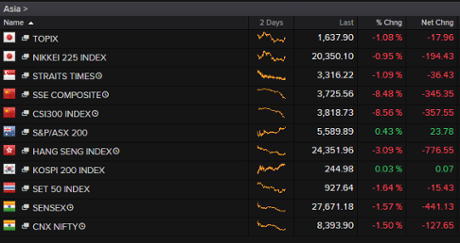
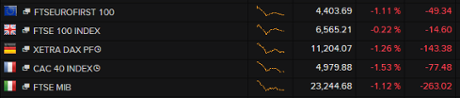
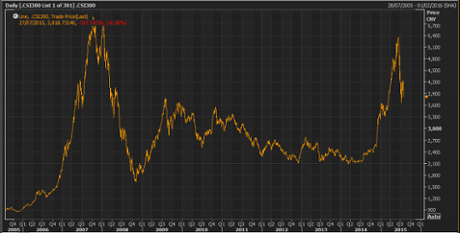
Amateur chartists in the audience may see some similarities between today’s slump and the events of 2007 and 2008:
Updated
Here’s confirmation that China’s main stock markets just suffered its biggest selloff since the dawn of the credit crunch over eight years ago.
How today's session on the Shanghai market rollercoaster compares with other one-day drops. http://t.co/VqPFn9JYER pic.twitter.com/4YZ7Dm9rpT
— fastFT (@fastFT) July 27, 2015
German business confidence beats forecasts
Germany appears to have taken the Greek debt crisis in its stride, with business confidence rising this month.
The IFO thinktank’s monthly business climate survey ticked up to 108 this month, up from 107.5 in June. Firms reported an improvement in current conditions, and are slightly more optimistic about future prospects.
It appears that the underlying strength of Europe’s largest economy helped it to defy the turmoil in Athens in recent months.
Carsten Brzeski, ING economists, says:
Even if the doses has been reduced somewhat, the German economy is still on steroids. Despite some recent rebounds, the weak euro exchange rate and low energy prices are still artificially extending the last phase of a very positive reform-growth cycle.
Forget about Greece? German Ifo increases in July. A quick take. http://t.co/gz7cgDbskm
— Carsten Brzeski (@carstenbrzeski) July 27, 2015
Greek jitters weigh on European markets
Europe’s stock markets are also suffering a bout of Greek worries, after talks with creditors had a false start on Friday (but should start today or tomorrow).
Sunday’s revelations about plans for a secret parallel payment system haven’t calmed nerves either, as Connor Campbell of SpreadEX explains:
The Eurozone indices weren’t helped by the weekend’s news that Yanis Varoufakis, at the behest of Tsipras, spent months working on a parallel banking system that, for all intents and purposes, would have dealt with an abrupt switch from euro to drachma; an unwelcome reminder as negotiations begin of the Grexit-stakes that lie at the heart of the saga.
Here’s our take on the story:
Ambrose Evans-Pritchard of the Telegraph has spoken with Varoufakis, who confirmed the story but denied that he’d been plotting Greece’s exit from the eurozone.
Varoufakis expects treason indictment. My two drachma on Plan B leak, his reaction. Greek crisis will go on and on http://t.co/a1VTNW6ZtR
— A Evans-Pritchard (@AmbroseEP) July 26, 2015
Updated
Europe’s stock markets have followed China’s lead, with the French CAC and German DAX both falling over 1%.
The FTSE 100 is only down 0.35%, though, with mining stocks recovering after Friday’s rout.
Here’s another reason for alarm: the amount of capital leaving China has accelerated sharply in recent months.
China's capital outflows are accelerating at an alarming rate. Chart via Goldman: pic.twitter.com/LUQpjUcnnl
— Jamie McGeever (@ReutersJamie) July 27, 2015
That indicates companies are investing less, suggesting economic growth is faltering.
Updated
Chinese share prices were a sea of green today (red, being a lucky colour, is used for rising prices):

Andrew MacFarlane of BNP Paribas says today’s slump shows “the vulnerability of the Chinese market despite the recent government support.”
Today’s crash comes three weeks after China took dramatic action to stem falling prices.
In a remarkable intervention, Beijing banned large shareholders from selling stakes, ordered state-run institutions to buy shares and letting many companies halt trading in their shares.
My colleague Nils Pratley covered it here:
In the short term, China’s actions did help the Shanghai stock market to recover:
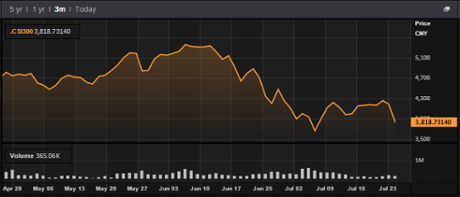
But that sticking-plaster appears to be coming off. On Friday, it emerged that the International Monetary Fund was pushing China to unwind its intervention, so that market forces could set the true price of shares. That may now be underway...
Analysts are struggling to explain exactly why the Chinese stock markets suffered such a slump.
Reuters attributes it to “profit-taking, concerns over economic health and fears of an end to Beijing’s inclination toward looser monetary policies.”
Many stocks on the Shanghai stock market were suspended after plunging 10%, which is the maximum allowed in one day.
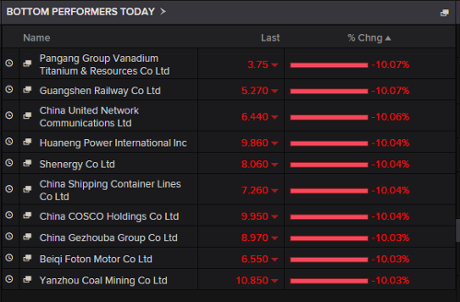
Only four stocks rose, out of 300.
Shanghai stock market plunges by 8.5%
The Chinese stock market has suffered its worst one-day fall in eight years, after a day of panic selling.
The benchmark Shanghai composite index just crashed by 8.5%, which is the biggest one-day fall since 2007, according to Bloomberg data.
The slump was triggered by worries over the Chinese economy, with a new survey showing that profit at China’s industrial firms fell by 0.3% last month.
But the scale of the rout suggests investors are also losing faith in recent efforts by the Beijing government to prop up share prices.
Updated
Introduction: China woes mount, as creditors return to Greece
Good morning, and welcome to our rolling coverage of the financial markets, the world economy, the eurozone and business.
With Greece temporarily on the back-burner (but not for long), China has elbowed its way to the forefront of investors’ attention, on fears that its economy is suffering a serious slowdown.
And the Chinese stock markets is suffering a bad day. The benchmark Shanghai index is has slumped by around 7% in late trading, in another rush of late selling.
That’s likely to hit Europe’s stock markets this morning too.
Also coming up today
Negotiators from Greece’s creditors are due to arrive in Athens today formally begin talks on a €86bn bailout, after talks were aborted on Friday due to a row over access to ministries - and which hotel would house the Troika.
We find out how much damage the Greek crisis has caused to Germany’s economy, when the IFO index is released at 9am.
And Greeks are also digesting the news that former finance minister Yanis Varoufakis spent months on a plan to develop a parallel banking system while in office.
Sunday’s edition of the Greek newspaper Kathimerini has the story.
Varoufakis claims had approval to plan parallel banking system
Here’s a flavour:
Former Finance Minister Yanis Varoufakis has claimed that he was authorized by Alexis Tsipras last December to look into a parallel payment system that would operate using wiretapped tax registration numbers (AFMs) and could eventually work as a parallel banking system, Kathimerini has learned.
In a teleconference call with members of international hedge funds that was allegedly coordinated by former British Chancellor of the Exchequer Norman Lamont, Varoufakis claimed to have been given the okay by Tsipras last December – a month before general elections that brought SYRIZA to power – to plan a payment system that could operate in euros but which could be changed into drachmas “overnight” if necessary, Kathimerini understands.
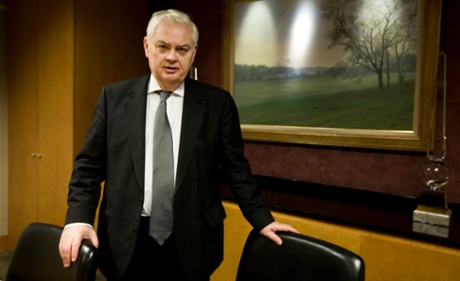
Lamont’s involvement is the icing on a particularly eye-catching cake.
I’ll be tracking all the main events through the day.....
Updated