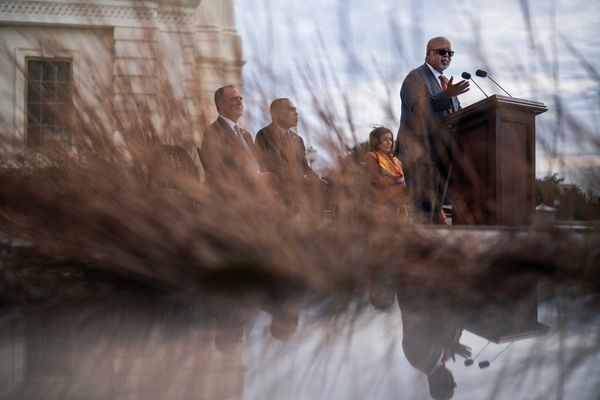
Some of Australia’s most powerful business leaders have made a rare public appearance together, holding a joint press conference in Canberra to pressure senators to pass the Turnbull government’s tax cuts.
Orchestrated by the Business Council of Australia, the chief executives of Qantas (Alan Joyce), the Commonwealth Bank (Ian Narev) and Wesfarmers (Richard Goyder) stood with the managing directors of BHP Billiton (Andrew MacKenzie) and Energy Australia (Catherine Tanna, a current Reserve Bank board member) to remind the Senate that the government was committed to its entire tax cut package and it deserved their support.
“This is the centrepiece of [the Coalition’s] economic plan that they took to an election and won,” the Business Council’s CEO, Jennifer Westacott, said on Wednesday. “The prime minister’s statement last week was a very important statement for leadership in this country, that he sticks to that plan and he is totally committed to it.”
The remaining members of the press conference included the Business Council’s president, Grant King (a former chief executive of Origin Energy), the Rio Tinto executive Joanne Farrell and the JBS CEO, Brent Eastwood.
The Turnbull government has less than 36 hours to convince the Senate to pass its tax package before parliament rises for a five-week break.
When parliament resumes on 9 May, the government delivers its budget.
The government needs the Senate to support its tax package this week so it can include the package in its budget but it does not have the numbers.
The Greens oppose the $48bn tax cut plan outright, Labor is only supporting tax cuts for businesses with a turnover of $2m, independent senators Derryn Hinch and Jacqui Lambie support tax cuts for businesses with $10m turnover and One Nation is supporting tax cuts for businesses with $50m turnover.
The Nick Xenophon Team says it supports tax cuts for business with $10m turnover, with the option of negotiating higher if the government supports an emissions intensity scheme.
But negotiations with NXT hit a hurdle on Wednesday because Xenophon had to return to Adelaide for a family funeral.
The Business Council, which represents the interests of the 100-biggest companies with operations in Australia, hoped Xenophon would agree to tax cuts for business with annual turnover higher than $10m.
“I think Senator Xenophon understands the importance of business investment in sectors like manufacturing,” Westacott said. “But I can say this, you won’t get investment in South Australia if you can’t get investment into Australia.
“He also says he wants energy fixed in advance but you can’t fix energy without large investment and you can’t get large investment if we haven’t got a competitive environment to invest in.”
King said he was disappointed with the Labor party.
“The leadership of the Labor party at the moment, when they were in government, gave some of the most eloquent arguments for a reduction in the tax rate,” he said.
“Something has changed their mind. There may be good reason but I hope it’s not just because it’s difficult to prosecute the argument. That is not an acceptable reason.”
Mackenzie said the business community strongly believed in paying its fair rate of tax but it also cared about having a taxation system “that promotes the economic growth and wellbeing of the country”.
“And Australia is not attracting its fair share of international investment in capital and we need to do something about that,” he said. “We’re about ensuring that Australia is competitive for international capital. It’s not at the moment.
“Without the change that the government is proposing it will remain uncompetitive and the economy will suffer ... for decades to come.”




.jpg?w=600)