It was like the morning after the big night before on Monday as federal parliament reviewed some of its more extreme agitated responses to the terrorist threat during the last sitting period in early October.
We learned that the parliament house threat level has not in fact increased since 2010 and remains at medium – despite the increase in the national threat level from medium to high. This despite the prime minister’s September warning that “chatter” involving the building had been picked up “between Australians in Syria and Iraq and their supporters here in Australia”.
And we learned the so-called “burqa ban”, and all the terrible signals it sent, and all the damage it did, was prompted by an anonymous tipster called “Media Manipulator” dialling the 2UE whisper line with a rumour about a protest, which was heard by Channel Nine, whose film crew passed it on the the Australian federal police.
Seriously, this whole furore started on 2UE when the host said: “We’ve got one here from Media Manipulator saying a lobby group and at least one TV station are considering sending someone in a full burqa into parliament house in Canberra today.”
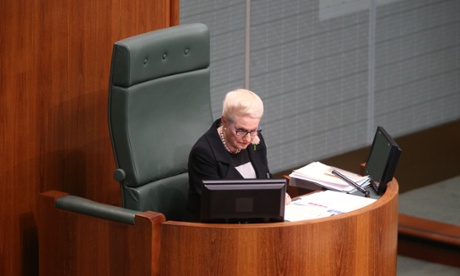
It doesn’t seem to have been the AFP or the parliamentary security services who let this rumour of what sounds more like a stunt than an actual protest go to their heads, but rather the speaker, Bronwyn Bishop, and the president of the Senate, Stephen Parry, who personally took the decision to segregate people wearing face coverings from the open public galleries based on the rumour.
They made the call, according to the most senior parliamentary official, on what was probably a “supposition” that the rumoured protest could turn into some kind of parliamentary disruption.
The ban on facial coverings in the open public galleries in the parliamentary chambers was quietly shelved via communique before the Monday’s proceedings even began. Anyone wearing facial coverings will now be identified at the front entrance, and can then move around like every other member of the public once inside.
Parry explained there had been a fear blokes could have entered the building in burqas, and that unruly but unidentifiable protesters could not then be effectively banned.
“There’s no point in us banning people if they can come back into the building disguised … we have now eliminated that prospect … so we can now allow people to wear facial coverings once they have been identified at the first point of contact coming into the building,” Parry explained.
Officials were also a bit sheepish about a briefing for MPs, senators and their staff where it was suggested workers keep their blinds drawn, vary the route they took to and from work and vary their exercise schedule as security precautions.
Mills said these had been general suggestions by an AFP officer which she had herself not followed. Parry said he would “describe that advice as over-cautious”.
It seems high time to take an aspirin and make sure decisions and advice are based on facts.