Closing summary: Burberry gloom doesn't dampen City spirits
The European markets have just closed, so let’s recap.
Shares in luxury fashion group Burberry have closed down 8.2% after the company warned that demand was slowing, led by falling sales in Asia.

The selloff wiped more than half a billion pounds off Burberry’s market capitalisation, sending the company to the bottom of the FTSE 100.
Burberry is planning to cut remuneration, starting at the top, reports Bloomberg tonight:
Burberry Group CEO Christopher Bailey will get a pay cut along with other employees after the U.K. trenchcoat maker forecast a second year of declining profit because of weakness in Asia.
The company will cut bonuses and long-term share incentives by as much as 30 million pounds ($46.5 million), Chief Financial Officer Carol Fairweather said on a conference call Thursday. Burberry also plans to trim discretionary costs like travel by 20 million pounds this financial year in response to plummeting sales in China.
Burberry to cut bonuses and share payouts by up to £30 million ($46 million) on weaker sales http://t.co/1IVfkQisnL pic.twitter.com/E7SbkYgQNi
— Bloomberg Business (@business) October 15, 2015
The blue chip FTSE 100 index jumped over 1%, though, to finish at 6338 points.
Tony Cross of Trustnet Direct sums up the day:
It’s been a day of decent gains for London’s FTSE-100 with the index adding around 1% by the close. The vast majority of stocks are sitting in positive territory but with concerns continuing to build over the Chinese economy, it’s mining stocks that have been left wearing much of the losses. The biggest faller however was Burberry and with some suggestions that China accounts for as much as 40% of sales, that cautionary note about difficult conditions in Asia Pacific in this morning’s results has rattled the high end fashion retailer.
On a brighter note, ARM Holdings is finding support as a result of read-across from sector peers, whilst results from Unilever have helped prop up the consumer goods play with Europe’s hot summer boosting ice cream sales.
European Closing Prices: #FTSE 6338.67 +1.10% #DAX 10064.8 +1.50% #CAC 4675.29 +1.44% #MIB 22217.69 +1.74% #IBEX 10101.7 +0.64%
— IGSquawk (@IGSquawk) October 15, 2015
Over in New York, Goldman Sachs has missed Wall Street forecasts for the first time since 2011. Shares in the investment back are up around 1% at pixel time, though, as traders anticipate little action on US interest rates soon.
The latest US inflation report, showing the cost of living was unchanged year-on-year, doesn’t give the Fed an excuse to raise rates right now....
....especially with another row over the US debt ceiling looming.
Pressure is mounting on the Brazilian government after Fitch downgraded its credit rating, to the brink of junk status.
That’s all for today, I think. Thanks, and goodnight. GW

Over in Italy, the government has approved a growth-friendly, expansionary budget in an attempt to get the country’s economy moving faster.
My colleague Phillip Inman explains:
The Italian government has approved a series of business-friendly tax cuts and measures to boost consumer spending that could put Rome in breach of austerity budget rules set by Brussels.
Prime minister Matteo Renzi said a reduction in the main corporation tax rate and cuts to levies on agricultural and industrial equipment were aimed supporting the country’s fragile recovery.
Putting forward a budget for next year on the last day of a deadline set by the EU commission, Renzi said €5bn worth of tax cuts would include the abolition of a wealth tax on the main residence of all Italians, worth around €200 a year to most homeowners.
The 40-year-old prime minister said the package would make Italy become “a simpler and fairer country,” adding: “This year not only are the taxes not going up but they are coming down,”
The proposals will now go before parliament, where it must be approved by the end of the year.
Greece’s biggest thinktank, IOBE, has a stern warning for the country’s politicians today - this is your last chance to fix the crisis.
IOBE urged MPs to stick to Greece’s bailout plan and implement the economic reforms it needs, as it predicted a less severe recession than feared.
The Kathimerini newspaper explains:
In its quarterly report, IOBE said the economy would shrink by 1.5 to 2.0 percent this year, less than forecast by Greece’s international lenders.
It also said the economy could return to growth in the second half of 2016 provided the government takes steps urgently to shore up the battered banking sector, reform Greece’s ailing pension system and make the country more business-friendly.
Updated
There are fresh rumblings of discontent in Greece as the Athens parliament prepares to vote on new austerity measures on Friday.
Around 200 demonstrators from the communist PAME union blocked the Labour Ministry today, carrying a banner reading “hands off the social security system”


Updated
Newsflash from Volkswagen: the German carmaker is to recall 8.5 million cars across Europe to address the emissions scandal.
This follows Germany’s rejection of a voluntary recall this morning.
This will include the 1.2m cars sold in the UK.
There’s no word yet on when the recall will take place.
BREAKING: Volkswagen says it will recall about 8.5M vehicles in 28 EU markets, actively informing customers.
— CNBC Now (@CNBCnow) October 15, 2015
The Brazilian currency, the real, has shed 1% against the US dollar since Fitch downgraded Brazil’s rating.
Fitch downgrades Brazil

Brazil has just been downgraded to the brink of junk status by Fitch.
Fitch has cut its rating on Brazil by one notch to BBB-, which is the lowest ‘investment grade level. It also left Brazil with a negative outlook, suggesting it could be downgraded again.
Brazil is currently in recession, hit by the emerging market slowdown, falling commodity prices, a weak currency, and political scandals. And Fitch fears that its government will struggle to get its debts under control. It predicts that the deficit could hit 9% of GDP this year, and remain above 6% in the next two years.
The statement says:
The rating downgrade reflects Brazil’s rising government debt burden, increased challenges to fiscal consolidation and a worsening economic growth backdrop. The difficult political environment is hampering progress on the government’s legislative agenda and creating a negative feedback loop for the broader economy.
The Negative Outlook reflects Fitch’s view that economic and fiscal underperformance is likely to persist while political uncertainty could continue weighing on broader confidence, delay a turnaround in investment and growth, and increase risks for the medium term fiscal consolidation needed for debt stabilization.
There’s nothing here to surprise astute City investors:
Fitch: Brazil is a deteriorating Credit. Also, water wet.
— Burnett Tabrum (@BTabrum) October 15, 2015
@CVecchioFX S&P is already sub investment grade. Moody's already at BBB- equiv. Fitch is just catching up
— econhedge (@econhedge) October 15, 2015
Updated
The FT’s Robin Wigglesworth has helpfully tweeted Jack Lew’s warning about the debt ceiling:
Um, Lew has moved forward the US Treasury debt ceiling drop-dead date forward to Nov 3..... pic.twitter.com/65SMkxbY8i
— Robin Wigglesworth (@RobinWigg) October 15, 2015
Burberry’s warning of falling luxury goods demand has hit sentiment across the sector, and follows similar problems at LVMH.
My colleague Julie Kollewe explains:
Burberry has blamed a sharp slowdown in sales on a tough market for luxury goods, in particular weaker demand from Chinese customers.
Shares in the FTSE 100 company, known for its British-made trench coats and cashmere scarves, tumbled as much as 12.6% on the news, to £12.36. This is a three-year low, and wiped £800m from Burberry’s stock market value. Shares across the luxury sector were hit, including Prada, Hermes, Kering and Salvatore Ferragamo.
Burberry joins LVMH, which earlier this week became the first major luxury goods company to warn that the stock market collapse in China over the summer had affected sales, particularly at its flagship Louis Vuitton brand.
Here’s her full take:
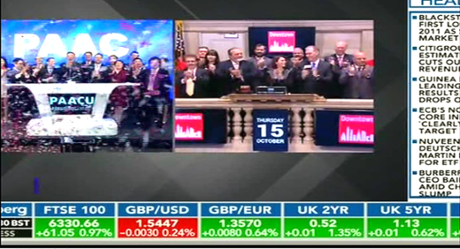
The opening bell has been rung on Wall Street, and the main indices are creeping higher.
Investors are digesting the fall in profits at Goldman Sachs, the drop in the annual US inflation rate to zero, and Burberry’s China warning. The feeling in New York, as in Europe, is that there’s little pressure on the Fed to raise borrowing costs.
The Dow Jones industrial average is up 0.35% in early trading, while the tech-heavy Nasdaq has gained 0.7%.
Updated
The dreaded US debt ceiling is creeping back onto the agenda.
Treasury Secretary Jack Lew has just warned that America will run out of spending wriggle room on November 3rd, two days earlier than expected.
So if Congress doesn’t agree to raise the limit by then, we could face a repeat of the 2013 crisis. Two years ago, the US experienced a government shutdown after hitting the debt ceiling.
Last time Initial Jobless Claims were this low, Richard Nixon was president. http://t.co/ELW8uAceVQ pic.twitter.com/KVmEkGLq11
— Bloomberg Markets (@markets) October 15, 2015
The number of Americans signing on for new unemployment benefit last week has hit a 42 year low.
Just 255,000 American people filed “initial claims” last week, suggesting that US firms are retaining staff.
Applications for US unemployment benefits drop to 42-year low, per @AP; jobless claims fell to 255,000 in latest week, per @Reuters.
— Micah Grimes (@MicahGrimes) October 15, 2015
America's inflation rate hits zero
The cost of living in America was flat last month, according to new inflation data just released.
The US consumer prices index was unchanged year-on-year in September, with cheaper fuel keeping inflation pegged.
That’s down from the annual inflation rate of 0.2% recorded in August, and the lowest reading in eight months.
On a monthly basis, the CPI fell by 0.2% in September compared to August, due to cheaper gasoline.
It rather vindicates the Federal Reserve’s decision to leave interest rates on hold this month.
Yeah, sure, flat CPI is so much better than -0.1%, even through down from 0.2%. So much closer to a #Fed rate hike. So hawkish
— Mike van Dulken (@Accendo_Mike) October 15, 2015
The report also shows a small rise in ‘core CPI’, which strips out volatile elements from the inflation data. It rose by 0.2% in September, up from 0.1% in August.
Annual core inflation pushed up to 1.9% - suggesting that underlying inflation pressures may be building.
Updated

America’s biggest motorhome maker, Winnebago Industries, has given another warning that some consumers are cutting back.
Profits at Winnebago fell 9% in the last quarter, with customers favouring less expensive models. Sales of Class A models fell by a third, while cheaper B and C class sales rose.
Analysts see Winnebago as a bellweather for high-end consumer spending in America, so this could show some belt-tightening is underway.
A top-of-the-range Winnebago is a serious investment. The class A Grand Tour costs at least $429,082; they do look quite cosy though....

Here’s our early news story on Goldman’s results:
That’s a 51% jump in profits at Citi - a year ago, they made just 88 cents per share in the July-September quarter.
Updated
And here comes Citigroup....and they’ve beaten expectations, with profits of $1.31 per share, against forecasts of $1.28.
EARNINGS ALERT: Citigroup posts earnings of $1.31 a share vs $1.28 expected http://t.co/B7Lyu6G0S4 $C
— CNBC Now (@CNBCnow) October 15, 2015
This is the first time in around four years that Goldman Sachs has missed forecasts, according to the FT:
Goldman posted its first EPS miss since the third quarter of 2011 as trading revenues fell. http://t.co/EdmCCIpMLy $GS
— Adam Samson (@adamsamson) October 15, 2015
Goldman Sachs profits hit by global growth fears.

Wall Street titan Goldman Sachs has missed Wall Street estimates for profits and revenue in the last quarter.
Goldman has reported that it made adjusted earnings of $2.90 per share in the three months to 30 September, a little shy of the $2.91 per share expected.
That’s a big decline on Q3 2014, when Goldman made profits of $4.57 per share.
Revenues came in at $6.86bn, below estimates of $7.12bn.
EARNINGS ALERT: Goldman Sachs Q3 EPS $2.90 vs. $2.91 est; Q3 revs. $6.861B vs. $7.125B est http://t.co/PDznWMkkql
— CNBC Now (@CNBCnow) October 15, 2015
Chief executive Lloyd Blankfein blamed fears over the world economy, telling shareholders that:
“We experienced lower levels of activity and declining asset prices during the quarter, reflecting renewed concerns about global economic growth.
Revenues from “Fixed Income, Currency and Commodities Client Execution” were down by a third, as Goldman’s customers cut back on trading bonds, foreign exchange, metals, oil, etc.
Blankfein remains optimistic, though:
We continue to see strong levels of activity in Investment Banking and growth in Investment Management, and looking ahead, are encouraged by the competitive positioning of our global client franchise. Our focus on serving our clients and improving operating leverage puts us in a strong position to generate superior returns for our shareholders.”
The results are online here.
Updated
It’s nearly time for Goldman Sachs’ results...
Reminder, $GS earnings historically have a tendency to come out 35 minutes past the hour.... watch this space!
— RANsquawk (@RANsquawk) October 15, 2015
Another Volkswagen development - the carmaker has been ordered to recall all its 2.4m vehicles on the road in Germany.
VW has hoped to implement a voluntary recall, in which drivers could have chosen to get the ‘defeat device’ which cheated emissions tests removed. Berlin, though, wants a compulsory recall.
My colleague Graham Ruddick explains:
The decision is likely to mean that all 1.2m vehicles affected by the scandal in the UK will also be formally recalled.

The US stock market is expected to open higher in two and a half hours time, following Europe’s rally this morning.
The Dow Jones industrial average is being called 105 point higher, at 17030, in the futures market.
Jasper Lawler of CMC Markets explains:
US markets look set for a stronger open buoyed by hopes of improved earnings in the banking sector and increased odds of zero percent interest rates for the rest of the year.

Over in parliament, the UK boss of Volkswagen has repeated his apology to customers over the emissions scandal.
Paul Willis also promised to ‘do the right think’ for those affected.
In other news this morning, the Bank of England has issued new details of the push to split retail banking and investment bank arms.
Banks have been warned that they might have to set aside up to £3.3bn of extra capital, but also told that ringfenced divisions could be allowed to pay a dividend to other units.
Analysts reckon that the extra capital hit isn’t too onerous:
one does have to wonder at a prudential rule where the cost of implementation is significantly greater than the additional capital required
— Dan Davies (@dsquareddigest) October 15, 2015
Burberry CFO Carol Fairweather has blamed August’s stock market turmoil for the decline in sales in China:
She told reporters:
“We believe this affected the confidence of and thus demand from luxury consumers, and especially the Chinese customers insome of our key markets,” Fairweather told reporters.”
(Thanks to Reuters for the quote):
Burberry’s sales figures look better if you strip out the falling sales in China, and particularly in Hong Kong where they are down 20%.
Here’s a breakdown of the last six months:
- Double-digit percentage growth in EMEIA* : driven by the travelling luxury customer, particularly in continental Europe [* that’s Europe, the Middle East, India and Africa]
- Low single-digit percentage growth in Americas: uneven demand in the United States, double-digit percentage growth in rest of Americas
- Mid single-digit percentage decline in Asia Pacific: Hong Kong decelerated further in second quarter
David Madden of IG says Burberry shares have “taken a battering this morning”:
Burberry took full advantage of the expanding Chinese middle class over the years, and now those middle-income earners will keep shopping more locally from now on.
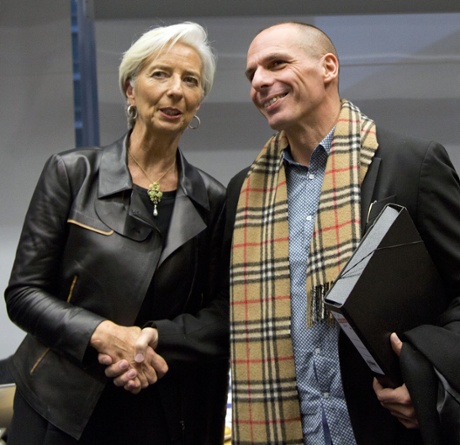
Perhaps Boris Johnson can give Burberry’s sales a lift?

He’s following in the footsteps of another politician, Greece’s Yanis Varoufakis, who wore Burberry to his first meeting of eurozone finance ministers in February:
Updated
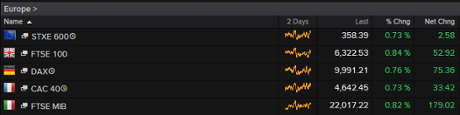
European stock markets are shrugging off Burberry’s disappointing results.
The main indices are all up nearly 1% this morning, as traders anticipate that central bankers will maintain loose monetary policy for a while.
Burberry’s problems do feed into that narrative; weak Chinese consumer spending could put more pressure on the People’s Bank of China to stimulate the economy.
Updated
Burberry CFO Carol Fairweather also insisted that today’s announcement is not a profit warning.
In today’s statement, Burberry does say that earnings would be “broadly in line with the average of those analysts who have recently updated forecasts”.
But today’s sales slowdown has come as a nasty shock to some investors, who have now driven Burberry’s shares down over 12%.
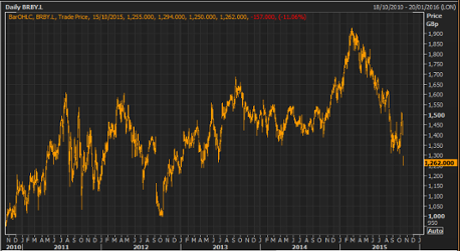
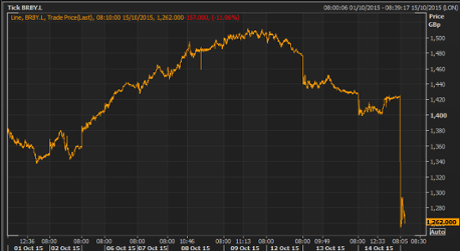
Burberry’s shares are on track for its biggest one-day fall since 2012:
And there goes @Burberry , down the most in 3years!! Sfter China hits sales & they downgrade profit forecast pic.twitter.com/xE7Vyv42N1
— Caroline Hyde (@CarolineHydeTV) October 15, 2015
Burberry reports falling sales in China and describes market for its luxury wares as "challenging". The company's share price is down 11%.
— Joel Hills (@ITVJoel) October 15, 2015
Burberry are briefing the media now on a conference call.
Carol Fairweather, chief financial officer, reveals that comparable sales have fallen by 4% in the second quarter of the financial year (July-September), after growing 6% in the first quarter (April-June).
The company is taking out £20m of costs in a bid to maintain profitability.
Fairweather also says that Chinese consumers are still spending, but only when they’re travelling abroad rather than buying from Burberry stores in mainland China.
Updated
Richard Hunter, head of equities at Hargreaves Lansdown Stockbrokers, points out that Burberry’s problems began in Hong Kong, where sales fell by over 10% in the April-June quarter:
“The news from Burberry is chequered once more, with an underwhelming second quarter not quite sufficient to take the shine from a reasonable first half of the year. However, as can be seen from the share price reaction, the market is in no mood to take prisoners at present.
As with markets in general, the company is naming China as the main culprit, where sales are subject to increasing pressure, washing out also to Hong Kong, where further deceleration is being seen. In addition, the general economic malaise has resulted in uneven demand in the US from both domestic and tourist customers alike.
Today’s selloff has sent Burberry’s shares down to their lowest level since April 2013:
Updated
Burberry shares tumble 10%
Boom! Burberry’s shares have fallen by over 10% , as investors give their verdict to today’s disappointing sales figures.
Shares lost 145p to £12.74, wiping around £600m off the company’s value.
Updated
The FTSE 100 has jumped by 40 points at the start of trading, driven by hopes that US interest rates will remain at their current lows until the end of the year (at least).
But Burberry’s shares haven’t traded yet, suggesting market makers are struggling to match bids.....
Retail analyst Nick Bubb doesn’t like the look of Burberry’s figures.
Here’s his first take:
The worry beforehand was that group performance would be hit by the slowdown in China and the comment that “For full-year 2016, we expect that adjusted profits before tax will be broadly in line with the average of those analysts who have recently downgraded forecasts” is ominous.
The news that first half retail sales were only up by 2% underlying, “in an increasingly challenging environment for luxury customers”, implying that Q2 sales were down....
When's a profit warning not a profit warning? When it's Burberry... @NickBubb1 is calling it one. V strange wording http://t.co/tR8hWjC5rB
— Simon Neville (@SimonNeville) October 15, 2015
Chinese slowdown hits Burberry sales

China’s slowing economy has hit Burberry, and forced the company to speed up its cost-cutting plans.
The luxury goods firm has reported sales figures which have missed City expectations.
Underlying retail sales are up just 2% to £774m in the six months to 30 September, short of forecasts of an 8% rise.
Burberry blamed an “increasingly challenging environment for luxury customers”, particularly in China.
China has been a major source of sales growth for Burberry for many years; but demand is being hit by weaker growth, as Beijing tries to rebalance its economy.
The stock market turmoil in August may also have hurt demand for luxury products.
Christopher Bailey, chief creative officer and CEO, says:
“The external environment became more challenging during the half, affecting luxury consumer demand in some of our key markets. In response, we have intensified our focus on driving sales and productivity, while taking swift action on discretionary costs.
While mindful of this external volatility, our plans for the festive season position us well to return to a more positive sales trend in the all-important second half. Looking further ahead, we maintain our focus on - and confidence in - the long-term growth opportunities for our business across channels, regions and product categories.”
Here’s some instant reaction:
BIG miss @Burberry results...cut FY profit £10 vs £20m, u/lying retail sales +2%, ests +8%. Asia-Pac slows, China particularly challenging
— Caroline Hyde (@CarolineHydeTV) October 15, 2015
Ouch from Burberry -sales up only 2% on "increasingly challenging environment for luxury"
— Louise Cooper (@Louiseaileen70) October 15, 2015
Updated
Introduction: Markets to rally as Fed rate hike risk recedes
Good morning, and welcome to our rolling coverage of the world economy, the financial markets, the eurozone and business.
Stock markets are expected to rally today, as investors decide that the Federal Reserve is increasingly unlikely to raise interest in 2015.
Yesterday’s disappointing US retail sales report, and a warning from Walmart, has added to speculation that America’s economy isn’t strong enough to shoulder a rate hike right now.
And that bad news could be good news for shares, it seems.
Our European opening calls: $FTSE 6299 up 29 $DAX 9976 up 61 $CAC 4642 up 33 $IBEX 10089 up 51 $MIB 21967 up 129
— IGSquawk (@IGSquawk) October 15, 2015
Stocks rallying because of delay in #Fed rate hike. But the delay is because U.S. economy is bordering on recession. Strange time to rally.
— Jim Rickards (@JamesGRickards) October 15, 2015
We’ll get a better picture of the US economy at 1.30pm BST, when the latest inflation figures are released. Could it add to growing deflationary fears, after the US inflation rate turned negative yesterday?
And in the City, we have results from Burberry and Unilever to chew through - plus Goldman Sachs’ results this afternoon.
We’ll be covering all the main events through the day....