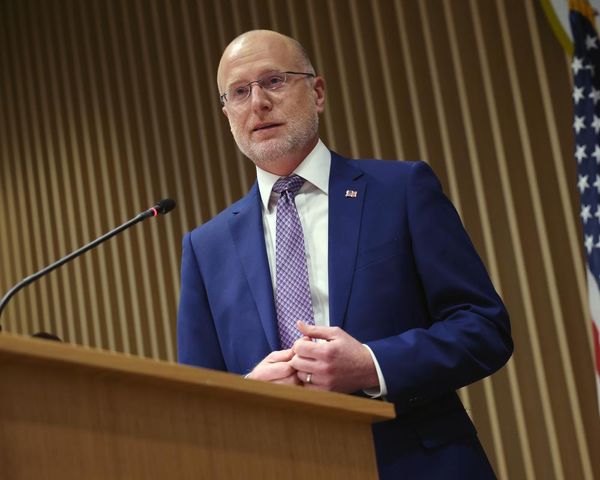
Oregon sheriff David Ward said Ammon Bundy and his armed supporters repeatedly threatened “to overthrow” him and tore apart his small rural community, in the first testimony in the high-profile militia standoff case.
Ward’s town is still recovering from the impact of the Malheur national wildlife refuge occupation, the sheriff told a packed federal courtroom in Portland on the second day of the trial.
“We’re still dealing with a lot of the fallout,” he said.
Ward, the local sheriff in rural Harney County, was thrust into the national spotlight at the start of the armed occupation, which began on 2 January when brothers Ammon and Ryan Bundy led a takeover of the Malheur national wildlife refuge to protest against the federal government.
The Bundys and their followers have long argued that federal authorities have no right to own or regulate public lands, and the activists traveled to Burns, a small town in eastern Oregon, to support two ranchers facing prison time.
Father and son Dwight and Steve Hammond were convicted of federal arson charges in a case that for some ranchers and rural communities in the west symbolized government overreach. The Bundys had hoped that Ward, as the top county law enforcement leader, would take a stand against the federal government and defend the Hammonds from imprisonment.
During the Bundys’ infamous 2014 standoff with US officers at their ranch in Nevada – stemming from the patriarch Cliven’s refusal to pay grazing taxes – the local Clark County sheriff, Doug Gillespie, expressed sympathy for the family and was critical of the federal government.
But Ward made clear from the start that he wanted the Bundys gone and the occupation over.
The sheriff told reporters that the Bundys were leading dangerous militia groups in an attempt to “overthrow” the government, and within days, Ward said he and his family were facing death threats.
The sheriff also met with Ammon on a remote road outside of the refuge during the first week of the standoff, offering to escort the protesters out of Oregon. The Bundys declined the offer.
He became particularly emotional when he reflected on the occupation in the immediate aftermath of the standoff, which dragged on for 41 days.
Ward testified that Ammon and another protester, Ryan Payne, met with him last November and threatened “civil unrest” if the sheriff didn’t intervene in the Hammonds’ case.
“I was told that my responsibility was to prevent them from going to prison,” Ward said. “If I didn’t do those things, they would bring thousands of people to town to do my job.”
Ward said the ultimatum was concerning and that the men told him: “We can’t control what they may or may not do.”
The sheriff further testified that he had read about the Bundys’ 2014 fight with the government and was frightened: “The thought of that happening in my community scared the hell out of me.”

The prosecution also presented 2015 emails from defendant Neil Wampler to Ward, including one that said if the sheriff did not support the Hammonds, the county would be “invaded by some of the most determined and organized – and armed – citizens alive in this country today”. In another message, Wampler wrote: “WE AIN’T PLAYIN.”
Brian Needham, a lieutenant in the sheriff’s office, also testified that one of the occupation leaders, Ryan Payne, told him in a meeting that he should consider killing Ward, his boss, and replacing him.
Payne allegedly told him he “should use any means necessary [to remove Ward] ... including death”.
Judge Anna Brown said she wanted to make it clear to the jury that the sentencing of the Hammonds was final – and that the sheriff had no legal mechanism to fight it. “The Hammonds had their process … A sheriff does not have the authority to change that.”
During cross-examination, Marcus Mumford, Ammon’s attorney, repeatedly asked Ward if he believed the federal government had the authority to regulate public land in Oregon.
At one point, the seemingly exasperated sheriff responded: “I’m not understanding your question. Did I investigate the federal government? … There’s 200 years of case law that shows that they can own … land.”
Ward also clarified that he did not feel physically threatened by Ammon and never saw him carry a gun.
The Bundys and five other defendants are accused of impeding federal officers through the use of force, intimidation or threats, and during opening arguments on Tuesday prosecutors said the defendants had launched a coordinated conspiracy against the government. Defense lawyers argued that the protesters were peaceful activists who were engaged in civil disobedience and were making a statement about protecting a disappearing way of life in the rural west.
The government has charged a total of 26 people, though 11 have negotiated plea deals.
The trial continued to attract large crowds on Wednesday, including Bundy relatives, their supporters and representatives of the Burns Native American tribe, which had historically occupied the refuge land and opposed the militia protest.
Outside the courtroom, Bundy supporters said Ward was to blame for the occupation, with one saying: “He will have to answer for it when he dies.”
A small crowd of flag-waving activists supporting the defendants gathered across the street from the courthouse Wednesday afternoon, carrying signs that said “Ranchers lives matter” and “Release the Malheur protesters”. A lone protester opposing the Bundys held up a poster that read: “No guns ... or explosions in our wildlife refuge.”
Before the hearing, Lisa Bundy, Ammon’s wife, told the Guardian that the family has been repeatedly disappointed by Ward’s actions. “He has more power than any federal official did, and he put all the power in their hands, which made me think he didn’t want to deal with it,” she said. “So why is he in that office?”
She added: “I would love for him to speak the truth … and not what he was told to say.”
Jeff Banta, one of the defendants on trial, said in an interview that he felt it was clear that the occupation was never dangerous or violent.
“I just wanted to help bring attention to the Hammonds,” said Banta, who was one of the final four holdouts at the refuge. “We did have arms ... but we were not going to shoot.”
“Only in self defense,” he added.