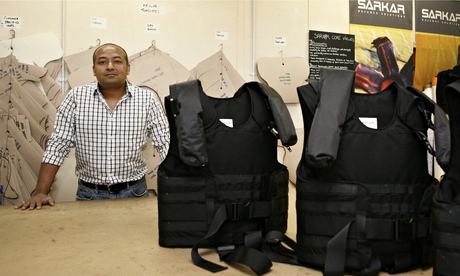
The news of a slowdown in UK growth came as little surprise to manufacturer Sam Sarkar. With a strong pound and troubles in the eurozone denting exports, manufacturing growth in the latest quarter was the slowest for 18 months. Services growth also lost steam and overall GDP was up 0.7% in the July to September period. Still solid but below 0.9% growth in the second quarter.
Sarkar, whose Glasgow-based company makes bulletproof vests and helmets, relies almost entirely on exports for sales. Of an estimated £3m turnover this year, 95% will come from overseas sales. His recent trade chimes with business surveys showing a drop in overseas orders for UK goods as its key market, the eurozone, grapples with low growth.
“We clearly had a slowdown in the last couple of months. I think this whole year has been slightly tough,” said the boss of Sarkar Defence.
Like many manufacturers, he is increasingly looking beyond Europe for business, selling to a range of customers including armies, police forces and private security companies.
“Things are getting back up and running because we are concentrating on different zones as opposed to thinking about the eurozone. We are looking further afield, at Africa and other emerging markets,” he said. “Last year 50% of our exports went to the European Union. This year that won’t be the case.”
Even for business beyond the eurozone, contracts are hard to win because of the strong pound, which makes UK goods more expensive to overseas buyers. With conflicts raging in many regions, demand is high for Sarkar’s products but he is competing with suppliers who quote in dollars.
“We are looking at faster-growing markets like Nigeria, Kenya, India. But for these markets, for India say, with the pound where it is, it is virtually impossible to do any profitable business,” he said.
He wants to see more government support for manufacturing and is worried about the potential damage to business from migration caps and a possible in-out EU referendum. The small business of 30 staff relies on technical experts from overseas and gets almost all its raw materials from the EU.
Nevertheless Sarkar is upbeat about the near-term “We are optimistic and will continue to do what we do,” he said.