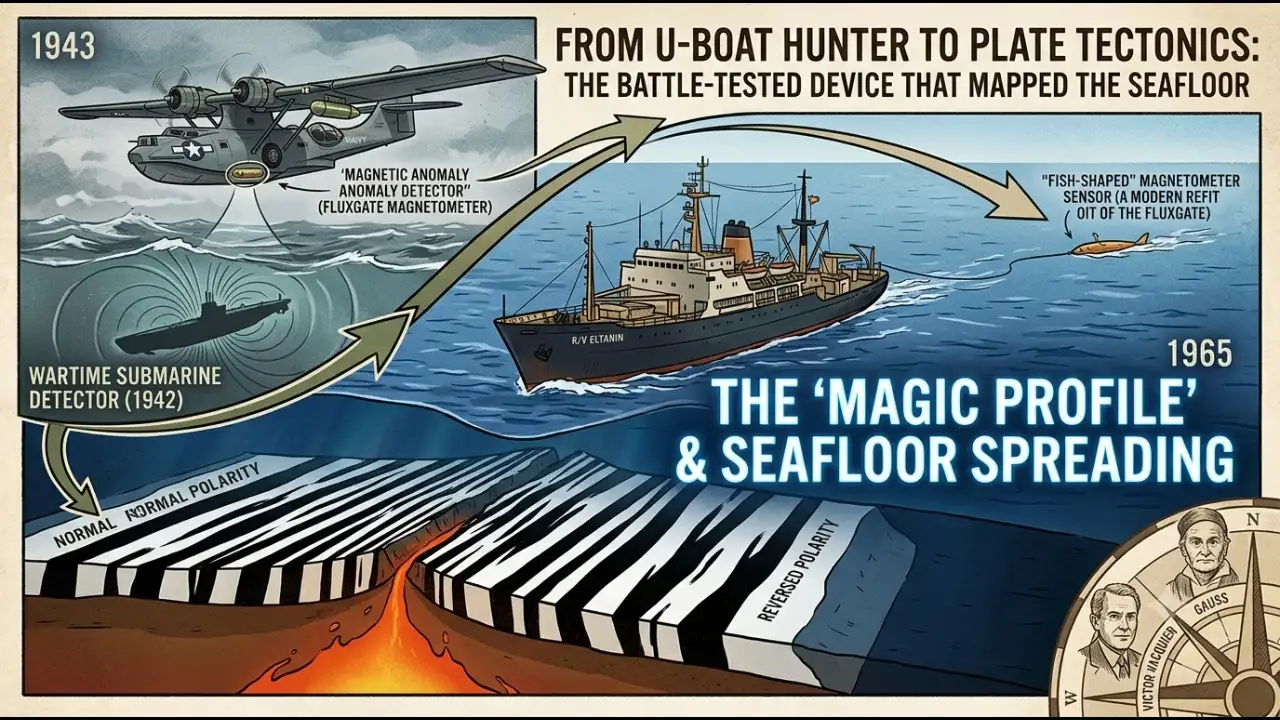
World War II fluxgate magnetometer : A device developed for military use during World War II went on to play a key role in one of the biggest breakthroughs in Earth science.
After the war, oceanographers refitted the portable fluxgate magnetometer, originally used to detect enemy submarines, so it could be towed behind research vessels to measure magnetic anomalies preserved in seafloor rocks. The measurements it enabled eventually led to the "magic profile," one of the most convincing pieces of evidence for seafloor spreading and, ultimately, the theory of plate tectonics, as per a report.
A wartime invention found a new scientific purpose
Although magnetometers had existed for more than a century, the US Navy sought a more precise instrument during World War II to detect small disturbances in Earth's magnetic field caused by submerged metal objects such as submarines, as per a Science News report.
Scientists designed the fluxgate magnetometer in 1936, but Russian-born geomagnetist Victor Vacquier, working at Gulf Research Laboratories, developed a portable version that could be mounted on aircraft.
Successful tests of Vacquier's instrument in 1941 drew the attention of the US Navy. With naval funding, airborne fluxgate magnetometers were being used to hunt enemy submarines by December 1942.
From submarine detection to seafloor exploration
After the war, oceanographers refitted the same technology so it could be towed behind research vessels as they surveyed the oceans.
During the 1950s and early 1960s, Vacquier, then at the Scripps Institution of Oceanography in La Jolla, California, and other researchers used the device to measure and map magnetic anomalies preserved in seafloor rocks.
The surveys revealed alternating bands of normal and reversed magnetic polarity across the ocean floor, a pattern that had not been observed in continental rocks. Scientists hypothesized that the stripes might be due to Earth's magnetic field reversing direction from time to time.
Even more significant, the magnetic bands formed nearly symmetrical patterns on either side of the world's mid-ocean ridges. The findings supported the hypothesis of seafloor spreading, the idea that as Earth's crust pulls apart at the mid-ocean ridges, magma wells up to form new ocean crust. As the new crust hardens, its iron-bearing minerals align with the current orientation of Earth's magnetic field, creating a new stripe in the pattern.
The "magic profile" strengthened the case for plate tectonics
In 1966, about 100 Earth scientists gathered for a two-day symposium at the Goddard Institute for Space Studies in New York City. There, geologists Walter Pitman and James Heirtzler of Lamont-Doherty Earth Observatory presented magnetic measurements collected in 1965 aboard the R/V Eltanin.
The remarkably symmetrical pattern of magnetic anomalies on either side of the Pacific-Antarctic Ridge became known as the "magic profile."
The profile became one of the most convincing lines of evidence for seafloor spreading and, ultimately, for the theory of plate tectonics.
The portable fluxgate magnetometer traced its origins to earlier efforts to measure Earth's magnetic field. During his travels in the early 1800s, German explorer and geographer Alexander von Humboldt observed that Earth's magnetic field varied in strength from place to place, according to the Science News report. Those observations led Humboldt in 1831 to initiate a coordinated effort to precisely measure Earth's magnetic field around the world.
In 1833, German mathematician Carl Friedrich Gauss devised the first magnetometer capable of measuring the absolute intensity of Earth's magnetic field. Those early efforts laid the groundwork for the later development of the fluxgate magnetometer, the instrument that ultimately helped produce the "magic profile" and transform scientists' understanding of the seafloor.
READ ALSO: Psychology researchers reveal how gaslighting rewires a person's sense of reality over time