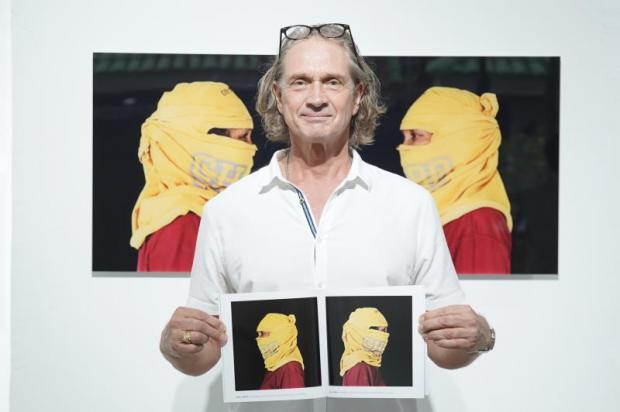
Construction workers are usually overlooked even though their work is fundamental to the building of cities. To shine a spotlight on them, German photographer Ralf Tooten exhibits construction-worker portraits in his exhibition "A.W.C. -- Asian Workers Covered", as a reminder of how and by whom Thailand's cities have been built.
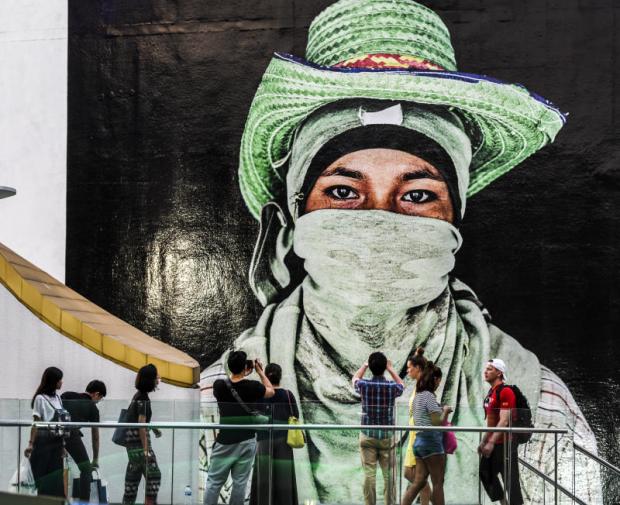
To create public impact, images of working-class people in colourful masks staring directly at viewers and other poses have been displayed on large screens at several venues in downtown Bangkok, including on LED screens on both sides of Patpong Road, at two shopping malls -- Siam Square One and CentralWorld -- as well as VGI screens at three BTS stations -- Asoke, Siam and National Stadium. There is also the 14x14m portrait of a female worker covered with green cloth and wearing a green hat in front of the Bangkok Art and Cultural Centre (BACC). And more than 20 portraits are demonstrated at Le Link Gallery.
"A.W.C. -- Asian Workers Covered" was originally shot between 2006 and 2009 in Thailand, Laos, Cambodia and Myanmar. In 2012, Tooten shot the second series of portraits, called "R.C.A. Ratchaburi Construction Workers Open Air", in Ratchaburi. And this year, he decided to bring back the A.W.C. collection as part of the Bangkok Art Biennale.
Life spoke to the photographer about his exhibition series.
Why did you decide to bring back "A.W.C. -- Asian Workers Covered" to Bangkok?
The Bangkok Art Biennale re-creates completely new audiences. It makes senses to show my works in the gallery and on big screens and big banners at BACC at the same time. This is what the main curator, Prof Dr Apinan Poshyananda, called the "Tooten Attack".
Is there any difference between this latest exhibition and the previous ones?
There are different selections. We also use different framing and presentations.
What was your inspiration for making "A.W.C."?
First, I was attracted by the colours, shapes and creative moments of workers covered. As a foreigner, I had never seen them before. And as a photographer, I really love it. Second, after talking with them, I understood the situations of migrate workers. Covering the face isn't only fashionable, but is also about protecting themselves from dust, sunlight, toxic gas, and maybe sometimes to cover their identities because they are migrant or underage workers.
Is there any particular portrait that gallery visitors shouldn't miss?
For me, the green lady on the banner at BACC is quite a strong portrait. It is one of my favourite pictures of the series, though it is so simple. I took this picture somewhere in a Bangkok suburb where workers built a luxury pool villa.
Was there any difficulty while working on the project?
Yes. A major problem was that construction companies weren't keen to have a photographer on their sites. They didn't understand our work. In one case, while we were shooting at the construction site of a housing estate, staff of the company found out and kicked us out. I used film and they wanted to have all my photograph materials. I gave them a roll of film which hadn't shot and left. A foreman who helped me to come to this construction site lost his job. We supported him financially for eight or nine months until he got a new job.
Some photos are from a project in Ratchaburi. Why did you want to shoot a project there?
At first, I wanted to exhibit photos all over Bangkok, but we couldn't get permission. I then was invited by [award-winning artist] Wasinburee Suphanichvoraparch, who has a gallery and network in Ratchaburi. The mayor of Ratchaburi welcomed the idea and supported us a lot. And it was easier to see the exhibition there because you could go around by tuk-tuk or boat to see all portraits in a short time. If you were in Bangkok, it probably took you a whole day to see everything.
Have any of your models or the workers ever seen the exhibitions?
In Ratchaburi, some of them came at the opening day. Most of them felt good about being a part of it. One of them said he liked the exhibition. Unfortunately, I couldn't find a Spanish internet TV programme that brought the workers to original locations and interviewed how they felt.
Should artists reflect society through their works?
It depends on the message of the artist. In this exhibition, yes, it is. But I had a project before ("Eyes Of Wisdom"), for which I travelled around the world and photographed holy people, includingthe Dalai Lama and Pope John Paul II. The project doesn't reflect society, but reflects culture.
"A.W.C. -- Asian Workers Covered" will be exhibited at Le Link Gallery until Feb 3.