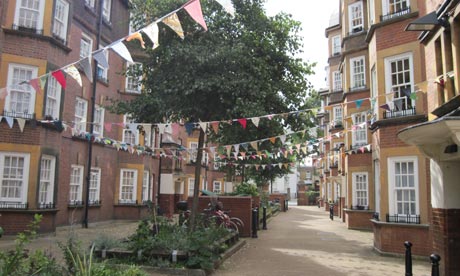
How a new breed of sustainable business and its brands could be instrumental in getting us all to buy into becoming more social.
Less than three weeks ago, the Guardian ran a story drawing our attention to the fact that David Cameron was having another stab – his fourth in fact – at launching his "big society" idea. With so many attempts to get the project out of their election campaign and into our collective imagination, even Francis Maude, the cabinet minister responsible for the project came clean on Radio 4 that the government was finding it tough going, saying: "We may have failed to articulate it clearly and we'll carry on explaining as best as we can."
Failed to articulate it clearly? Unable to engage your audience? This has all the hallmarks of a poorly thought through brand launch: no clear proposition, no clear communication, no clear strategy. Which is ironic, as although not explicit within the big society idea, chances are that many of its proponents consider our apparent slavish relationships with brands – and consumption in general – one of the principle reasons why we need to re-build society in the first place. After all, the big society is defined in no small part by our transition from consumers who demand our rights, to citizens who respect our duties. So could it be that the big society needs to borrow some know-how from a dark discipline that may well have been instrumental in whittling-down society in the first place? Maybe.
But I believe there's a chance that the relationship could run even deeper: that not only does the big society notion need to use brand-based expertise to get mass-scale buy in, but that it needs to use brands.
Before going any further, I agree that many aspects of our modern lives – consumerism and materialism specifically – are bad for society. Not only does the former swallow up so much of your time that you're just not able to squeeze-in being particularly social, but those who demonstrate high levels of materialism appear to be more prone to insecurity and depression, and less able to connect emotionally or form long-lasting relationships.
But there's something else happening around brands that may be highly constructive; something that may represent a key to getting some momentum behind the big society and indeed us all moving towards a more sustainable future. Brands are starting to find themselves in the middle of rich, dynamic communities – communities that would not exist were the brand not involved at the outset. That is not to say the brand is in control: instead, the bonds between individuals are the ones of real value. The brand simply convenes what Benedict Anderson calls the "imagined
community", with value and control intricately woven into the myriad relationships and bonds.
Now it's not a huge leap to link community to society: that a big society is one that is rich in diverse communities. But this isn't just breaking down the big society idea into more manageable chunks. Within communities – including brand communities – people behave differently. Just like conventional economics considers us rational, individual utility-maximising creatures, so conventional consumer psychology considers us lone, information-processing, utility-hunters. Which of course we're not: David Brooks makes this case elegantly in The Social Animal, and we're well-used to the convincing arguments from the likes of Thaler and Sunstein.
When it comes to consumers operating in communities – in other words environments where they are visible, where social identity is important, and reciprocity is expected amongst members, there's a whole slew of new attitudes, intentions and behaviours that emerge. Whether it's because it's what we genuinely think is right (an intrapsychical motivation) or whether it's because we want to be seen to be thinking it's right (impressions management) the immutable truth is that being within a community makes us all behave more prosocially. Which has to be good news, as prosocial behaviour is a crucial determinant of sustainable behaviour.
More than that, in dense and rich communities, where a behaviour is deemed by that community to be prosocial (or sustainable) in nature, there's an emerging argument that says rebadging that behaviour as such will re-form positive attitudes towards that and other similarly badged behaviours in the future. In other words, when we get into a community environment, the opportunities to engage consumers in prosocial behaviour – and prosocial attitudes – increase dramatically, with consumers getting more out of the experience as a result. Community behaviour and sustainable behaviour are two sides of the same coin.
Back in late 1800s, sociologists believed industrialisation was pounding community into the ground; that intuitive, intimate community was being replaced with a "depersonalised, mass produced and less grounded type of human experience". Tonnies (1887), with his Gemeinschaft und Gessellschaft even pitched community and modernity as antonyms. But what if community is actually more resilient? What if community is actually just evolving? After all, if we accept the argument that traditional community was temporarily disoriented by modernity and consumerism, it seems the perfect synthesis that it should now re-emerge within and around what are probably the most iconic representations of modern life.
So would this be a bad thing? Not necessarily. Because business is starting to realise in its own circles that rich communities around them are good for business long-term: information flows faster and more frequently, ideas are shared, and people – consumers and employees – are happier, healthier, more engaged and more productive. All this, not from focusing on the narrow value of economic transaction, but rather what Rowan Williams calls the "unproductive activity – it is these extra things that make us human." And with this realisation comes an appreciation not solely for products sold, but experiences shared, stories told, and ideas formed and tested. In other words, the very creation of a community around the brand forces the dynamic between the firm and its constituents to change; and if we agree with Philip Pullman's position on our emerging "wakefulness", then it becomes exciting to think how these communities will co-create new branded products and services in the near future. It is these businesses – and their brands – that will be our truly sustainable exemplars, for the simple reason that they recognise their intricate relationship with, and reliance on, society and community.
So back to the big society. Maybe it's not a problem of articulating it clearly, as Frances Maude claims. Maybe it's a problem of not articulating it correctly. If we believe in this idea of new communities of genuine social worth growing around brands – and brands engaging for the long- term – maybe this is the single killer proposition for the big society? It shouldn't be a plea for how things used to be, but rather a vision of how things could be: the interrelatedness of sustainability, community and personal wellbeing in a context that's relevant for the 21st century. It's about the natural evolution of community: the resilience and adaptability of community. If so, then those who are the architects and communicators of the big society need to spend less time reminiscing and more time looking ahead. After all, this is exactly what the next generation of sustainable businesses and their brands are doing.
Guy Champniss is an independent strategy consultant, and co-author of Brand Valued: How socially valued brands hold the key to business success and a sustainable future
This content is brought to you by Guardian Professional. Become a GSB member to get more stories like this direct to your inbox