Here’s a taste of what people are saying about the budget outside Westminster. It’s from my colleague Amelia Gentleman.
Customers in the Cafe 96 Degrees in Leicester were paying scant attention to the budget, being broadcast from a television on the chrome bar, next to piles of brownies and croissants. No-one looked up from their salads (goats cheese and roasted pepper with feta) when the Chancellor reminded them again of his conviction that: “We are all in this together.”
But residents across Leicester will be affected in greater numbers by the welfare reform announcements made yesterday than people in much of the rest of the country. Leicester is fifth highest local authority ranked according to the number of people receiving child and tax credits – with 12% of households receiving them (14,800 households). By contrast, just 2.4% of households in Kensington and Chelsea depend on those benefits.
“The benefits system should not support lifestyles and rents that are not available to the taxpayers who pay for that system,” the chancellor said, before detailing that working age benefits would be frozen for the next four years and that tax credits and housing benefit payments would be limited to two children, so that families choosing to have more children (after April 2017) would not get additional payments.
In the abstract, there was support in central Leicester for the chancellor’s mission to move Britain from a low-wage, high-welfare economy to a higher-wage, lower-welfare economy – but this was combined with consternation about the practical implications of that shift.
Residents here – almost none of whom had watched the chancellor’s speech and had yet to digest the details of the announcements – welcomed the introduction of a national living wage, rising to £9 an hour by 2020.
Standing outside Tim Hogarth pawnbrokers (“Best rates in Leicester guaranteed”), one of three pawnbrokers jammed together in a row on Market Place, forklift truck driver, Jason John, said a rise in the minimum wage would help with his family’s finances. “Sometimes the money goes straight away, on bills, transportation, food. This will mean you’ll have an extra penny to play with.”
Pushing his three-year-old son through the covered market in central Leicester, Nitish Khanane, 33, a chef in an Indian restaurant, said the rise in wages would be very good for his family, but he was unable to calculate whether the freeze to the working and child tax credits his family receives would make them better or worse off in the short-term. He was not planning on having more than two children and supported the decision not to increase welfare payments beyond two children. “Two is enough,” he said.
Working on the exotic fruit stall in the market, Sarah Lunn, 21, who plans to go to university in the autumn said she thought restricting payments to just two children would stop people her age from “popping out one baby after another”. “A lot of the kids I was at school with are on their second child. There’s not much else for them to do,” she said. The increased minimum wage might “encourage them to think ‘Can I do something better with my life?’” she said.
Politics summary
In her book Get it Together, Zoe Williams recalls how Ed Balls came to the Guardian offices at some point in the last parliament and, in the course of a briefing, said: “What we did with working families’ tax credits was the biggest back-door redistribution a government has ever done.” By stealth, Gordon Brown tilted the benefits system towards the poor. Today, through his £13bn benefit cuts, George Osborne is giving it a massive shove the other way.
You can’t exactly accuse Osborne of stealth. The Tories made no secret about their plans to slash welfare spending, even if they were egregiously opaque before the election about where those cuts would fall. But with restrictions on non-doms, a levy on business for apprenticeships and a living wage (even if it is not the living wage - see 4.07pm), Osborne has managed to cloak his small-stateism with some Labourish measures that would have had the CBI and the IoD going ballistic if Balls had ever had the temerity to introduce them. In terms of his overall fiscal plans, Osborne has also trimmed quite a lot since March. Spending cuts will not be as severe as planned, and he has delayed by a year the date by which he intends to balance the budget.
News is what’s new and, given that the cuts were well expected, the national living wage announcement is likely to dominate the headlines tonight.
But, overall, what matters most is what the budget says about the role of the state. There has been a perennial struggle in British politics between those who favour a Scandinavian tax/welfare model (high/good), and an American one (low/minimal). Brown hiked us some way towards our Scandi neighbours. Today, Osborne is looking out to the Atlantic and yanking us off to the West.
That’s all from us.
Thanks for the comments.
UPDATE: The IoD says tell me they back the living wage.
. @AndrewSparrow - we've backed the new living wage. 87% of IoD members pay the real one already http://t.co/WsMV4ASVuy
— IoD_press (@IoD_press) July 8, 2015
@IoD_press Thanks. Will get that in (though my point was that, if Labour tried this, business reaction might be rather different)
— AndrewSparrow (@AndrewSparrow) July 8, 2015
Updated
Economic summary
As expected, George Osborne unveiled a slight slowdown in UK economic growth this year, but the over-riding budget message on the economy was that the recovery was still on track. Meanwhile the pace of reducing the deficit will be more gradual than previously expected.
GDP is forecast to grow by 2.4% this year, compared to the 2.5% which was expected in the March budget. But this was not much of a surprise, given a slowdown in the first quarter and worries about growth in the US and China, not to mention the turmoil in the eurozone with the possible departure of Greece from the single currency.
Further ahead, UK GDP is expected to grow by 2.3% next year – the same as forecast in March – and by 2.4% in 2017, up from the 2.3% predicted previously.
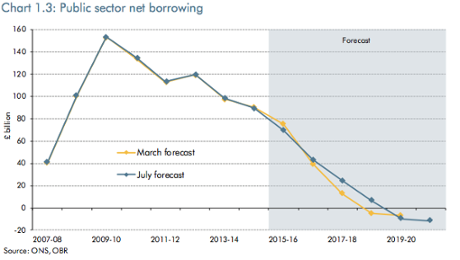
The transformation of the deficit into a surplus has been pushed back a year as Osborne eases back on austerity.
And with welfare cuts and tax increases, government departmental spending will be £83bn higher than forecast in March. So the forthcoming spending review is likely to be less savage than previously expected.
On the business front, companies will benefit from the reduction in corporation tax to 18%, although the removal of tax allowances on goodwill for acquisitions came as a surprise.
Banks will see a scaling back of the banking levy, to be replaced by a surcharge on profits, which helped support some of their share prices. But newly floated so-called challenger banks such as Aldermore and Virgin Money fell back, since they did not pay the levy but will now pay the surcharge.
The housebuilding and estate agency sector was hit by the removal of higher rate tax relief on buy to let mortgages as well as changes in the non-dom rules, which could discourage property investment.
And Drax, the power company in the process of changing its coal-fire plant to biomass, saw its shares fall by28% after the removal of an exemption from the climate change levy for renewable electricity. The company said the move could reduce earnings this year by £30m and £60m in 2016.
Overall stock markets took the budget in their stride, with the FTSE 100 closing up nearly 1% at 6490.7.
Updated
Here are three more verdicts on the budget.
Mr Osborne’s gamble is that some businesses will simply eat the cost of higher wages (unlikely), or train their workers better and give them better tools so that the higher wages can be justified with higher productivity. It is possible this may work. It is enormously risky, and if the move is the wrong one it will be hard to reverse. The lesson of the 1980s is that, once lost, jobs are not easy to find again.
One might ask why the chancellor is willing to take such risks and to order the Low Pay Commission to do his bidding rather than be guided by evidence. The answer is not hard to find: Mr Osborne needs political cover. He is hacking away at the welfare state, notably the system of tax credits that was designed to encourage people to work rather than stay at home.
One can only guess what Milton Friedman, one of the inspirations behind the Thatcherite revolution, would have made of all this. In place of a carefully designed system of incentives for people to go to work, we are to be offered a wage increase set by a politician’s whim. Friedman knew that, even in the complex market for jobs, one does not simply abolish the laws of supply and demand.
It was a coalition, not a Conservative, Budget that Osborne had expected to deliver. After the Tories’ unforeseen victory, this was a statement designed to ruthlessly consolidate their advantage. Labour’s weaknesses were exploited through the budget surplus law and the reduced benefit cap; the Conservatives’ were addressed through tax cuts and a “National Living Wage”. After another Budget sweeping in its scope, the opposition is less sure than ever about how to reset the terms of debate in its favour.
-
James Forsyth at Coffee House says this budget makes it easier to imagine Osborne as prime minister.
What makes this Budget so politically astute is how it all fits together. The four-year freeze on working age benefits and the cuts to tax credits are made palatable by the introduction of a national living wage. Meanwhile businesses’ potential objections to this wage hike will be muted by the cut in corporation tax to 18p and the hypothecation of vehicle excise duty to road improvements.
It is hard to define this Budget politically. There were plenty of things in there to please the Tory right, the commitment to spend 2% of GDP on defence in particular. But it was also one that made several raids on Labour territory in areas such as non-dom taxation and skills and a big land grab on the national living wage.
Bloomberg’s Robert Hutton has been carefully analysing George Osborne’s jokes.
Significant that in #Budget2015 Osborne revealed who he sees as key opponent. Clue: not Labour http://t.co/De9gMw85o2 pic.twitter.com/mfS5ibdyBv
— Robert Hutton (@RobDotHutton) July 8, 2015
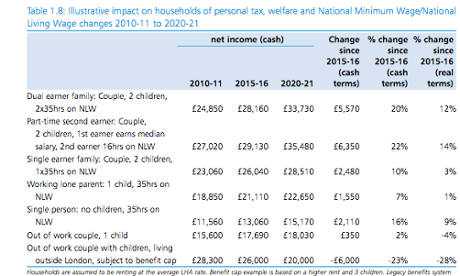
One of the key issues for the budget is whether the amount low-earners will gain from tax changes and the national living wage will compensate for the amount they will lose from the benefit cuts. (See 2.50pm.) Welfare experts say that, for many families, the losses will easily outweigh the gains, but the Treasury has a chart in its red book that supposedly shows many families will gain.
It shows the changes in net income for various family types resulting from the tax, welfare and minimum wage/living wage changes.
And here’s an extract from the text.
A typical renting household with two children and two full‐time earners currently at the minimum wage will see their net income rise by 12% in real terms over the Parliament. Over the Parliament, a typical renting household with one child, and one adult in work currently at the minimum wage, is expected to see their net income rise by 6% in real terms, whereas the same household with no one in work is expected to see their income fall in real terms by 4%.
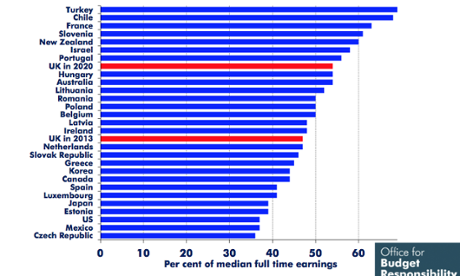
The Office for Budget Responsibility says that the national living wage policy will take Britain from middle of the OECD league table, in terms of the value of its minimum wage as a percentage of full-time median earnings (red line in the middle - UK now), to near the top (red line about three quarters of the way up).
This chart is from Robert Chote, the head of the OBR’s, presentation.
Here’s our reality check on the national living wage:
The Institute for Fiscal Studies will give its full verdict on the budget at a briefing tomorrow, but Paul Johnson, the IFS director, was on the BBC earlier. Here are some of the key points he made.
-
Johnson said that people on tax credits were among the big losers.
There are clearly some losers here, some fairly high income people with dividends, for example, are going to be hit by the increase in dividend taxation. Also, if they are higher rate taxpayers who are buy-to-letters, then they’re going to be losing from that as well. The other big losers are those who are receiving some parts of the tax credit system.
-
He said the tax credit cuts could undermine universal credit.
A lot of this will actually affect universal credit, which isn’t yet in place. The big change that this will have is it will reduce significantly the amount that you can earn before you start losing the benefit. Actually, it begins to undermine a little bit the really important aspect of the way that universal credit was put together, which was it was deliberately designed to allow you to earn a reasonably significant amount of money before you started losing your benefits. The amount you are going to be able to earn before you lose your benefits is going to go down.
- He said that overall it was a tax-raising budget.
-
He said there was “considerable uncertainty” about the impact on jobs of the national living wage.
[Osborne] is legislating higher wages and he will bring quite a lot of people in to this new national living wage, a lot more people will be directly affected by it than are affected by the national minimum wage. I think we are entering slightly unknown territory actually in terms of having a minimum wage. He says the OBR has estimated that it will have a relatively small effect on the number of jobs; actually I think there is some considerable uncertainty about that.
Here’s the view of our economics editor Larry Elliott:
It is one of the iron rules of British politics that chancellors take tough decisions in the budget that immediately follow a general election – and George Osborne did not break with tradition.
The meat of the first all-Conservative package in almost two decades was a series of measures designed to turn a deficit of £70bn this year into a surplus by the end of the parliament. There will be tax increases that will raise a total of £47bn by 2020 and welfare cuts that will raise £35bn.
Even so, there will be less pain than was promised in the last coalition budget in March. The deficit-reduction programme will be spread over a longer period and the squeeze on public services spending will be eased...
There is both a political and an economic motivation for [the announcement of a national living wage]. Politically, it helps Osborne make the case that the Conservatives are the party of hard-working people, a key message during the election campaign. Economically, the national living wage is designed to offset the impact of the very deep cuts in tax credits, which will hit those on the lowest incomes hard.
For many of those on low pay, the national living wage increase will not compensate for the tax credit losses. But it allows Osborne to say he is “giving Britain a pay rise” at the same time as saving billions from the welfare bill.
Full comment here:
The Living Wage Foundation has given a qualified welcome to George Osborne’s national living wage announcement. But it says that the cuts to tax credits could mean the living wage needs to be even higher.
It is worth clarifying that Osborne’s national living wage is not the same as the foundation’s living wage. They may have the same name (Osborne pinched the title), but Osborne’s is just a new tier of the minimum wage, ultimately pegged to median earnings. The foundation’s is pegged instead to prices, and is set at a level intended to cover the basic cost of living.
Here is the Evening Standard splash.
Treasury will be pleased with this #budget2015 pic.twitter.com/mjyHwkyOPw
— Lewis Goodall (@lewis_goodall) July 8, 2015
Here is the verdict on the budget from the Comment is free panel: Tom Clark, Polly Toynbee,Matthew d’Ancona, Gaby Hinsliff, and Aditya Chakrabortty
This is from Polly’s piece.
Keep your eyes on their prize – the deep and permanent shrinking of the state. Ignore the confetti of distractions – look where we are headed. The “low tax, low welfare” UK state will be smaller even than the US as a proportion of GDP by 2019 – far from the European social democratic norm.
Before these cuts, the IMF and OECD projected the UK state would fall to 36.6%, very close to the US at 35%. Germany is at 45.4%. Today’s £12bn welfare cuts add another 1.6%, so UK spending will fall below America’s.
Reaction to the budget confirmation that the National Health Service will receive an extra £8bn by 2020.
Rob Webster, chief executive of the NHS Confederation which represents 85 per cent of NHS providers and commissioners, welcomed the news and said:
As highlighted in today’s budget document, the £8bn needs to come in staged increases and we would emphasise this should reflect the bigger cost pressures expected in the first half of this Parliament. There is an opportunity for a multi-year funding deal to be aligned with planning in the NHS, for example around pricing, contracting and allocations. Through NHS Employers, we will look at the impact of the budget on our workforce.
The additional funding will also need to account for investment in transformation, to support double-running and other costs that will be needed to move to new models of care. What cannot be forgotten though is the impact that social care cuts are having on the NHS. We need urgent action to look at how we address the gap in social care funding, currently estimated at £4 billion by 2020.
“We also look forward to continuing to work with the Treasury and the Department of Health in addressing these urgent questions as part of the spending review due in autumn. Through this process we hope to secure a sustainable settlement for health and care, which allows our members to get on with the bigger challenge of delivering change in service delivery, to better meet the needs of people in the 21st Century.
Daniel Mortimer, chief executive of NHS Employers, said:
Patients and employers want to see improved and better seven-day services, and what we urgently need to consider is the workforce and pay and contract reform required to support this, especially for medical staff.
In continuing with the work to reform terms and conditions of service in and across the NHS, we now look forward to the publication of reports and the observations from the pay review bodies. Following publication we will be urgently seeking to speak with our trade unions, to ensure we continue to work in partnership to progress pay reforms and service improvement across the NHS.
Our discussions will now need to be set against the context of today’s announcement from the Government of continued public sector pay restraint and we recognise that these discussions are now likely to be more difficult.
Here is Frank Field, the Labour chair of the Commons work and pensions committee, on the budget.
The living wage initiative could be a game changing move. What’s crucial now is to ensure that the level at which it’s set by the end of the parliament is matched by productivity increases so it is sustainable. The immediate issue, however, is how many strivers will be made worse off by the other announcements the chancellor has made and what moves should we initiate to ensure that our constituents’ wish that work will pay is fulfilled.
Small print alert: affordable housing
According to the Office for Budget Responsibility report (pdf), the decision to impose a 1% a year cut in social housing rents will lead to less affordable housing being built. (Bold print inserted by me.)
The government’s decision to impose 1 per cent annual rent reductions in the social rented sector for four years from April 2016 will directly reduce social landlords’ rental income, and therefore their financing for, and returns to, investing in new housebuilding. To reflect this we have reduced our forecast for residential investment, proportionate to the expected reduction in rental income. This reduces private residential investment by around 0.7 per cent by the end of the forecast period. Around 37,000 ‘affordable homes’ were built by Housing Associations in England in 2013-14. The adjustment would be broadly consistent with reducing housebuilding by housing associations by around 4,000 in 2019-20, when the full effect of the policy on their rental income has been reached. Over the forecast period, our assumptions suggest around 14,000 fewer ‘affordable homes’ will be built.
One for the law of unintended consequences?
By cutting UK corporation tax to 18%, the chancellor might have encouraged another round of tax-inversion bids, where multi-national companies (in reality US corporations) attempt to take over UK registered businesses and relocate their head offices to gain the benefit of lower tax rates. Pfizer made one such attempt when it bid for AstraZeneca before being rebuffed. But Neil Shah at Edison Investment Research, said:
The Chancellor has raised the for sale sign over UK plc by reducing UK corporation tax to 18%, a full 2% below even the lowest of any advanced economy and crucially the lowest rate in Europe. Expect tax inversion-style led approaches for UK listed multinationals to come once again from the US with the dollar strengthening both against a troubled euro and boosted by the possibility of US interest rate hikes.
And here’s more from Katie Allen at the OBR briefing:
OBR says govt on course to meet existing and planned fiscal rules pic.twitter.com/l9BY8yTi34
— Katie Allen (@KatieAllenGdn) July 8, 2015
OBR head Chote concludes #SummerBudget represents a "big fiscal package", less reliant on public services cuts pic.twitter.com/hftYYvExCC
— Katie Allen (@KatieAllenGdn) July 8, 2015
Small print alert: OBR says some of Osborne's tax savings assumptions highly questionaable
On page 185 of its report (pdf), the Office for Budget Responsibility publishes a table giving an “uncertainty” rating to all George Osborne’s spending/saving decision. It measures how likely they are to save/cost as much as the Treasury thinks.
Measures that will save money through penalising the low-paid, such as freezing benefits, have a “low” uncertainty rating (meaning that there is little doubt that the money will come).
But the bad news for Osborne is that some of his most high-profile, progressive measures are deemed to have a “very high” uncertainty rating. That means there is some doubt as to whether they will work.
Here are the measures with a very high rating. The figures quoted as the sums they are expected to raise for the Treasury in 2020-21.
Restricting pension tax relief - £1.2bn
Dividend tax reform - £565m
Getting rid of permanent non-dom status - £385m
Measures to stop capital gains tax avoidance - £375m
Changing inheritance tax rules for non-doms - £85m
The bank surcharge - £105m
This is from Alison Garnham, chief executive of the Child Poverty Action Group, on the budget.
The welcome move on a higher minimum wage cannot disguise the truth that this is a budget that damages the economic security of working families, and takes us further down the road to being a two-nation economy, with higher child poverty for millions and lower taxes for the better off.
We have long called for a genuine living wage, but no single wage level can take account of family size, so families which appear to gain under this proposal may end up worse off overall if cuts to child benefit, child tax credits and working tax credits go ahead. It’s vital that any savings the government makes through higher wages are re-invested to help families with children.
Last week, the government declared it would invent its own measure of child poverty; today’s budget announces cuts that will increase child poverty on the measures everyone else uses. Contrary to what the chancellor said, absolute child poverty has risen by half a million since 2010 – and the fall in child poverty happened in the coalition’s first year in office, before key benefits were cut.
Our colleague Katie Allen is at the Office for Budget Responsibility briefing:
#SummerBudget OBR head starting briefing on fiscal and economic forecasts pic.twitter.com/F9Iji7xPCD
— Katie Allen (@KatieAllenGdn) July 8, 2015
OBR Chote slides on impact of Osborne's national living wage plan pic.twitter.com/FcyUHgrCmF
— Katie Allen (@KatieAllenGdn) July 8, 2015
OBR fcasts not adjusted for Greece effect but Chote says: if confidence across eurozone is hit by events there "UK would be affected"
— Katie Allen (@KatieAllenGdn) July 8, 2015
Small print alert: housing and inheritance tax
The Office for Budget Responsibility says that the changes to the inheritance tax (which give older people less incentive to sell) could lead to more over-crowding for the young. This is from page 42 of the OBR’s report (pdf).
Changes to the inheritance tax regime could make it more likely that the co-existence of under-occupation among older owners and over-crowding among younger renters will become even more prevalent. It is not clear to what extent that might affect regional labour mobility or other issues relevant to our macroeconomic forecast, so we have not made any adjustments on account of this.
The Scottish secretary David Mundell has welcomed the budget as good for Scotland, telling the BBC that the Barnett consequentials would be minimal, probably with a surplus of around £7m.
So it’s an economically neutral budget for Scotland but not politically - as George Osborne indicated in his speech when he told the SNP that, with new power for tax raising and on welfare: “You’ve got the powers, now what are you going to do with them?”
Labour leadership contender Kezia Dugdale described it as “the true blue budget the Tories have waited nearly twenty years to deliver,” while the Scottish TUC described the living wage proposal as a cheap gimmick.
Grahame Smith, general secretary of the Scottish TUC, said: “The chancellor’s so-called national living wage, pitched at £7.20 next year, will be nothing of the kind and is simply a cheap gimmick aimed at undermining the successful work we have undertaken to promote a meaningful living wage that genuinely helps people out of in work poverty.
“Despite the statement that Britain deserves a pay rise, this will not be the case for many low paid public sector workers with the continuation of a public sector pay cap. This is another kick in the teeth for hard working public service workers.”
According to Labour, a single parent working 16 hours a week with two children will gain just over £400 from George Osborne’s national living wage. But she would lose £860 from changes to tax credits in 2016-17.
Labour is pointing out more bits of bad news buried in the budget small print.
- Productivity has been revised down. The OBR has revised down its forecast of the rate at which it expects productivity to increase for the next four years.
- The government is set to miss its target of doubling exports to £1tr by 2020 by £367bn, the OBR says.
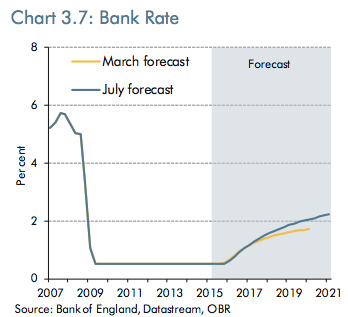
Interest rates are still forecast to rise in the first half of next year, but might rise slightly more quickly than expected in March, said the Office for Budget Responsibility:
Since our March forecast, medium-term interest rate expectations have risen slightly but the first increase in Bank Rate is still expected in the second quarter of 2016.
For the geeks out there, here are the full costings for all the Budget measures pic.twitter.com/yV27bCoPVq
— Ed Conway (@EdConwaySky) July 8, 2015
Labour says budget will not help working people
This is what Chris Leslie, the shadow chancellor, had to say about the budget on BBC News just now.
When you actually look at this more in the totality, in the round this really been a budget to hit those in work, particularly those on low pay. [George Osborne’s] doing his usual political trick, lots of headlines - he’s a headline chancellor - but when you take away the spin, actually he’s taking billions and billions away from the tax credits that people need in work. A work penalty has been introduced into the tax credit system, and he’s done it in a number of different way.
First of all, he’s halved the level at which people can be awarded the full amount of tax credit, going from £6,000 to £3,000. So effectively, for those people on tax credits, it’s a bit like halving the personal allowance for them. And then he’s taking it away at a much faster rate. And there’s no way that the increases in the minimum wage, much as though we welcome some of those, can keep pace with the hit that is going hurt those on the lowest pay. So, for all the slogans about helping working people, he is definitely not doing that.
As flagged earlier, protesters gathered at Downing Street to show their displeasure with the government’s planned welfare cuts:
Updated
Small print alert: renewable energy
Renewable electricity will no longer be exempt from the climate change levy. The budget documents say:
This change will correct an imbalance in the tax system by preventing taxpayers’ money benefitting renewable electricity generated overseas, and by helping ensure support for low carbon generation provides better value for money for UK taxpayers.
But it has not gone down well in environmental quarters. Green Party leader Natalie Bennett said:
As many other states are powering ahead with renewable energy, we have a government that’s making it even harder to establish and develop renewable energy projects, while ignoring the economic, social and environmental benefits of investing in providing warm, comfortable, affordable-to-heat homes for all.
Osborne takes the axe to exemption for users of renewable electricity from the Climate Change Levy. Another blue attack on green policies.
— Terry Macalister (@TerryMac999) July 8, 2015
Welfare cuts - Where the money is coming from
The most important table in the budget red book (pdf) is table 2.1, which sets out how much money the chancellor is saving and spending from his various budget measures.
Overall, this is a tax raising budget. It raises almost £1bn net in tax this year (2015-16), and the overall tightening this year (tax rises plus spending cuts) is worth £3.5bn. By 2020-21 the overall tightening is almost £19bn.
By 2020-21 these measures will save almost £13bn from welfare. Here are the measures, listed in order of how much the cuts are worth by 2020-21. (Some decisions, like freezing benefits, do not take any money out of the budget this year, but do take a lot of money out down the line.)
Freezing working-age benefits and tax credits for four years - £4bn
Reducing income thresholds in tax credits and universal credit (UC) - £3.4bn
Cutting social housing rents by 1% a year for four years - £1.4bn
Limiting child tax credits and universal credit (UC) to two children - £1.4bn
Removing the family element in tax credits for new claims - £675m
Cutting employment and support allowance for some claimants - £640m
Cutting the benefits cap - £495m
Changing support for mortgage interest to a loan system - £255m
Increasing the tax credits taper to 48% - £245m
Getting wealth social housing tenants to pay market rents - £240m
Cutting the income rise disregard in tax credits - £110m
Stopping most 18 to 21-year-olds getting housing benefit - £40m
Imposing new conditions on UC claimants when youngest child turns 3 - £30m
Loosing the squeeze on public services spending funded by welfare cuts, net tax increases and three years of higher government borrowing - that is the budget verdict of the Office for Budget Responsibility.
Day to day government spending would be £83.3bn higher over the current parliament than the coalition suggested in March. Tax cuts - mainly a decrease in corporation tax, a rise in income tax personal allowances and extending inheritance tax relief for main residences - would cost £24.6bn.
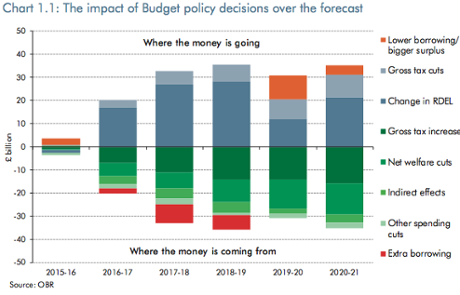
These are being funded from five main sources, says the OBR:
- tax increases raise £47.2bn over the Parliament, including increases in dividend taxation, insurance premium tax and vehicle excise duty, plus cuts in pensions tax relief, earlier corporation tax payments, and anti-avoidance and evasion measures;
- welfare cuts raise £34.9 billion. These include a four-year freeze in the uprating of most working-age benefits, cuts in the generosity of tax credits and reduced work allowances in universal credit. The government will also force local authorities and housing associations to cut rents, thereby reducing the cost of housing benefit;
- other spending decisions raise £8.1 billion. These include reductions in departmental capital spending and a cut in funding for the BBC reaching £745 million in 2020-21;
- these various tax and spending decisions have indirect effects that raise a further £14.2 billion. These include the pension contributions that would be paid by additional public sector workers, and higher income tax and NICs receipts;
- the Budget decisions also imply £3.5 billion of extra borrowing over the Parliament, on top of the £14.6 billion increase implied by our pre-measures forecast. This includes £16.7 billion of additional borrowing between 2016-17 and 2018-19, to help avoid the sharpest cuts in public services spending. Thereafter the Government uses some of the welfare cuts and tax increases to aim for bigger budget surpluses.
Overall the forthcoming spending review is likely to be less challenging than it appeared in March, said the OBR:
The Government would have to identify further real cuts in public services spending rising to a peak of £17.9 billion in 2019-20, rather than £41.9 billion in 2018-19. Thereafter spending is assumed to rise again in real terms. Public services spending would fall by an average of 1.5 per cent a year in real terms over this Parliament as a whole, slightly less than the 1.6 per cent a year cuts over the last.
Updated
Here’s Iain Duncan Smith’s reaction to the national living wage:
Updated
The introduction of the national living wage could increase the chances of interest rates going up, Sky points out.
Colleague @iankingsky makes the v good point that if the @bankofengland gets wind of this mass wage rise issue, likely to hasten rate rises
— Faisal Islam (@faisalislam) July 8, 2015
Snap economic verdict
Snap economic verdict:
As expected George Osborne unveiled a lower than expected growth forecast for this year, down from the 2.5% expected in March to 2.4%. That follows slower than expected growth in the first quarter, and the subsequent problems with the global economy which has seen slowdowns in the US and China. And of course the eurozone crisis and the prospect of Greece leaving the single currency has also had an impact.
Further out, GDP growth is expected to be 2.3% next year, as forecast in March, but the forecast for 2017 has been raised from 2.3% to 2.4%.
So things look pretty much on track, albeit the global problems could yet see that optimism dented.
Osborne pushed back the date when the public finances would move into surplus:
2015/16 £69.5bn from £75.3bn in March
2016/17 £43.1 from £39.4bn
2017/18 £24.3bn from £12.8bn
2018/19 £6.4bn borrowing from £5.2bn surplus
2019/20 £10bn surplus £7bn surplus
But he highlighted better than expected tax receipts, higher savings and the sale of the state stakes in taxpayer backed banks for a smoother path for public sector spending.
Meanwhile companies will welcome the cut in corporation tax from 20% to 19% in 2017 and 18% in 2020. As a reminder it was 28% in 2010.
Updated
National living wage - How it will work
Here is more about how the new national living wage (NLW) will work.
- The NLW will be a new premium on top of the minimum wage, starting at £7.20 when it comes in in April next year. That is 70p higher than the minimum wage now, or 50p above the rate that will come in in October.
- The NLW will only apply to workers over 25. Effectively, it is just a new national minimum wage rate for the over-25.
- The government will give the Low Pay Commission a new remit, so that it recommends increases in the NLW, as well as the minimum wage, and the government will ask it to ensure that the NLW reaches 60% of median earnings by 2020. That would take it to over £9.
- The Treasury says that 2.7m people will receive a pay rise as a direct result, and that 3.25m in total could get an increase when you take into account the knock-on effect on other workers. It says that by 2020 someone working 35 hours a week previously on the minimum wage will have seen their gross pay rise by a third, or £5,200 a year, compared to 2015.
- The Treasury says that the idea for the NLW pegged at 60% of median earnings was taken from a report by Professor Sir George Bain for the (left-leaning) Resolution Foundation thinktank.
-
It says the cost to business of NLW will be equivalent to 1% of corporate profits by 2020. The OBR says NLW will cost 60,000 jobs by 2021, but that overall employment is due to be higher by then by 1.1m anyway.
Markets and the pound both moved higher during the course of Osborne’s speech but fell back to end unchanged by the time he had finished.
The FTSE 100 is up around 1%, with investors buoyed by the growth forecasts and the cut in corporation tax.
Banks were boosted by the phasing out of the bank levy, but housebuilders were hit by the changes to non-dom rules - which could have an effect on property investment - and to buy to let.
Snap political verdict
Snap political verdict: This was a budget that lived up to expectations. The squeeze on tax credits was as brutal as everyone expected, but the living wage announcement was a genuine spectacular, that should see some low-earners see their pay go up from £6.50 an hour now to £7.20 an hour next year. Without seeing the detail it is not possible to make a definitive judgment, but it looks as though this policy trumps what Labour was offering on low pay at the election (a rise in the national minimum wage to £8 an hour by 2019), and it will do much to bolster the Conservatives’ “blue collar” credentials. If the Tories really can fully embrace blue collar Conservatism (and, even after today, they still have some way to go), Labour will be in even deeper trouble than they realise.
Updated
Here’s the summary from the Office for Budget Responsibility:
The new Government has used its first Budget to loosen significantly the impending squeeze on public services, financed by welfare cuts, net tax increases and three years of higher borrowing. The Government has also delayed the expected return to a budget surplus by a year to 2019-20, but is then aiming for a slightly bigger surplus in the medium term
Its full report is here.
Updated
Osborne is winding up now.
He says the Conservatives are introducing a national living wage. This shows the Conservatives are the party for working people. It is a one nation policy, from a one nation government, he says.
And that’s it.
Big cheers for the national living wage from Conservatives, in contrast to earlier disruption from opposition when Osborne announced benefit cuts.
Osborne turns to pay.
It cannot be right that firms are subsidised to pay low wages.
Conservatives are against unfair subsidies wherever they are, he says.
Britain can afford a pay rise, he says.
- A new national living wage to be introduced. It will apply to over-25s. It will start next year at £7.20 per hour, rising to £9 by 2020.
The OBR says this will have only a “fractional” effect on jobs. By 2020, there will be 60,000 fewer jobs as a result. But overall jobs will go up.
The OBR says this will affect just 1% of corporate profits. But corporation tax is going down.
-
2.5m people will receive a pay rise as result, Osborne says.
Updated
Osborne turns to defence.
- Defence budget to get additional resources. It will rise in real terms every year, and a joint security fund, worth £1.5bn a year by the end of the parliament, to be set up.
-
Osborne commits to spending at least 2% of GDP on defence, not just this year, but every year of this parliament.
Osborne says income tax.
- Tax free personal allowance to be raised to £11,000 next year. After that, the personal allowance will always rise in line with inflation.
-
Higher rate threshold to rise to £43,000 next year.
Osborne says by 2010 tax credits were available to nine out of 10 people. Under these changes, they will only be available to five out of 10 people.
-
Welfare changes to save £12bn by 2019-20. Measures to be included in a welfare reform bill being published tomorrow.
Osborne says the benefits system should not support lifestyles not available to taxpayers not on benefits.
The government introduced a benefits cap at £26,000. Labour opposed it, but it encouraged people to find work, he says.
- Benefits cap to be reduced to £23,000 in London, and to £20,000 elsewhere.
- Wealthy social housing tenants to pay market rents.
- Tax credits and universal credit will only support the first two children. After April 2017, people who have an additional child will not get extra help, and people who make a new claim will only get money for two children. There will be exceptions for multiple births. There will be similar changes in housing benefits.
Osborne says no family will see a cash loss.
These changes are not easy, but they are fair.
Osborne says we spend more on family benefits than we do in Germany, France or Sweden.
As Frank Field says, this is simply not sustainable.
He says Alistair Darling says tax credits are subsidising employment in a way never intended.
He says, since the crash, benefits have gone up 21%, but earning have gone up much less.
- Working-age benefits to be frozen for four years. Statutory benefits like maternity pay to be excluded from this.
- Rents in social housing to be reduced by 1% a year over next four years.
-
Tax-credits to be focused on the very poorest.
Osborne says these three measures will save £9bn by 2019-20.
Osborne turns to welfare.
The welfare system should support the elderly, the vulnerable and the disabled.
The BBC will take on the cost of free TV licences.
-
Disability benefits will not be taxed or means-tested.
Those who can work will be expected to work, he says.
- New youth obligation for those aged 18 to 21, saying they must earn or learn.
-
No automatic entitlement to housing benefit for those aged 18 to 21. But there will be exceptions for the vulnerable.
Osborne turns to the employment and support allowance. But those in the work related activity group get more money per week than those on jobseeker’s allowance.
-
For future claimants, the ESA rate for people in the work related activity group (WRAG) will be the same as jobseeker’s allowance.
Meanwhile housebuilding and property shares have been hit by the various measures unveiled.
The move to tighten non-dom tax rules with permanent non-dom status to be abolished has hit companies with a focus in London , including Berkeley Group and estate agency Foxtons.
Some reaction: The London property market and economy will be hit by the move on non-doms, according estate agents Jackson-Stops & Staff.
— Richard Edgar (@ITVRichard) July 8, 2015
“[The rule changes] will make UK less favourable for wealthy internationally mobile entrepreneurs. This could impact on the level of foreign investment seen,” says Genevieve Moore at chartered accountants Blick Rothenberg.
And with the buy to let changes perhaps making that option less attractive, other housebuilders are also lower.
Osborne says there will be further cuts to corporation tax.
-
Corporation tax to be cut to 19% in 2017, followed by a cut to 18% in 2020.
Osborne says corporation cut has already been cut to 20%.
He says he cannot bring it lower, while there are incentives to people to self-incorporate.
He says he will make major changes to dividend taxes. Some 85% of those with dividends will not pay more, or will have their tax cut.
-
New tax free dividend allowance up to £5,000. But higher taxes on dividend income beyond that.
Combined with ISAs, this means people will be able to receive £17,000 a year tax free.
Osborne says the annual investment allowance will go up to £200,000 a year. This will help small and medium-sized firms, he says.
Osborne turns to housing. Further planning reforms will be announced on Friday.
He says buy-to-let landlords have an advantage, because they can offset mortgage payments against income. That has encouraged the growth of buy-to-let mortgages. Osborne says he wants to level the playing field.
- Mortgage tax relief for buy-to-let landlords to be restricted to the basic rate. This will be phased in, he says.
-
A new allowance will increase the inheritance tax threshold, so that people will be able to pass on estates worth up to £1m free of inheritance tax. It will not apply to estates worth more than £2m, he says.
Osborne says this will be more than paid for by changes to pensions. The tax allowance for high earners putting money into pensions will be cut to £10,000.
-
Osborne to consult on creating ISA-style pensions, where people would lose the tax relief when they pay in, but would be able to take their money out tax free.
Osborne says he has agreed with the 10 councils of Manchester to extend the Northern Powerhouse.
- Manchester to get new powers over the fire service, a land commission, children’s service and employment programmes.
- Similar devolution deals being negotiated with Liverpool and Sheffield.
-
Osyter-style ticketing to be introduce in the north of England.
Osborne turns to tuition fees.
People said these would discourage students from poor homes. But applications from people from these backgrounds went up, he says.
He says the student maintenence grant system is unsustainable.
- Student maintenance grants to be abolished from 2016-17. They will be replaced with loans, which people will start to pay back when they earn more than £21,000. The maximum value will be increased, to £8,200.
-
Tuition fees to rise in line with inflation.
Osborne promises to unveil a plan to improve UK productivity on Friday:
Productivity - will require quite a plan. #SummerBudget pic.twitter.com/W4uZShUIE4
— RBS Economics (@RBS_Economics) July 8, 2015
Osborne says the skills of the young are no higher than the skills of the old.
Many firms do an excellent job with training, but some do not.
-
Apprenticeship levy to be imposed on all firms. Those that offer apprentices will get more out of this, in terms of funding for apprenticeships, than they put in.
Osborne turns to cars.
By 2017, three quarters of new cars will pay no vehicle excise duty (VED) because they are fuel efficient. This penalises those who cannot afford new cars. Only Labour could designed something so regressive.
-
New VED tax for new cars from 2017. It will apply in three bands. It will be used to fund a roads fund from the end of the decade.
Osborne says this is a major reform to improve road, and to make the car tax system fairer.
-
No change to fuel duty plans set out in March. Fuel duty to remain frozen this year.
The bank levy changes have lifted share prices in the sector, with the City welcoming the plan to phase out the charge.
Osborne says he will fund a memorial to victims of terrorism overseas.
There will be £50m for cadet units in schools, so that 500 schools get them.
The Children’s Air Ambulance will get an extra helicopter.
And he will fund an RAF fighter command memorial.
Osborne turns to the banks.
- Bank levy to be phased out, and replaced with an 8% surcharge on bank profits.
-
A new insurance premium tax will be introduced at 9.5%.
Osborne says he will bring forward tax paid by big companies.
Osborne says he is will put more funds into tax evasion/avoidance work.
Serial users of tax avoidance schemes will be named and shamed.
The non-dom system has been an important feature of the tax scheme, he says. Abolishing it would, as Ed Balls noted, probably cost the country money. But there are some unfairnesses in the regime.
- People born in the UK to parents domiciled here will not be able to inherit non-dom status.
- People will not be able to have permanent non-dom status. Anyone resident in the UK for 15 of the last 20 years will pay full UK tax.
-
The non-dom changes will raise £1.5bn, he says. They will come into effect in 2017.
Here’s our first take on Osborne’s statement:
George Osborne has boasted that Britain is growing faster than any other advanced economy, as he delivers what he promises will be a budget that “recognises the hard work and sacrifices of the British people”.
The latest economic forecasts from the independent Office for Budget Responsibility, published alongside the Budget, point to GDP growth of 2.4% this year, down slightly from 2.5% at their last forecast in March Next year, the OBR expects GDP growth of 2.3%, unchanged from March.
Today’s statement is Osborne’s second budget in four months; but the first since the Conservatives gained an overall majority at May’s general election, allowing them to govern without the Liberal Democrats.
The budget takes place against the background of the spiralling Greek debt crisis, with Europe’s leaders due to gather on Sunday to decide whether the crisis-riven country can remain in the eurozone.
Osborne said Greece’s plight demonstrated the need to press on with his programme of spending cuts. “If a country does not take control of its borrowing, the borrowing takes control of the country,” he warned.
Full story:
Osborne says he will set out savings of £17bn today, with £12bn coming from welfare cuts and £5bn coming from tax evasion/avoidance measures.
Further savings will come from departmental budget cuts, to be set out in the autumn.
He says none of the cuts will be as deep as in 2011-12 and 2012-13.
- Public spending pay rises capped at 1% a year for the next four years.
-
Another £8bn being committed to the NHS.
Listening to Osborne deliver #Budget2015 you'd never guess that UK deficit - at 4.8% of GDP - is SIX TIMES higher than that of Greece.
— Fraser Nelson (@FraserNelson) July 8, 2015
Osborne says the richest are now paying a greater share of tax than they used to..
And a greater share of state support is going to the most vulnerable, he says.
Osborne says the surplus is forecast to be £10bn in 2019-20, and £11.6bn in 2020-21.
He says Britain has turned the corner. It has left the age of irresponsibility behind
He says he is publishing the new fiscal mandate for the government. It will commit the government to running a surplus in normal times.
MPs will vote on this in the autumn.
Updated
More on the GDP figures:
As expected, UK growth has been edged lower for 2015. In the March budget the Office for Budget Responsibility forecase GDP growth of 2.5% in 2015.
This has now been cut to 2.4%, albeit as Osborne says the strongest economic growth of any major advanced economy. Other GDP forecasts:
2016 2.3% (as in March budget)
2017 2.4% up from 2.3% in March
Updated
Osborne says decisions to save money will be taken with moderation, but determination.
Osborne says the deficit was 10.2% in 2010. It is 3.7% this year, and will fall to 2.2% in 2016-17, 1.2% in 2018-19, 0.3% in 2018-19.
A surplus of 0.4% is forecast for 2019-20, followed by a surplus of 0.5% the following year.
This will be the highest structural surplus for 40 years, he says.
Osborne says the budget deficit is less than half what it was in 2010.
How fast should he cut the deficit? At the same pace as in the last parliament, he says.
There will be no roller-coaster ride in public spending, he says.
He says the public finances are healthy, as a majority government it is easier to make cuts, and he is getting revenue from the sale of shares in banks.
He can achieve a smoother path of deficit reduction, he says.
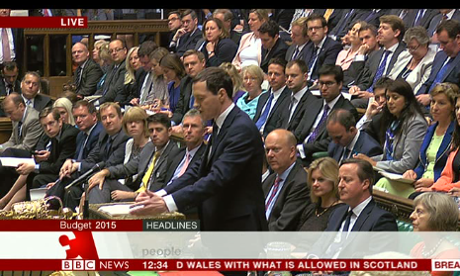
Osborne says the growth forecast for 2015 is revised down from 2.5% to 2.4%.
After that the economy is forecast to grow by 2.3% in 2016, then 2.4% in 2017.
Osborne turns to OBR forecasts.
In the March budget it was thought the economy grew by 2.6% last year. Now we know it grew by 3%.
Updated
Osborne says the economy is growing faster than in any other major economy.
Some 2m more jobs have been created.
But Greece shows that if a country is not in control of its borrowing, the borrowing takes control of the country.
He says he will be bold in transforming education, reforming welfare, building infrastructure and building the Northern Powerhouse.
George Osborne's budget statement
George Osborne is starting his statement now.
It is a budget that puts security first, he says. It recognises the hard work and sacrifice of the people over the last five years. It will put hard-working people first.
It is a one nation budget, from a one nation government.
People trusted the Conservatives to finish the job. They know you have only have a strong NHS with a strong economy.
Labour’s Justin Madders says, when he questioned the government, he found that they did not know where the Nothern Powerhouse is. Is it just in the prime minister’s imagination?
Cameron says Labour ignored the north for years. Labour cannot stand the fact his government is doing something about the north.
This is from the Sun’s Tom Newton Dunn.
Budget: Govt insiders suggest nobody will be talking about Osborne easing austerity in an hour's time. Expect significant brutality.
— Tom Newton Dunn (@tnewtondunn) July 8, 2015
Cameron tells John Redwood that he “fears for the future” of Greece.
Cameron says people who say that the jobs being created under the government are low-paid and part-time are not looking at what is actually happening in places like the Midlands.
Here is some Twitter comment on David Cameron’s exchanges with Harriet Harman.
From Sky’s Adam Boulton
COMMENT DC did not have answers to HH's issues but blustered through. We are none the wiser on sport participation. Scorers untroubled.
— Adam Boulton (@adamboultonSKY) July 8, 2015
From LabourList’s Conor Pope
By far the worst #PMQs exchange since Harman took over. Interminable.
— Conor Pope (@Conorpope) July 8, 2015
From ITV’s Paul Brand
Labour in a tricky spot on #EVEL. Harman protests about it, but says 'we agree there's a problem', so what is their solution? #PMQs
— Paul Brand (@PaulBrandITV) July 8, 2015
From Huffington Post’s Owen Bennett
Cameron is really spinning 'facts' today. #pmqs Even his sports minister @tracey_crouch said: "We’ve seen a continued downward trend.."
— Owen Bennett (@owenjbennett) July 8, 2015
From the Birmingham Post’s Jonathan Walker
The Olympics was a great sports event lasting a few weeks. If long term effects don't live up to the hype that's because hype was ott #pmqs
— Jonathan Walker (@jonwalker121) July 8, 2015
Snap PMQs verdict
Snap PMQs verdict: A comfortable win for Cameron, even if he was deploying some statistical jiggery-pokery during the exchanges on sport. (Harman was asking a specific question about sports participation since 2012, but Cameron brushed her aside with a series of more general sports participation stats.) Harman’s Magna Carta question did not get through Cameron’s defences, and, although, on English votes for English laws (Evel), she had a point about Cameron not consulting the procedure committee, it is hard to score a hit at PMQs with a point about select committee consultation, and Cameron’s general point about Labour’s evasiveness on Evel was more telling.
Harman says participation has gone down since the Olympics. In the English manifesto the Tories promised, Cameron said he would consult the Commons precedure committee before introducing English votes for English laws. When did he do this?
Cameron says there have been consultations with the head of that committee. At least he published an English manifesto, unlike Labour, he says. There is a problem of fairness. He is trying to address this. It is a “very modest proposal”. Will Labour oppose it?
Harman says she agrees there is a problem. And there needs to be change. But it has to be done properly. Last week Cameron said parliament would have plenty of time to look at the plans. He cannot have consulted the procedure committee, because it has not even been set up. He should consult properly. If he doesn’t, he will be breaking a promise.
Cameron says he has published plans. There will be a vote. Labour needs to get off the fence, and say whether or not it supports the plans.
Harman says if we are staying in the convention, we may as well keep the HRA. Has participation in sport gone up or down since the Olympics?
It has gone up, says Cameron. And there is more activity in primary schools.
Harman says Cameron is wrong. Since 2010 the number of people participating in sprot has gone down. The government is squandering the legacy of the Olympics.
Cameron says there are 1.4m people playing sport once a week than when we won the Olympic games. Average time spent on PE at schools has increased by over two hours. As Labour MPs jeer, Cameron tells them they might not like facts, but he will give them. More than eight in 10 schools have seen a rise in the number of children doing sport.
Harriet Harman mentions the anniverary of 7/7 and says Cameron celebrated the Magna Carta recently. So why does he want to water down the Human Rights Act?
Cameron says Magna Carta shows there were human rights before the Human Rights Act. He wants a British bill of rights so more of these decisions are taken by British judges.
Harman says government decisions sent out signals to other countries. Some ministers suggest they want to leave the European convention of human rights. Will Cameron commit himself to staying in the ECHR?
Cameron says Harman should not believe everything in the papers. He thinks a British bill of rights is compatible with staying in the convention.
Julian Lewis, a Conservative, says the government should be spending 3% of GDP on defence, not just 25, the Nato target.
David Cameron says the government is investing in defence.
PMQs
PMQs is about to start.
I will be covering David Cameron’s exchanges with Harriet Harman, and budget-related answers.
Here are some budget speech stats.
Some Budget speech stats: Osborne's shortest to date was in 2013 (54 min, 28 sec) and his longest was in March 2015 (58 min, 54 sec).
— Ian Jones (@ian_a_jones) July 8, 2015
Osborne's longest in terms of word count was in 2010 (8,810) and his shortest was in 2013 (7,374).
— Ian Jones (@ian_a_jones) July 8, 2015
Downing Street has announced there there will be a free vote on changes to the anti-hunting legislation in the Commons next week.
Government have cheekily announced a free vote on fox-hunting an hour before the Budget, keeping it well away from the front pages
— John Ashmore (@smashmorePH) July 8, 2015
govt waters down manifesto free vote on hunting act repeal, opts for free vote next Thursday on amendment legalising Scottish-style system>
— Faisal Islam (@faisalislam) July 8, 2015
David Cameron likely to vote in favour of relaxing fox hunting ban next week, his spokesman has indicated. 'He believes in freedom to hunt'
— Steven Swinford (@Steven_Swinford) July 8, 2015
Melissa Kite broke this story in a Spectator blog last night.
The Mirror’s Jack Blanchard thinks the timing of the announcement is no coincidence.
Leak it to the Spectator late on a Tuesday night, then confirm it an hour before the Budget. You'd almost think the Tories are embarrassed.
— Jack Blanchard (@Jack_Blanchard_) July 8, 2015
Here’s the traditional scene of the chancellor showing off the red budget box before heading to the commons.
Updated
The Lib Dems are complaining that George Osborne has blocked them on Twitter.
Honestly George, let it go. #budget2015 pic.twitter.com/Cg4UjxJmHx
— Lib Dem Press Office (@LibDemPress) July 8, 2015
This is from the Daily Mirror’s Jason Beattie.
Cabinet "banged table" after Budget presentation this morning. Presumably with fists rather than heads #budget2015
— Jason Beattie (@JBeattieMirror) July 8, 2015
This is what David Cameron’s spokeswoman said about the budget.
This is a Budget that will put our country firmly on the path from a high tax, high welfare society to a lower tax, lower welfare society. It will provide a strong and solid foundation to secure a better future for people across the UK in the years ahead.
Harriet Harman, the acting Labour leader, will respond to the budget in the Commons, but the real interest will be in what the four leadership candidates have to say about George Osborne’s plans.
Here are tweets from the four candidates setting out some pre-budget points.
Tax credits, student grants, Sunday trading ... looks like #budget2015 will be long list of things people weren't told about before Election
— Andy Burnham (@andyburnhammp) July 8, 2015
.@YvetteCooperMP on George Osborne's first Tory budget in @HuffPostUK: http://t.co/WPmba5DapM pic.twitter.com/xoyIpo4nW0
— Yvette For Labour (@YvetteForLabour) July 8, 2015
If the Tories won't tackle low pay in today's #budget2015, I will. http://t.co/7M6H73ZcNz pic.twitter.com/dDOGjHYHE8
— Liz Kendall (@LizforLeader) July 8, 2015
"Does Labour stand up to the Tories' miserable and divisive austerity policies," #jeremy4leader pic.twitter.com/RD5tk9jMlU
— JeremyCorbyn4Leader (@Corbyn4Leader) July 7, 2015
The last Conservative-only budget was delivered by Ken Clarke in November 1996, and the Press Association has helpfully reminded us what else was happening at the time:
- Prince Harry was just 12 and Prince William 14, and their parents Prince Charles and Diana had divorced three months earlier
- The Prodigy were top of the singles chart with Breathe, while Robson & Jerome had the number one album
- A first class stamp cost 26p compared to 63p today
- At Wimbledon Sir Cliff Richard led a sing-song on Centre Court during a rain delay
- Alex Ferguson won his second title with Manchester United
- Chris Evans’ TFI Friday, recently revived, was first launched in 1996
- And Take That split up (for a while).
Updated
Campaigners are protesting outside Number 10 about the planned welfare cuts in the budget.
Protests at gates of Downing Street over benefit cuts #Budget2015 pic.twitter.com/KZsqZWc9IK
— norman smith (@BBCNormanS) July 8, 2015
George Osborne has left Number 11 for the Commons.

One of the photographers outside Number 10 this morning is clearly hoping for a job at the Football Association. He shouted ‘Morning girls’ at Nicky Morgan and Amber Rudd as they left cabinet. Here’s the ITV footage. They weren’t impressed.
And here’s the Guardian’s video:
Updated
Although we have had plenty of information about what will be in the budget already, George Osborne is expected to produce at least one “spectacular”.
The Telegraph’s James Kirkup suggests it could be merging income tax with national insurance.
Re speculation that the #summerbudget surprise is merger of income tax and NICs, John Redwood worth re-reading: http://t.co/FRYeTvcjgx
— James Kirkup (@jameskirkup) July 8, 2015
Osborne first announced a move in this direction in 2011, but progress on this front then stalled. The idea was then floated again last year.
Anti-austerity campaigners are planning protests across the UK to coincide with the budget, as well as a series of strikes across the capital.
Our report here:
Which seems to have led to increased security:
More security than normal on Whitehall for anticipated budget anti-welfare cuts protests: #SummerBudget pic.twitter.com/gmudS5B6HS
— Faisal Islam (@faisalislam) July 8, 2015
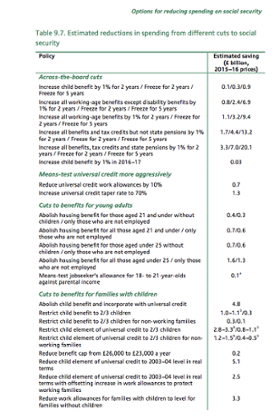
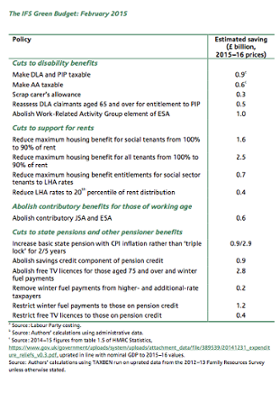
If you are looking for a guide as to how George Osborne can achieve welfare cuts of £12bn, this chapter, from the Institute of Fiscal Studies’ green budget earlier this year (pdf), is about as good as anything.
Here are the key charts, showing how much various measures would save. They start on page 225.
George Osborne has been tweeting about the budget.
Today I will present a Conservative Budget - a Budget that puts economic security first pic.twitter.com/yQ8kD8nmo9
— George Osborne (@George_Osborne) July 8, 2015
You can read today’s Guardian budget coverage here.
As for the rest of the papers, here are two comment articles worth reading.
One of the differences between households and governments that economists always talk about is that the latter has the power of taxation. They can’t borrow “too much”, say the economists. Such an idea is nonsensical, they say, because governments, unlike households, can raise money by using their legal power to demand it from people.
Yet this assumes that people will agree to let them use that power; it assumes that people will agree to pay the taxes. In America and in Greece, this idea has been tested and found wanting. Governments can much more easily gain consent to borrow money than they can gain consent to pay back the loans ...
When George Osborne started his cuts in 2010 the argument of, for instance, the distinguished economist Paul Krugman or Ed Balls, was that this was no time to be cutting. They said it was economically illiterate to cut when the country wasn’t growing.
Now is the test of this view. The country is growing. So if 2010 wasn’t the time to cut, by the same token, now is. They should support now what they opposed then. I’m not holding my breath.
Importantly here, Mr Osborne is proving to be a good thief, adept at pinching bright ideas from others. Labour people, missing the point, squeal that he nicked the Northern Powerhouse theme from them. That comes after he stole the Lib Dem tax policy of jacking up the starting threshold for income tax, and then decorated it with the language of Blue Collar Conservatism, again a concept he’s appropriated from others. In his Budget today, it will be no surprise if he moves on the living wage and the working poor, a cause Boris Johnson has tried to make his own.
Yet for all the rebranding and restyling, for all the intellectual heavy-lifting and light fingers, Mr Osborne is a contender because of his record, both political and economic.
He was at least jointly responsible for the big wager of the last Parliament, that deficit reduction would deliver a recovery, and votes. Now, you can debate the economic consequences of his fiscal policy ad nauseaum: maybe fiscal tightening actually delayed the recovery, and maybe he actually eased off on austerity, even if he doesn’t like to admit it. But politically what matters is how voters see all this. And they bought his argument that Labour spent all the money and that he had to balance the books if Britain was to prosper again.
Ever wonder what the Lib Dems are up to? This is from Phil Reilly, a Lib Dem official in the last government.
1st budget day for 5 years I haven't spent trying in vain to get credit for Lib Dems for raising tax-free allowance. Might make a cup of tea
— Phil Reilly (@phil_reilly) July 8, 2015
Today Tom Newton Dunn in the Sun says that George Osborne will cut most benefits for young people under the age of 21 in today’s budget. He also says that Osborne could cut tax credits for the under-25s. The story quotes a minister saying:
This will be one of the boldest budgets in a very long time, in more than a decade certainly. It will fundamentally recast the relationship between the state, the individual and the employer.
Markets are edging higher ahead of the Budget statement, with the FTSE 100 up around 0.4%.
But traders have more on their minds than Osborne’s speech, with an emergency summit on Greece called for Sunday, which could sign the country’s exit from the eurozone. China is also a worry, with its markets continuing to fall and regulators warning of “panic” among investors.
There will be a focus on UK banks as Osborne speaks, with traders looking for any changes to the bank levy and comments about selling off more of the state’s holdings in Royal Bank of Scotland and Lloyds.
Housebuilders could be affected by any changes to building regulations or council tax.
Updated
The cabinet meeting has broken up.
The Chancellor must have plenty to talk about: the pre-Budget Cabinet briefing has broken up after an hour and 20 minutes.
— Joe Churcher (@JoeChurcher) July 8, 2015
An artist, Kaya Mar, has been posing outside Number 10 with this picture of George Osborne. It is probably not one that the chancellor will be hanging in his living room.

Economic view
Osborne and the Conservatives have benefitted from a recovery in the economy, with GDP growing for nine consecutive quarters.
But the chancellor may have to announce a slightly worse outlook for the year, given signs of weakness in the first quarter. The Office for Budget Responsibility (OBR), which produces independent forecasts for the government, forecast in March that growth this year would be 2.5%, but this may now be scaled back to 2.4% or even 2.3% as it takes into account the effects of any spending cuts.
Osborne will be hoping the OBR will indicate the first quarter weakness was only temporary, and that future growth targets will be met. But he will be well aware of the possible impact on the UK economy of the crisis in Greece, especially if the country exits the eurozone.
Watch out for a repeat of his mantra on Greece: “We hope for the best, but prepare for the worst.”
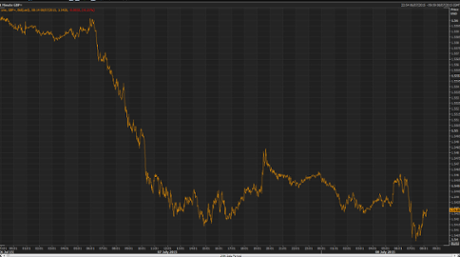
If the OBR does reduce its forecasts for this year, sterling could well slip back. Kathleen Brooks, research director at Forex.com said:
If the OBR revises down the growth forecast for the next few years on the back of the spending cuts, or expresses doubt that the government can reach its deficit targets during this parliament, then we could see the pound struggle, particularly against the US dollar.
[But] if Osborne announces any measures to boost the manufacturing sector then it may limit the pound’s downside, particularly after weak manufacturing production caused a sharp drop [against the dollar] on Tuesday.
Updated
The Treasury has tweeted a picture of the budget document being printed.
The document's printed, the speech is prepped; only 14 hours until @George_Osborne presents his #SummerBudget https://t.co/QByVtiieop
— HM Treasury (@hmtreasury) July 7, 2015
According to Andrew Grice in the Independent, George Osborne will announce that he is cutting maintenance grants for poorer students in the budget today. Here’s an extract from his story.
Maintenance grants for university students from low-income families will be scrapped and converted into loans in the Government’s next round of spending cuts ...
At present, students in England and Wales from families with annual household incomes of £25,000 or less qualify for maintenance grants of £3,387 a year.
If the family’s income is £30,000, the grant falls to £2,441; at £35,000 to £1,494 and at £40,000 to £547. It is not paid when household income is more than £42,620.
The grants are not repaid –– unlike the loans which cover tuition fees of up to £9,000 a year, which graduates start to pay off when their income reaches £21,000 a year.
Ministers may ensure that students from the very poorest families still qualify for grants – for example, by reducing the cut-off point from £42,620 to £25,000. They may also announce new moves to help young people from low-income families go to university.
The cabinet normally meets on a Tuesday, but this week’s meeting was postponed until today, so that George Osborne could brief his colleagues on the budget measures. Here is some video of ministers arriving at Number 10 this morning.
The Cabinet gathers to hear from George Osborne about his first all-Tory Budget: pic.twitter.com/0BQyawwe9P via @JoeChurcher
— Press Association (@PA) July 8, 2015
The Tory MP Chris Philp has tweeted a picture of the scene in the members’ lobby in the Commons earlier, where MPs were queuing up to reserve a seat for today’s budget.
Waiting with other MPs to reserve seats in the Commons for today's budget pic.twitter.com/goWrdJYK5S
— Chris Philp (@chrisphilp_mp) July 8, 2015
Updated
Any politician - or, indeed, anyone remotely interested in the craft of politics - dreams about the laws they would pass if given a totally free hand. Of course, politicians never get a totally free hand; even a prime minister with a large majority is constrained by internal party politics, Whitehall inertia, the judiciary, and a host of other factors. But for George Osborne, the chancellor, today will probably be as close as he will ever get to that moment of maximum elbow room. This is his seventh budget, but his first without Nick Clegg and Danny Alexander vetoing some of his ideas. The Conservative majority is small, but Tory MPs are buoyed by their surprise election victory and Osborne will never have a better chance to get difficult measures through the Commons. As a result, we’ve been told that this will be a very big budget indeed - one that will define the government for the next five years.
A budget statement lasts about an hour, but these days budgets have become like Indian weddings or music festivals - a week-long news event, with the first stories coming out well in advance. As a result we have already had quite a lot of detail about what is coming. (Whether these stories are “leaks”, or proper Treasury announcements, is sometimes a moot point - since the Lib Dems left government, the supply of proper budget leaks has somewhat dried up.) And new information emerged last night, as Patrick Wintour has reported in the Guardian’s budget story. Here’s how it starts.
George Osborne will use the first Conservative budget in 18 years to slash billions from in-work tax credits and housing benefit, although the chancellor is likely to slow the pace of an expected £12bn cuts to the welfare bill.
An initial cut of £8bn in welfare over two years was being predicted on Tuesday night, closer to the pace of welfare cuts agreed under the previous coalition government and intended to protect Osborne from criticism he is likely to face from Labour and charities.
The scheme would mean that the plan to cut £12bn by 2017-18 has been altered to give the work and pensions secretary Iain Duncan Smith an extra year to implement the savings.
Analysis Summer budget 2015: what to expect from George Osborne Clues from past budgets and manifesto pledges can help us gauge the likely changes Read more
The budget will also set out plans first laid out in the Conservative election manifesto to raise the 40p tax threshold. The manifesto proposed that, from April 2016, the 40p rate should only kick in when earnings reach £42,700 and, from April 2017, when they reach £43,300. Officials added the rate would rise further to £45,020 in 2019.
The change is estimated to cost the exchequer £1.68bn by 2019-20. The tax break for the middle class will be defended on the basis that a failure in the past to raise the threshold has brought more people into the 40p rate.
The changes to welfare, the biggest test of Osborne’s political judgement since his “omnishambles” budget in 2012, also leave in question the future design of universal credit, the government’s major integration of in- and and out-of-work benefits. The cuts will probably put hundreds of thousands of families into poverty under the definitions the government abolished only last week.
I will be covering the budget today with Nick Fletcher. We will be highlighting the best pre-budget reporting, covering the statement as it happens, and then bringing you the best comment and analysis, with a focus on the details contained in the budget small print.
Here are the key timings.
12pm: David Cameron takes PMQs.
12.30pm: George Osborne delivers the budget.
If you want to follow us on Twitter, I’m on @AndrewSparrow and Nick is on @nickfletchergdn