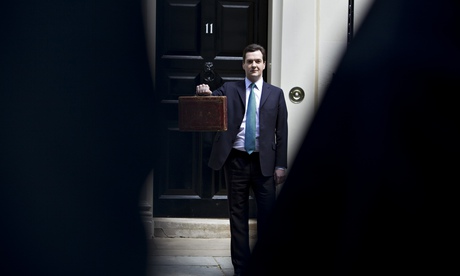
When George Osborne delivers what could be his last budget on Wednesday, just weeks before the election, it will be a time to look forward: the chancellor’s annual day in the spotlight will set the tone of the Tories’ campaign, and perhaps even lay the groundwork for a future leadership bid.
But lest we get too swept along by the theatrics of the occasion, and the practised rhetoric of this consummate politician, it’s worth comparing his record over the past five years with the task he set himself in the “emergency” budget of 2010.
You could almost hear the stirring cadences of Jerusalem in the background as Osborne promised “to raise from the ruins of an economy built on debt a new, balanced economy where we save, invest and export… An economy not over-reliant on the success of one industry, financial services – important as they are – but where all industries grow. An economy where prosperity is shared among all sections of society and all parts of the country.”
No one could expect even the most zealous reformist government, particularly one that came to power following the worst financial crisis in living memory, to reshape the nation’s economic model in five years against the background of a shaky global recovery.
But it’s fair to ask whether, and where, Osborne has made a start. Let’s take it from the top. Are we “saving, investing and exporting”, instead of relying on debt to generate demand?
Saving: not much. The Office for Budget Responsibility warned last December that the reason it believed growth would slow in 2015 was that the acceleration in consumption that has helped to fuel expansion over the last two years “was still financed mainly by lower saving, rather than stronger income growth”. While the rate of job creation has been impressive over the past couple of years, wage growth has been weak: so while families may have felt confident enough to start spending again, they haven’t yet had the pay rise to match.
And for many households, it’s all but impossible to save anything. A report from the Social Market Foundation last week found that the lowest income households have on average just six days’ earnings put aside: less than in 2005.
Investing: a bit. Perhaps one of the chancellor’s worst mistakes was to stick with Labour plans to cut capital investment sharply at the start of the parliament. It has since picked up again, and Osborne has stressed that it will expand in line with GDP over the next five years, boosted by high-profile projects such as HS2. Business investment has belatedly started to expand too. It would take far more rapid growth to undo decades of underinvestment, but it’s a start.
Exporting? Not as much as we’d like. As a recent report from the Institute of Public Policy Research pointed out, Britain has a few areas of exporting strength, including drugs, cars and chemicals, but the overall trade deficit has barely budged.
The OBR expects the contribution of trade to the UK’s economic growth over the coming years to be “slightly less negative” than of late, and for our share of world markets to continue to fall, but at a slightly slower pace than before the crisis. That’s a modest improvement, but hardly the kind of transformation Osborne hoped for.
Some of Vince Cable’s efforts at establishing a 21st century industrial policy, such as the government-backed Catapult centres for innovation, may yet yield fruit; and there has been progress in boosting exports to major emerging economies such as China. But with sterling strengthening rapidly against the single currency – to the selfish delight of those of us planning an Easter break in the eurozone – exporters have been losing competitiveness against their German rivals by the day.
As for “an economy not over-reliant on the success of one industry”, the latest data shows business services and finance – which includes consultants and accountants as well as bankers – growing twice as fast as manufacturing in the final quarter of last year, and workers in that sector getting the largest pay rises of anyone in the economy.
On Osborne’s aspiration that prosperity would be “shared among all sections of society and all parts of the country”, the picture is mixed. There have been some pluses as far as rebalancing is concerned: the chancellor has made much of his plans for a “northern powerhouse”, devolving fresh economic decision-making powers to Manchester, for example; and intriguing research by the Resolution Foundation last week suggested that the biggest gains in median incomes over the past year were not in London or the south-east, but in Yorkshire and the Humber, and the north-east.
But on prosperity being shared by “all sections of society”, the record is woeful: as the Institute for Fiscal Studies says, the benefits of the coalition’s central tax-cutting measure – the increase in the personal income tax allowance – never reach the poorest, who rarely earn enough to use up their personal allowance anyway. Higher paid two-earner couples benefit twice. Meanwhile, the recovery in the housing market has continued to bolster the fortunes of older voters at the expense of twentysomethings unable to get a foot on the ladder, and the jobs market too has been far kinder to older workers than those starting out.
So while Osborne will boast that the UK is now growing faster than most other major economies, beneath those headlines many of the old faultlines already evident before the crash – between north and south, City and industry, young and old, rich and poor – have only deepened since 2010: and it is hard to see how five more years of austerity is going to help them heal.