The £100m for driverless cars announced by George Osborne will be matched by a similar commitment from business, to help fund research and development on the computer and telecoms systems needed to make the cars a reality.
The chancellor said the money would help the UK’s “brilliant automotive industry ... to stay ahead in the race to driverless technology”.
Now companies will bid for funding through a series of competitions, with projects expected to work collaboratively between the automotive, telecoms, IT and infrastructure sectors, exploring how driverless vehicles would connect to each other and the wider transport system.
The first trials of driverless cars in public areas of Britain were started this year. Steve Yianni, chief executive of Transport Systems Catapult, which is trialling a prototype in Milton Keynes, said: “We welcome this opportunity for the UK to consolidate its position as the world leading place to trial and demonstrate driverless technologies.”
The government believes the UK’s research centres and dedicated university departments, as well as the most open regulation in Europe, make it well placed to lead in autonomous transport technology, a field it estimates could be worth £900bn globally by 2025.
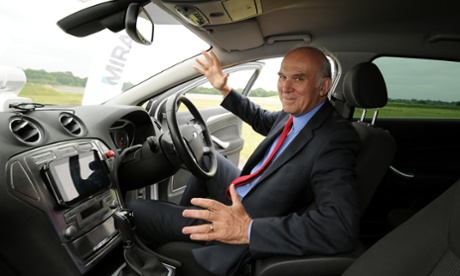
The business secretary, Vince Cable, said: “Today’s £200m investment will ensure the UK stays at the cutting edge and is well placed to profit from the growing market for high-tech vehicles of the future – creating jobs and driving economic growth.”
Industry observers warned far more would still be needed.
Nathan Marsh, who leads on smart infrastructure at consultants EY, said: “The £100m investment to support driverless cars is excellent news and will help existing pilots schemes get out of first gear. However, if we are to truly see a driverless car revolution, the government will need to commit to additional investment in smart infrastructure and cities, in order to support integration across the existing road network.”