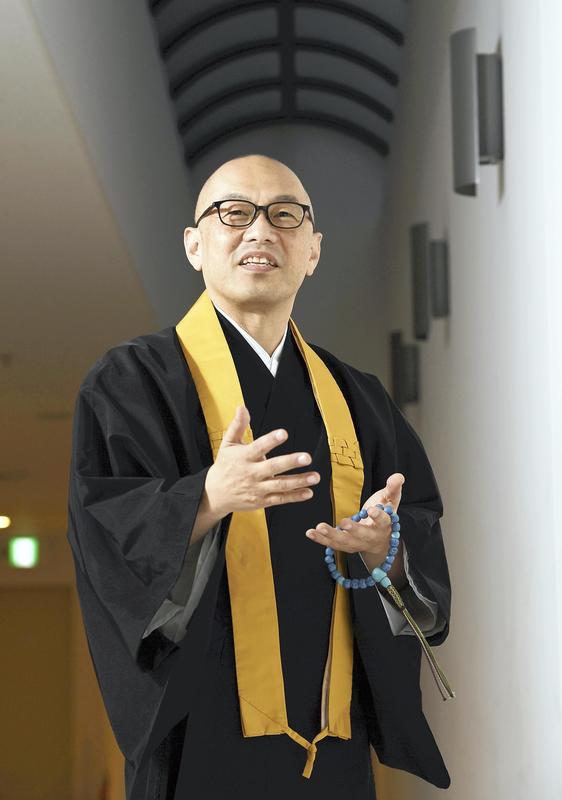
The new coronavirus pandemic is continuing to spread, and fear and frustration are mounting within people. What should we keep in mind in such a situation? Priest and religious scholar Tesshu Shaku has contributed his view on the topic to The Yomiuri Shimbun.
Born in 1961, Shaku is the chief priest of the Nyoraiji temple in Ikeda, Osaka Prefecture, and a professor of religious studies at Soai University. He also serves as president of a nonprofit organization that runs a group home for people with dementia, and he is the author of books on Buddhism.
The current situation is not such that everything will be back to how it was if we simply endure the present. On this occasion, we will likely reconsider and reassemble our society and how it was before the pandemic. For example, I think the virus has revealed that having a trusting, steady relationship between the government and the people is important, and that local governments making decisions and speedily executing them can be effective at times.
We have also learned that urban centralization has rendered our society vulnerable to crisis. There is also need for a review on public medical institutions, infection-control measures and other areas likely to be neglected in peaceful times due to efficiency-first policies. Forms of religion and school education systems may change all at once as well. There is no bystander to this. Everyone is a participant.
Do you know of the cognitive distortion called normalcy bias? Humans, even in a time of crisis, try to maintain a sense of normalcy by keeping their behavioral patterns unchanged. It is a psychological coping mechanism humans have, trying to cling to everyday life. So much so, sometimes, that they find it difficult to leave home even when an evacuation advisory has been issued, for example. Even though the possibilities of massive earthquakes are discussed, there is no actual plan for relocating capital functions. However, a great opportunity will present itself due to the pandemic. In a way, there are opportunities to breathe fresh air into areas once rigid and inflexible thus far, if they can be steered in the right direction.
In any case, the present situation will be here for a long while. We have to settle in for the long haul to avoid a sudden peak in infections. To do so, we need to change our mind-set.
For example, it is not only the virus being transmitted; there is also the feeling of being overwhelmed. When people's minds are overwhelmed, rejection and hatred occur. Anger and violence transpire aboard trains and in family homes. The mentality of "only me" and "only now" strongly takes hold, while being aware of mutual aid dwindles. Depending on circumstances, it may cause divisions between haves and have-nots. Minds that are overwhelmed harbor antagonism and aggression. Emotions and sensibilities are under considerable threat as well.
The opposite of the overwhelmed and rigid mind is an open mind. Buddhism teaches "nyunan-shin," or an open mind. It is an unprejudiced, harmonious mind. Buddhist teaching can open your mind and help make your own sense of what is convenient for you less rigid. It does not have to be Buddhism. Listen to and look into the wealth of wisdom traditional religion has accumulated, and you can make your mind more open. Try having a more open mind.
What is important, above all, right now is to wait and to forgive. People nowadays are not good at practicing patience and forgiveness in the first place, which is quite a problem. Any traditional religion preaches generosity and waiting for the right moment. Now is the time we all must confront this issue. We have to slow down compared to when we were moving at an incredible speed. During this long-term war against the virus, impatience will only diminish your mind. It is vital to look inward and deliberately prolong the length of time in your awareness. Come to think of it, novelist Hiroyuki Itsuki had a nice metaphor: If the economy is the accelerator and engine, and politics is the steering wheel, religion is the brakes.
To repeat myself: We are not simply enduring this situation until things return to how they were. This is us preparing to go to the next step. Not that what was before all this was necessarily normal.
Read more from The Japan News at https://japannews.yomiuri.co.jp/