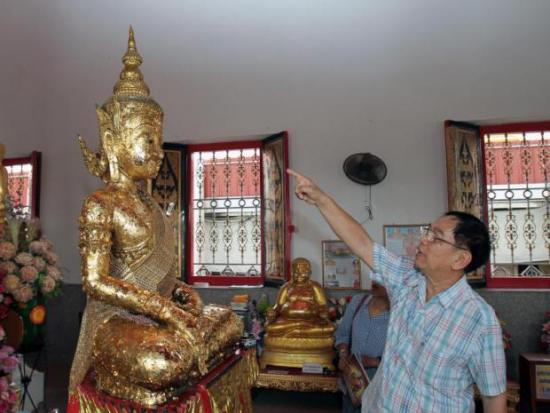
Wat Toom, a local temple in Ayutthaya province, is famous for its ancient Buddha statue, which believers claim to be a source of mysterious holy water.
The temple has recently attracted many visitors as it will be one of the sacred water sources for use in the coronation rites for His Majesty the King next month.
Wat Toom is situated in Phra Nakhon Si Ayutthaya district, an ancient town which was a former capital of Thailand until three hundred years ago.
The temple has long been famous among residents who come to worship the bronze Luang Phor Thongsuk Samrit statue.
The upper part of the head of the statue can be opened and taken off, revealing a hollow space on the inside where monks claim sacred water mysteriously drips from.
According to Wichai Sa-nguanpath, a temple attendant, the water leaks out "as if it were drops of sweat".
"The water never dries out," said Mr Wichai.
On the first day of Dhammasavana, or Wan Phra, of each month, as well as other significant days of the Buddhist calendar, a ceremony is held to open the Buddha statue's head and collect the water inside.
The sacred water is then mixed with clean water in large jars for distribution to visitors and local worshippers.
"Some put the sacred water into their own containers or even plastic bags to take home. Local people believe that the holy water from Luang Phor Thongsuk Samrit statue's head can cure diseases and bring good fortune," Mr Wichai told Bangkok Post.
Phra Sitthi Phatthanodom, the temple's abbot, said that there is no record of when and by whom the temple was built, only that it is believed to date back prior to the establishment of the Kingdom of Ayutthaya over 600 years ago.
The temple was deserted after the downfall of the Ayutthaya Kingdom in 1767.
Wat Toom subsequently underwent several renovations in the Rattanakosin era.
Kings Rama IV and Rama V visited the temple to perform special krathin ceremonies -- the presenting of robes to the temple monks, according to the abbot.
The temple was also a place where a ceremony was held to inscribe sacred script on Thong Chai Chalermphol, or the Flags of Victory that were given to Siamese troops who fought in the 1st World War, the abbot said.
The temple was registered by the Department of Fine Arts as a historic site in 1934 and is one of 108 sources of sacred water across the country.
On April 6, there will be a ceremony to take the water from the 108 sacred sources nationwide.
The water will be blessed by monks at their respective temples on April 8, and then taken to Wat Suthat Thepphawararam in Bangkok for a final blessing ceremony on April 18.
The lustral water will be moved to Wat Phra Si Rattana Satsadaram, or the Temple of the Emerald Buddha, in the Grand Palace on April 19 for use in the coronation ceremonies, which span three days from May 4-6.