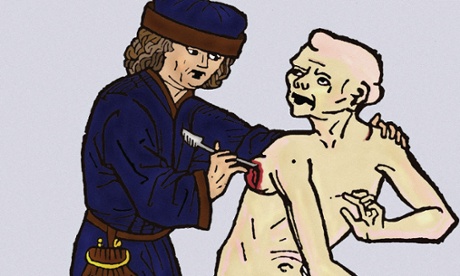
There are two forms of plague: the first is the common bubonic form which is transmitted from fleas to humans. In some cases, however, the human can also become a transmitter, and then the disease becomes the pneumonic plague, which can kill within 24 hours.
Roughly one case in 50 turns into pneumonic plague. The affected person then becomes a serious health risk in his environment and this is when in a densely-populated city, such as the poor districts or prisons of Madagascar, a plague may mean disaster.
Professor Rogier from the Pasteur Institute of Madagascar (IPM)describes such situations as the “nuclear blast” because the disease would then become extremely difficult to stop and contain. That is the major risk with bubonic plague, which is why the health ministry and other actors in Madagascar have put in place a contingency plan.
The plague spreads in Madagascar ever year and the Red Cross focuses closely on trying to prevent the plague within Madagascar’s prisons. Inmates are at particular risk due to a lack of water and overall sanitation in prisons; they share their cells with cockroaches, bugs and hundreds of rats. Prisons in Malagasy are tough and very overcrowded, so if one or two people become sick with the plague, it can rapidly become a catastrophe. Our aim is to ensure that we stick to zero cases.
This involves training the “rat brigades”; we teach them how to to prepare special boxes through which the rats pass so that their fur gets covered in insecticides that kill the fleas and their eggs. It is only after the rats have been used to spread the insecticides that they are captured and killed and the brigades check if any of them have been infected. Eleven prisons now have properly-trained rat brigades, and we just have to supply them with the necessary items.
In fact, this is the process that you are supposed to carry out everywhere – not just in prisons – if you want to reduce the risk of catching the plague. The difficulty is that the rats are everywhere in the capital. I live in Antananarivo, and just yesterday we saw rats running around our house. We were just saying, “Well, we need to do something about it in our own home!”.
But, as I said, this year is not particularly different to previous years; it’s just that people are now writing about it and linking it to Ebola. An outbreak of disease comes along and everybody freaks out a bit. It’s true that in the 14 and 15th centuries bubonic plague wiped out half of Europe. It still has not been eradicated completely from the world; around 20 countries are still affected.
The last case in the US was reported back in 2011. One person died, a scientist. He was tracking a wild animal, and for some reason he found a fox and he decided to carry this animal back home for an autopsy. Basically, the animal transmitted the plague and he died.
But in truth, the biggest problem here and around the world is ignorance. The biggest killer in this country, and in many places of the world, is really ignorance. Because with the plague, as long as you have access to medicine, to a diagnosis, information, to prevention techniques such as keeping your place clean of rats, there are many measures that can be aken. And even if you are sick, as long as you get to a doctor, get a diagnosis and the antibiotics, that’s it, you are okay.
It’s just that people don’t get the diagnosis, don’t get the antibiotics, and die. And this is the drama of this country. The plague should not kill anybody in Madagascar. The health ministry has a stock of antibiotics and the treatment of plague is free so there is no discrimination. It is ignorance that is killing people.
Christophe Vogt is with the International Committee of the Red Cross, and has been based in Madagascar since July 2012.
Vogt was speaking to Maria Evrenos.
Read more stories like this:
• Meet the 23-year-old TB survivor taking on South Africa’s patent laws
• In pictures: Syrian children paint a brighter future
• ‘Five of our patients have attempted to take their own lives’
• Advertisement feature: The dawn of a new era for malaria elimination
Join our community of development professionals and humanitarians. Follow @GuardianGDP on Twitter.