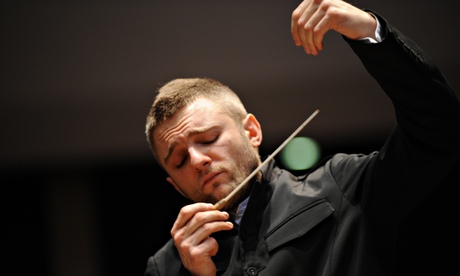
Kirill Karabits has already proved himself to be a most astute conductor of Beethoven, and the drama he brought to the overture Coriolan made for a bristling start to this Bournemouth Symphony Orchestra concert. It immediately raised questions as to how he would interpret the main work of the evening, Schubert’s Great C major symphony.
Taut classical discipline is a Karabits fundamental and this Schubert was no exception. Yet, from the outset, the symphony had a gently romantic and lyrical flow: Karabits underlined its distinctive orchestral colour – notably the inclusion of three trombones – without any trace of overblown or pompous gestures. The andante, too, often reduced to a slow military march, was instilled with a light, dancing quality and the finale carried a mercurial exuberance. Beethoven may have been the composer for whom Schubert carried a torch, both in the metaphorical sense and, in the end, literally, as he walked in Beethoven’s funeral procession, but Karabits made everything seem to point to the future, in particular to Dvořák, brimful of ideas and natural vitality.
Giving concerts titles is risky and the Swansongs label – occasioned here by the pairing of Schubert with Strauss’s Four Last Songs – can anyway sound like the kiss of death. The cycle’s aura of philosophical contemplation is, of course, capable of inducing a transcendent bliss but, in this performance, it fell somewhat short of that expectation. Soprano soloist Sally Matthews didn’t quite radiate the warmth or intensity she might, words often lost, and Karabits seemed a bit heavy-handed with the orchestral tones for the Colston Hall acoustic. Rather, it was Nicolas Fleury’s horn solo in the postlude of September and that of leader Amyn Merchant’s soaring violin in Beim Schlafengehen that sang out.