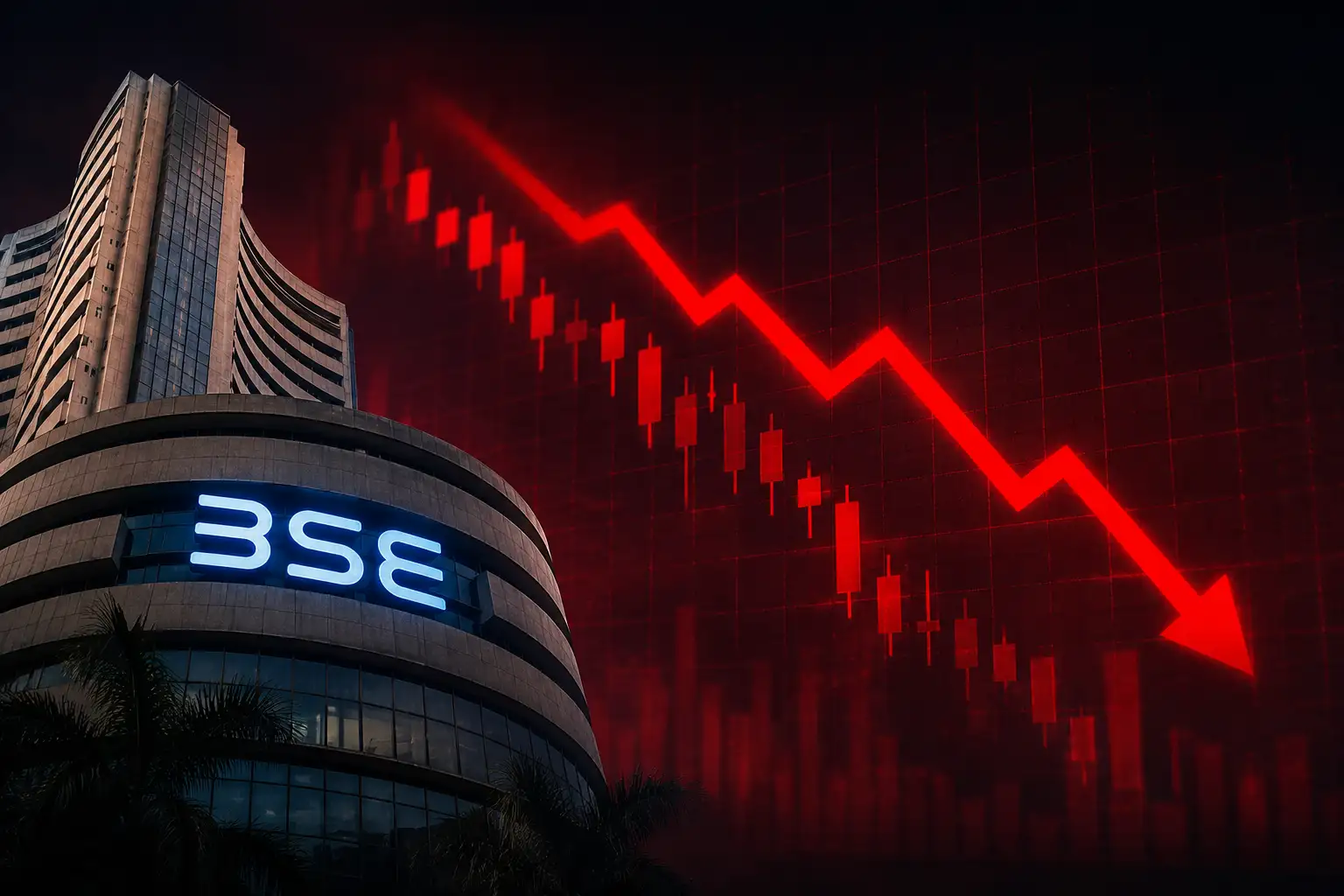
Shares of BSE dropped around 3% on Tuesday, extending losses for the fifth consecutive session after Nuvama downgraded the stock’s rating to Hold from Buy, and slashed its target price, listing three key headwinds converging in FY27.
BSE shares dropped to Rs 3,235 apiece on Tuesday morning, the lowest level seen by the stock in around five months. Shares of the stock have now fallen more than 10% over five consecutive sessions of losses.
Nuvama on BSE share price
Nuvama downgraded its rating on the shares of BSE to ‘Hold’ and slashed its target price to Rs 3,240 apiece from Rs 4,090 apiece. The latest target price implies around 3% downside potential from the stock’s previous closing price of Rs 3,332 apiece.
The brokerage highlighted three headwinds for the stock exchange that converge in the ongoing financial year 2027. Here are the 3 key headwinds.
1) CAS has reset volumes, impairing expiry-day decay trading dynamics
The newly introduced closing auction session (CAS) has led to huge confusion among traders, resulting in lower participation. Nuvama highlighted that BSE’s index option premium volumes (ADPTV) of Rs 18,100 crore are the lowest since January 2025.
The premium per contract, which had spiked 54% to Rs 2,605 in the first week of August, has fully unwound, and premium-to-notional is back to 11.1 bps versus 10.9 bps in July, it added, noting that the key issue is lower trading velocity and participation loss.
“Earlier, option premiums decayed predictably into expiry, enabling repeated participation through short duration trades. CAS introduces uncertainty in final settlement due to auction-based closing, reducing the predictability of this decay path. This weakens theta-harvesting strategies and reduces leverage for buyers that previously relied on rapidly falling premiums, and reduces seller interest due to uncertainty of option decay—impacting a large part of the ecosystem,” Nuvama said.
The damage is visible as BSE expiry-day contracts fell 33% versus 24% for non-expiry, the brokerage highlighted.
2) Bank guarantee norms are second leg
RBI's bank guarantee norms are the second leg, and they arrive precisely as CAS impact could heal, according to Nuvama. Tighter collateral requirements may raise capital intensity for intermediaries, reducing turnover efficiency in high-frequency strategies that drive contract volumes, it added.
The brokerage feels that the impact is likely gradual but could cap recovery into FY28.
3) Market share gains are nearing saturation
Nuvama highlighted that BSE’s contract share of nearly 51.5% is already high, but ADPTV's share remains lower at around 36%, due to a lower mix of non-expiry-day contribution. This is limiting incremental upside from further share gains, according to the brokerage.
“With contract MS at 50% and incremental levers exhausted, we see no near-term trigger. The gap to ADPTV share of 36.3% is structural due to higher concentration near expiry,” it further said.
Nuvama cut BSE’s EPS estimates by 6.3% for FY27 and 15% for FY28. However, it sees a recovery in VIX as the largest swing factor, suggesting that a move in VIX towards 16–18 could materially lift premium per contract and ADPTV even without a recovery in contracts.
Faster-than-expected adaptation to CAS, deeper closing-auction liquidity, regulatory recalibration of CAS mechanics, and stronger non-expiry participation could also drive volumes above Nuvama’s revised assumptions.
Jefferies on BSE share price
Nuvama's downgrade comes a day after Jefferies downgraded the counter to 'underperform' from 'hold' and trimmed the target price to Rs 2,940 from Rs 3,520.
Jefferies flagged risks to BSE’s revenue from domestic proprietary traders, who account for around 50% of notional turnover. It sees headwinds from the STT hike, RBI’s bank guarantee norms and the Closing Auction Session (CAS).
Also read | BSE shares tumble 5% after Jefferies downgrades stock to 'underperform'. Here’s why
BSE share price
BSE shares have fallen over 9% in a week and 8% in a month, although the stock is overall up 25% in 2026 so far. After hitting a 52-week low of Rs 2,021.50 apiece in September last year, BSE shares more than doubled in eight months to hit a 52-week high of Rs 4,447 apiece in May this year. The stock has now fallen more than 27% since then to trade at Rs 3,235 apiece on Tuesday morning.
In the longer term, BSE shares have delivered stellar returns of 1,038% in three years and more than 2,500% in five years. The company has a market capitalisation of more than Rs 1.3 lakh crore.
(With inputs from agencies)
(Disclaimer: Recommendations, suggestions, views and opinions given by the experts are their own. These do not represent the views of The Economic Times.)