Imagine a world where making architecture is calm and civilised. Light and ready-made components arrive on site in vans. White-coated technicians clip them neatly into place and in due sequence, without noise, mess or confusion. Buildings progress in days and weeks, not months and years. So smooth has the process of construction become that designers can focus on their clients’ needs, against a backdrop of orderly space and beauty.
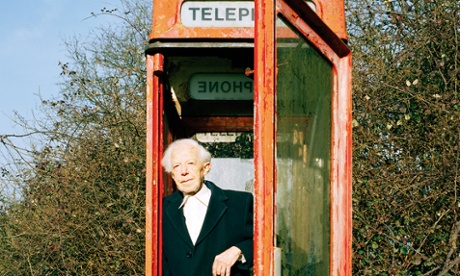
That was the pipe dream of the architect Bruce Martin, who has died aged 97. The last member of the team that built a series of renowned schools in Hertfordshire after the second world war, Martin shunned fame to pursue the architectural holy grail of “modular coordination”. One by-product of that search was his design of the modernist K8 red phone box in 1968.
Like many architectural idealists of the austerity period, Martin had a background steeped in practical engineering. He was born in Clapham, south London, to Marcelle, a Frenchwoman, and Harold, an English electrical and mechanical engineer. His father worked for the Admiralty, and young Bruce was brought up near Portsmouth dockyard. Unable to start studying architecture until he was 18, he spent two years in Hong Kong, where his father had been posted, helping a Belgian architect to design flats. Back home, in the febrile atmosphere at the Architectural Association School of Architecture in London during the mid-1930s, he was one of three star students – along with David Medd and John Madge – who were asked by the modernist architect Berthold Lubetkin to review the technical arrangements for Lubetkin’s new Finsbury Health Centre in north London. It was one of the first modern buildings to have a separate zone for all the services.
During the second world war, Martin worked at Short Brothers’ factory in Rochester, Kent, making drawings of Short Stirling bombers. While there he wondered whether the manufacturing precision obligatory in aircraft production could be transferred to construction.
That was one of the goals of the team that came together in Hertfordshire in 1946-48 to deliver the county’s urgent programme of dozens of prefabricated primary schools. Martin was one of the first arrivals, drawn in by Medd and Mary Crowley. The buildings were simple but fresh and optimistic, with airy, lightweight and flexible classrooms.
Martin worked on Burleigh junior school at Cheshunt and Morgans Walk junior and infants school at Hertford, which still survive in use. But he quickly grew impatient with the clumsy compromises involved in the project and set out to devise an entirely fresh system from scratch. If you could agree a basic dimension or module and have all building components manufactured to multiples of that size, he believed, then you could revolutionise construction.
These ideas had been pioneered in the US by Albert Farwell Bemis, and had been taken up in Germany by Ernst Neufert and Konrad Wachsmann. After the war, they also made rapid headway in Britain, where the dominance of the public sector seemed to make reform of the wayward and irrational construction industry a real possibility.
Martin put his theories into practice on two schools in Hertfordshire – Clarendon secondary modern in Oxhey and Summerswood primary school in Borehamwood, designing both on a module of 3ft 4in – close to a metre. They were technically brilliant, but not much liked by the teachers who had to work in them.
In 1953 he joined the British Standards Institution (BSI), where he worked in a small unit pursuing the great mission of modular coordination, both within Britain and across continental Europe. Propaganda was conducted by the eccentric Modular Society, run with an iron grip by Mark Hartland Thomas, with Martin as a stalwart disciple. But the task was herculean and soon fell foul of established interests, particularly in the British brick industry. Building sites remained shambolic, component sizes only half-standardised.
Martin left the BSI in the 1960s to teach part-time at the Cambridge School of Architecture and to run his own one-man practice, which won a General Post Office competition to design a new phone box. The K8, introduced in 1968, revealed Martin’s deftness as an industrial designer. The 450 pieces of the previous K6 box were reduced to 183 if you counted every screw – or just seven if you counted the separate elements. But like so much of Martin’s legacy, it did not last. Only about 50 of the more than 11,000 K8s survive, the largest cluster of them in Hull.
Alongside his architectural practice, Martin’s work on modular coordination continued until the 1980s. He sacrificed years of his life to gathering knowledge of the nuts and bolts of modular coordination; the results included such encyclopedic publications as Joints in Buildings (1977). He was a logical positivist among architects, believing in building components as the sole rational elements of architecture, like nouns or facts in language. His practicality was entwined with a pinch of mysticism in his passion for number and order; he would say, for instance, that Jesus had 12 apostles, which was the perfect number for a small organisation.
While Martin was something of a loner, he combined charisma with great charm and gentleness. In 1949 he married Barbara Parr, a fellow architect who worked at the Building Research Station (now the Building Research Establishment). They lived all their married life in Little Hadham, Hertfordshire – from 1957 in a thatched cottage painstakingly restored. He was a good gardener in a taxonomic sort of a way, while Barbara, expert in alpine plants, was subtler. Together they travelled widely, once as far as Tashkent, in pursuit of plants.
Barbara predeceased him in 2001. He is survived by their children, Susan and Jonathan, and by three grandchildren, Cassie, Anna and Toby.
• Bruce Martin, architect, born 20 December 1917; died 22 April 2015