Groups using the names and imagery of 1970s-era militant movements are reappearing in public protests tied to immigration enforcement, underscoring how intensely ICE raids are reshaping activism in cities.
The big picture: Today's groups are not the original Black Panthers or Brown Berets, yet their visibility signals a broader shift toward confrontational symbolism as ICE and Border Patrol face little accountability over excessive force accusations.
State of play: The appearance of sometimes militant armed groups could heighten tension following the shooting deaths of Alex Pretti and Renee Nicole Good by federal agents.
- These groups present themselves as immigrant-rights defenders, not paramilitary forces — but the revived names carry historic weight.
Catch up quick: ICE enforcement activity has increased in several cities, prompting large protests and neighborhood-level response efforts.
- In that climate, groups using the "Brown Berets" name have appeared publicly in Texas, Minneapolis and California.
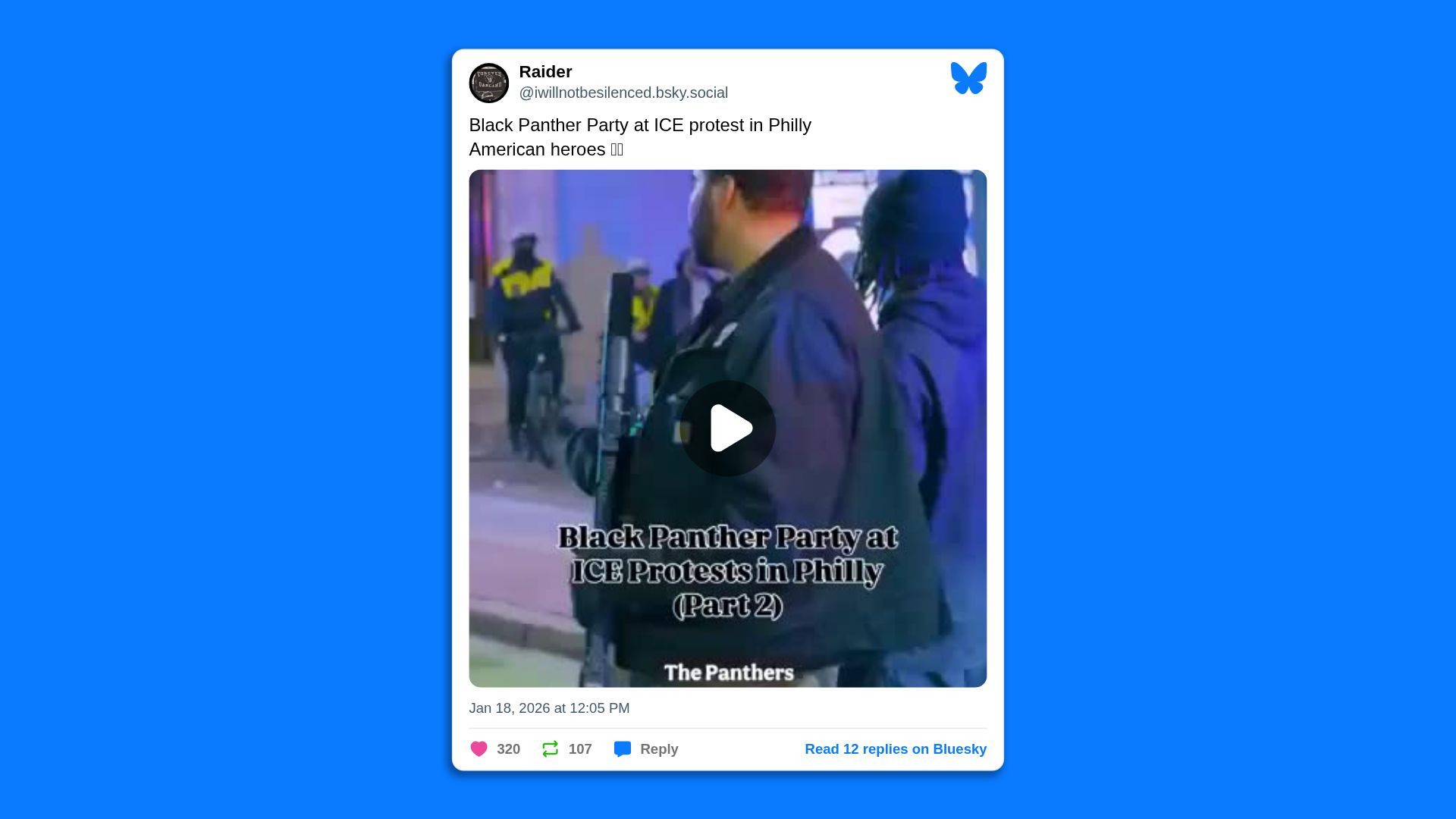
- Separately, individuals claiming to be the "Black Panther Party for Self-Defense," and later changing their name, surfaced at anti-ICE protests in Philadelphia. Others have also appeared in San Diego.
- The American Indian Movement (AIM), an Indigenous rights organization founded in 1968, said it has also started "community patrols" in Minneapolis.
Zoom in: North Texas Brown Berets were visible at a vigil following a shooting at a Dallas ICE field office, per KERA News.
- In San Antonio, Texas, a group identifying as Autonomous Brown Berets posted warnings about heightened ICE activity. West Side Brown Berets in Salt Lake City are also involved in demonstrations.
The intrigue: Even where historic names aren't used, Panther-style community patrols are spreading like Los Angeles volunteers patrolling neighborhoods to warn residents of ICE presence.
- Organizers openly cite Black Panther "cop-watch" models as inspiration, often stressing that patrols are unarmed and focused on documentation.
What they're saying: "It is the duty of the Panthers to fight injustice and engage in activities that unify the community," Robert War, chairman of the San Diego Black Panther Party, said in an Instagram post.
- War said the group is "in sync" with groups fighting against ICE and the Border Patrol.
- Paul Birdsong, chairman of the Black Lion Party for International Solidarity, expressed similar sentiments and promised his group would protect people in Philadelphia.
The other side: Some people connected to the original Panther legacy have publicly criticized efforts to participate in anti-ICE protests, saying they distort the movement's historic focus and misuse its name.
- Myesha Newton — the niece of Black Panther Party co-founder Huey P. Newton — posted a video condemning the Philadelphia group using the party name at anti-ICE events.
- Others on social media argue that invoking the Panther brand in the context of immigration protests risks turning a historically specific movement into a catch-all symbol.
Yes, but: Birdsong and others have countered that argument that the original Black Panthers previously worked with Palestinians, Chicanos and offered help after the Stonewall Riots.
Context: Philly's Black Panther Party was founded in 1968 and lasted for about five years, running breakfast programs and community patrols, but its membership dwindled following targeted police pressure, according to the University of Washington.
- Birdsong — who didn't respond to Axios request for comment — told the Inquirer that members of the Black Panther Party recruited him to restart the local chapter following the killing of George Floyd in 2020.
- Birdsong's group has conducted food giveaways from their North Philadelphia headquarters and has been spotted patrolling neighborhoods, armed with long guns that have led to some terse interactions with police.
Flashback: The Brown Berets emerged in the late 1960s as a Chicano movement group focused on police brutality, education and self-determination.
- The Black Panther Party combined armed self-defense with expansive social programs — and became a central target of federal surveillance.
- Both groups left a lasting visual and rhetorical legacy, even after dissolving.
Between the lines: Panther-branded activism today reflects a generational shift, not a straight 1960s movement revival, Jennie Luna, a professor of Chicana/o Studies at California State University Channel Islands, tells Axios.
- "It's no different than what young people were doing back then, pushing the elders, saying, 'This is who we are now'."