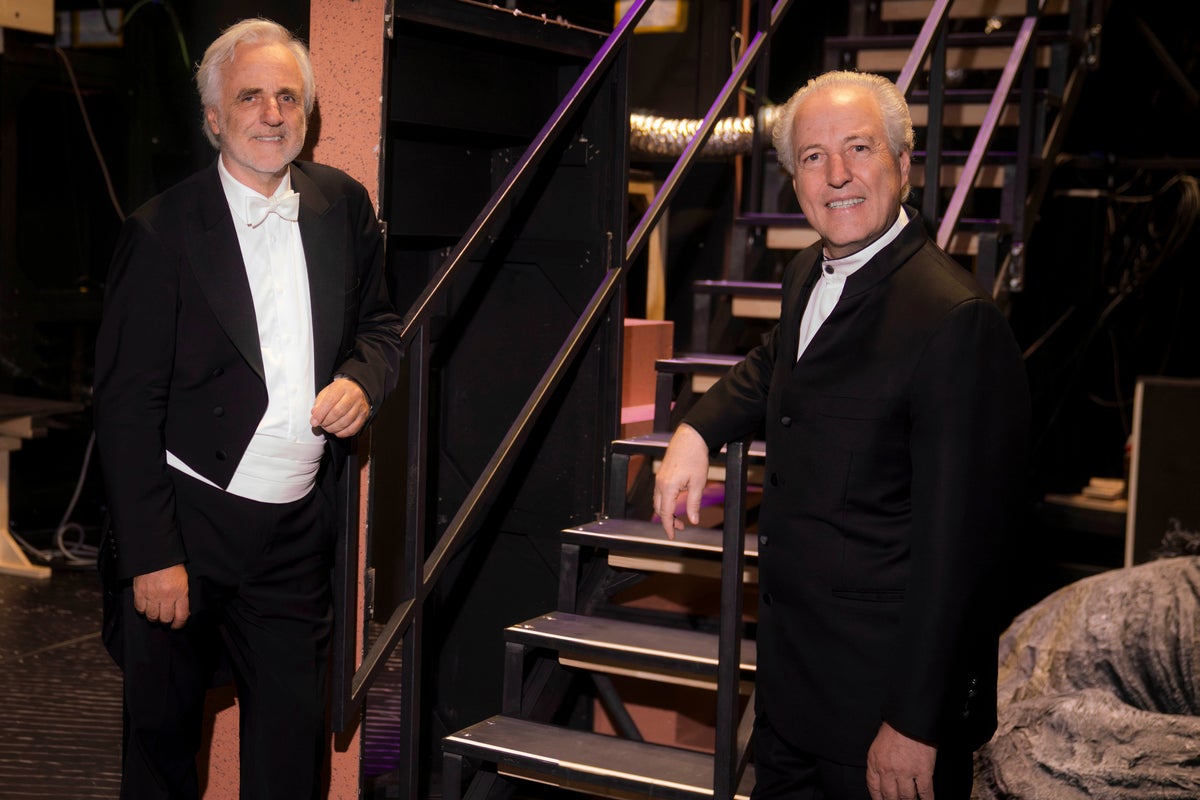
Austrian conductor Manfred Honeck was walking out of a rehearsal with soprano Christina Nilsson and the Vienna Philharmonic at the Haus für Mozart when they passed a violinist who had just been practicing with them.
“This is the concertmaster,” Honeck said, “and also my brother.”
Among nine siblings, Manfred and Rainer are making a rare joint appearance in the Salzburg Festival's new production of Richard Strauss' “Ariadne auf Naxos,” which runs through Aug. 28. Director Ersan Mondtag's unconventional staging shifts the setting from Vienna to Mars and is available to stream on Medici.
Otto, the Honecks' father, was a postman in Nenzing, Austria, who played the flugelhorn and zither in his spare time.
“He wanted us to all play an instrument. I’m not sure whether the Trapp family was somehow in his head," Manfred said, referencing the musical clan in Rodgers and Hammerstein's “The Sound of Music.”
Manfred, who turns 68 next month, became the Pittsburgh Symphony Orchestra's music director in 2008-09 and in June agreed to a contract extension through 2032-33 that will move him past William Steinberg (1952-76) as the orchestra's longest-serving head.
Rainer, 65, joined the Vienna State Opera Orchestra in 1981 and was admitted to the Vienna Philharmonic three years later. He has been a concertmaster — the lead violin — since 1992.
A sister, Sibylle, plays cello for the Vienna Volksoper and an older brother, Otto, was a pianist and coach for the Frankfurt Opera. Manfred's son Matthias is a principal second violin in the Vienna Symphony Orchestra.
Family didn't have much money
Manfred, the seventh sibling, and Rainer, the eighth, both played violin as kids.
“Our father was very consistent. He wanted us to practice every day, and he practiced with us,” Rainer said. “So he played on the piano and that was very important for us to get this routine, to have every day only one hour, but every day a practice.”
A teacher, Grete Urbanek, gave them fruit yogurt at lessons.
“We could not afford to buy yogurt at home. And we had only meat on Sunday. The other seven days we were eating local food, which is called ribel,” Manfred said of a local cornmeal.
Their mother, Frieda, died in 1965 after giving birth to her ninth child. A few years later, their father moved the family to Vienna so the children could access better music teachers.
“If he would not have done this, I think we would not have this profession,” Manfred said during a joint interview with Rainer. “It always reminds me: One human makes a decision and it changes your whole life."
Seven Honeck siblings lived with their father in a 2 1/2-room apartment, while the two oldest sisters worked to help support the family.
Rainer studied with Alfred Staar, a Vienna Philharmonic violinist, and at age 15 he decided to become a professional musician.
“I was not good in Latin. I was behind and there was the decision: Do I repeat the class one more year or do I want to be a violin player?" he said. “That was a decision which many of my family members didn’t agree with but my father did.”
Rainer plays a Stradivarius from 1725 known as “Chaconne.” He joined Manfred and the Pittsburgh orchestra for concerts at their home hall in 2015 and the Aspen Music Festival the following year, for Beethoven’s “Fidelio” with the Vienna Symphony at the Theater an der Wien in 2020.
“He is great in terms of style, of articulation, phrasing," Vienna Philharmonic General Manager Michael Bladerer said. "When he says something to the section it will sound different after.”
Unplanned instrument shift
Manfred made a sudden switch from violin to viola in December 1982 when he learned the Vienna Philharmonic had an upcoming opening.
“The audition was in April and so I thought, OK, I want to do it,” he said, recalling he practiced every day, from morning to midnight.
Manfred won the audition but shifted his focus to conducting in 1987, becoming an assistant to Claudio Abbado at the Gustav Mahler Jugendorchester. He conducted regularly at the Zurich Opera from 1991-96, was part of a trio of principal conductors at the MDR Leipzig Radio Symphony Orchestra from 1996-99.
He later served as music director of the Norwegian National Opera, the Swedish Radio Symphony Orchestra and the Staatsoper Stuttgart.
Manfred’s Pittsburgh Symphony is the only American orchestra appearing at this summer’s Salzburg Festival, part of a 13-concert European tour through Sept. 10. He’s become the Pittsburgh orchestra’s face.
“We joke sometimes that he probably spends more weeks in Pittsburgh than he does in Altach, his home,” Pittsburgh Symphony CEO Melia Tourangeau said.
Nilsson, the soprano, had never worked with Manfred before “Ariadne.”
“I have learned from him to really trust the colors and to experiment how far can we go in the pianissimi and the softness,” she said.
Kindness from usher to child
Manfred credits an usher at Vienna's Musikverein for sparking his interest in conducting when he was a child in the late 1960s or early 1970s. Manfred wanted to see Willi Boskovsky lead the famous New Year's Day concert and lined up with his father for standing room tickets.
“We could not afford any seat places,” Manfred recalled. “There were 200 people around me and I had no chance to see. He saw me and he picked me out and put me in front of all the people who were standing in line for a whole day to get the best standing places. Hearing and seeing Willi Boskovsky, it seems to me that this was one of the occasions where I felt I really wanted to do this.”