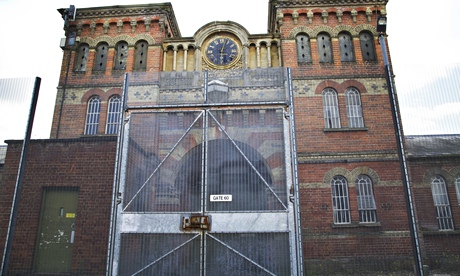
After five years of negotiations, a documentary team received permission to film for a year inside Britain’s most famous high-security psychiatric hospital. The result is two hour-long episodes of Broadmoor (ITV). Inside the 53-acre complex, built 150 years ago as an asylum for “criminal lunatics” and often mistaken as a prison, so forbidding and impenetrable are the measures taken to stop patients from escaping and from harming themselves or each other that the only thing unbounded is human misery.
Most of the patients we hear from (who are by definition well enough to have been able to give informed consent to being filmed) have childhood histories of being physically and sexually abused at home or other places of supposed safety. They turn to drink and drugs and then to violence, and start to rip other people’s lives apart. When people endure this “triple whammy of genetic predisposition [to mental illness and/or violent behaviour], childhood adversity and substance misuse,” says Dr Amlan Basu, the hospital’s clinical director, “it becomes a long-term project, putting them back together”.
Basu, like the rest of the clinical and therapeutic staff, has all the calmness and self-command their suffering patients lack. We hear – don’t see, because the man involved is too ill to consent, and his words are spoken by an actor – the sound of one of the patients being wrestled to the ground and manhandled back into his room after he refuses to leave the yard, in which the most dangerous inmates are being allowed to exercise one at a time. There are no raised voices except his. The 10 staff involved eventually slam the door shut with only relief. There is no triumph, no momentary exhilaration. Every other day, the patient’s primary nurse, Mohamed Jalloh, estimates, sees them involved in a similar event. The act of depriving a man of his liberty with your own hands, no matter how necessary, still, it seems, comes hard.
It was a sober, measured hour – and doubtless the second will be too – but it is hard to entirely escape the feeling that vulnerable people are being put to a use which is not wholly to their benefit. I presume there is a feeling among Broadmoor’s staff that opening up to ordinary viewers will increase awareness and sympathy and improve understanding of the lives and treatment of mentally ill and violent offenders. Maybe this is a way of fighting back against increasingly emotive political and public rhetoric that inveighs against anyone who falls outside a white-native, two-parent, hardworking, tax-paying family bracket. I would quite understand if so, and I wouldn’t doubt for a moment that the decision to let cameras in was undertaken with the best of motives and intentions. I do doubt that the actual gains will end up outweighing the potential risks. But then, the doctors and nurses going into Broadmoor every day to try and help put these broken people back together show more faith in human nature and the human spirit than I could muster in a lifetime, so I shall try in turn to trust that they know best.
Secrets of the Universe: Great Scientists in Their Own Words (BBC4) was a study of the opposite extreme – of men (and one woman) for whom more or less everything had gone right. Instead of prisons and hospitals, Oxford and Cambridge. Instead of abuse and acts of violence, a careful nurturing of talents to breed insights that changed the world. Instead of incarceration, Nobel prizes.
It set out to show how the personalities, rivalries and eccentricities of the major physicists of the 20th century had moulded the scientific revolution. Einstein, for example, welcomed and enjoyed the fame his theories of relativity brought him. His celebrity added extra weight to his name when he endorsed a letter to President Roosevelt on the eve of the second world war recommending that the US start work on “extremely powerful bombs of a new type”. That led to the Manhattan project and Hiroshima. It lay on Einstein’s conscience forever. If he had been shyer, less happy in the limelight, would the world have been different?
The programme didn’t engage in counterfactuals – it was covering too much material at too much of a gallop already – but after a while it began to feel like quite an oversight. Much was made, for example, of the fact that astronomers Fred Hoyle and Martin Ryle were rivals – the former believing in the steady state theory of the universe, the latter believing in the big bang – but gave us no sense of whether this was an unusually fierce enmity (in which case we should have heard why – was it aggravated by their class differences, for example? – and about whether it spurred them to greater heights or the lack of shared information restricted their progress) or just the normal way of things (in which case, why are we talking about them rather than any other pair?) By the end you could only ask – should a science documentary be raising so many more questions than it answers?