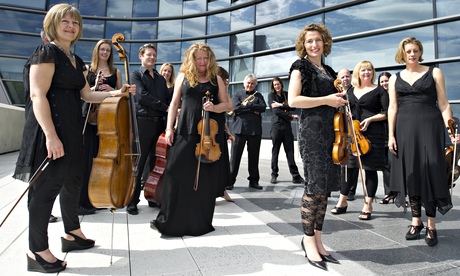
John Woolrich goes back a long way with the Britten Sinfonia – more than 15 years in fact. He used to be the orchestra’s composer-in-association and now he is one of its artistic advisers; a role in which his outstanding skills as a concert programmer must be invaluable. Woolrich had devised the programme that the Sinfonia, conducted by Duncan Ward, gave to celebrate his 60th birthday. This was the London premiere of one of his most substantial recent works, preceded by a series of his transcriptions and paraphrases of other composers, interwoven with pieces by Stravinsky and Mozart.
It was a typically self-effacing portrait, and a truthful one; some of Woolrich’s most rewarding and revealing works have refracted his own musical personality through those of his historical predecessors. Music by Purcell and Wolf began the concert – three of Purcell’s songs from Orpheus Britannicus, realised by Michael Tippett and then given string-orchestra arrangements by Woolrich, and seven numbers from Wolf’s Italian Lieder Book, turned into string miniatures, their vocal lines ambiguously absorbed into the textures. Ulysses Awakes, though, is a much less straightforward reworking. It’s part paraphrase, part fantasy for viola and strings from the first act of Monteverdi’s The Return of Ulysses – a beautiful, dark-hued meditation, constantly haunted by shadows of the original vocal lines.
Mary Bevan (a last-minute replacement for her sister Sophie) was the elegant soprano in the Purcell and in the Mozart concert aria Per Pietà, while Clare Finnimore threaded her mellow viola line through Ulysses. The leader of the Britten Sinfonia, Thomas Gould, was the soloist in the Violin Concerto. Gould’s performance was less urgent, and less immediate, than Carolin Widmann’s had been when it premiered at the Aldeburgh festival in 2008, but it still underlined the satisfying unity of the 20-minute work with its clear, unswerving trajectory and its moments of genuinely poetic reflection.