People have been denied the right to vote in local elections for the first time due to a controversial new pilot of checks that force voters to prove their identities before casting their ballot.
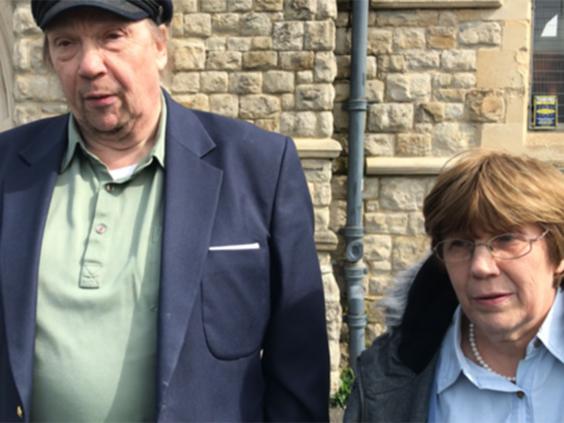
A 76-year-old man who has lived in Bromley for 40 years told The Independent he was “shocked” to be turned away because he did not have a bank card or passport. “This is a nonsense scheme,” Peter White added.
Gosport, Swindon, Watford and Woking are also running the pilot schemes, which have long raised fears that people will be wrongly disenfranchised.
Mr White's wife, Kathleen Milward, said that although she does have the relevant identification, she will not be voting out of principle.
"I'm angry because I don't believe in carrying ID. Having the vote is a basic human right in a democracy, and this is supposed to be a democracy,” the 72-year-old added.
"I'm choosing not to vote, and I've never done that before. I think people who have problems with their ID will certainly be disenfranchised, even if they've lived here for many years.
"As we know from this last week or two, there are a lot of people out there who are in that situation. And means I have to make a stand from that point of view too, because I know that they will be either disenfranchised or will not feel happy to come down and vote."
Under the pilot scheme, voters are required to produce accepted identity documents including a passport, driving licence, European ID card or Oyster 60+ London Pass.
The the voter does not possess any of the documents specified, they can use a combination of two other items including their name and registered address, like a debit card, bank statement or utility bill.
Ministers claimed the scheme will help combat electoral fraud but critics argue it will suppress turnout, particularly among the elderly, migrant communities, asylum seekers and disadvantaged people who have the right to vote may have no stable residence or the proof required.
Demanding a rethink of the policy in March, a group of 40 charities and academics said Electoral Commission figures showed there were only 28 allegations of impersonation out of almost 45 million votes in 2017, and one conviction.
“Decades of international studies show that restrictive identification requirements are particularly disadvantageous to certain voter groups who are less likely to possess approved ID for a variety of socio-economic and accessibility reasons,” said a letter to the government. “Voter ID reforms could therefore affect young people, older people, disabled people, transgender and gender non-conforming people, BAME communities and the homeless."
Chloe Smith, minister for the constitution, said local authorities could help people find the documents required and "eligible voters who have none of the required identification will be accommodated for".
She added: “Voter ID is an important step to ensuring the public can have confidence in the systems that underpin our democratic system.
"We already ask that people prove who they are in order to collect a parcel from the post office or rent a car. We believe it is proportionate and reasonable to take the same approach to protect voting rights."
The government pointed out that many other countries require ID to vote, including Northern Ireland, which brought in the measure in 1985. There have been no reports of voter impersonation since 2003.
Across England, more than 4,000 seats are being contested in around 150 councils - including all 32 London boroughs, as well as every ward in Birmingham, Manchester, Leeds and Newcastle.
Mayoral elections are taking place in Hackney, Lewisham, Newham, Tower Hamlets, Watford and the Sheffield City region, but there are no polls in Scotland, Wales or Northern Ireland.
Recent national opinion polls have seen Conservatives and Labour running neck-and-neck on about 40 per cent each.
London is the major battleground for today's elections after recent polls pointed towards a substantial swing to Labour.
Jeremy Corbyn's party will be hoping to win control of Tower Hamlets and Barnet and possibly even the flagship Conservative councils of Wandsworth and Westminster.
Upsets are possible elsewhere, with Labour also hopeful of taking power in the Yorkshire town halls of Kirklees and Calderdale, Trafford in Greater Manchester, and Plymouth and Swindon in the south.
Liberal Democrats are hoping their promise of a second referendum on Brexit will help them regain Remain-supporting areas, while the Conservatives may be boosted by Ukip's decline in the polls in Basildon and Great Yarmouth.
Polls close at 10pm and the first results could begin to arrive at around midnight and are expected to be in full flow by 2am.
Most councils are counting votes overnight but others will declare results during the day on Friday.
Additional reporting by PA