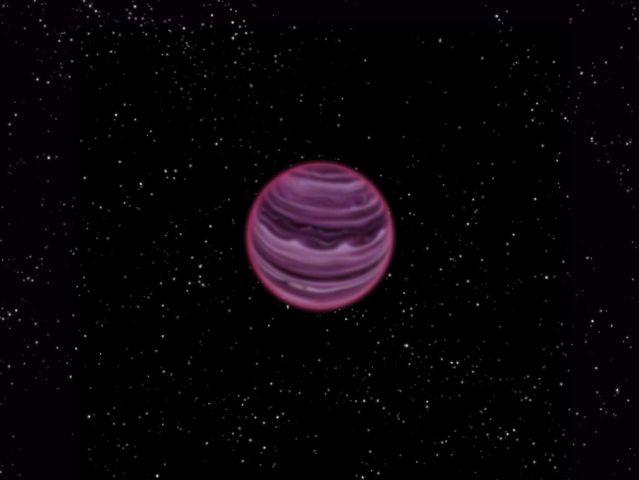
Thick clouds made of droplets of molten iron have been discovered on a bizarre sunless planet 75 light years from Earth.
The planet-like object, which was discovered in 2013 and given the catchy name PSO J318.5-22, was already considered one of the stranger bodies in the sky because it does not appear to orbit around a star.
Now, after the latest discovery by astronomers from the University of Edinburgh, the strange planet has become even stranger.
Using a telescope in Chile, the astronomers discovered that the lonely world is covered in layers of cloud, which are made up of molten iron and super-hot dust.
By capturing hundreds of infa-red images of the object as it rotated, the astronomers were able to compare its brightness with other nearby bodies and deduce what the clouds were made up of.
Even though it would seem like having no nearby star would make the object harder to see, it actually allowed the team to make more accurate measurements - with no star to emit light, the astronomers were able to measure the brightness of the object with very little interference from outside light sources.
PSO J318.5-22 is about the size of Jupiter, and is estimated to be 20 million years old.
The techniques used to make these discoveries could one day be used to find out if far-away planets are capable of sustaining life - if scientists develop the technique so it is applicable to planets that are cooler and smaller than PSO J318.5-22, scientists could find out more about distant planets' weather systems and use that information to see whether they could host alien life.
Dr Beth Biller, from the University of Edinburgh's School of Physics and Astronomy, said: "We're working on extending this technique to giant planets around young stars, and eventually we hope to detect weather in Earth-like exoplanets that may harbour life."
However, you can bet that humans are unlikely to ever get anywhere near the object - the temperature inside the iron clouds is estimated to be around 800°C, and if humans were to travel to the object on a craft going the same speed as Nasa's New Horizons probe (around 10 miles a second), it would take just over 1.4 million years to get there.