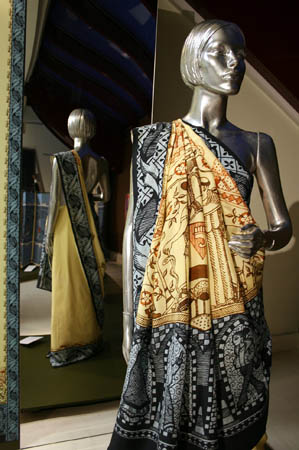
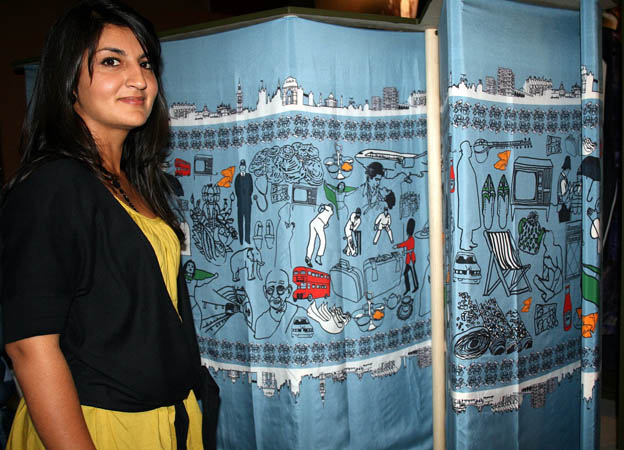
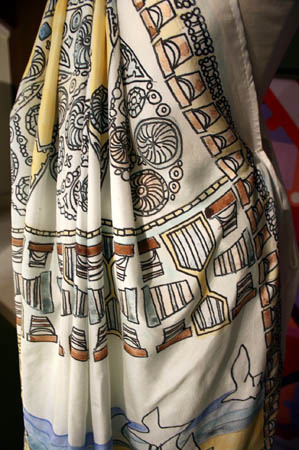
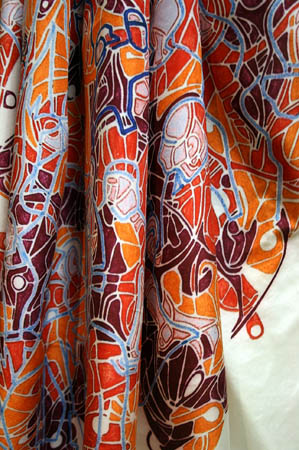
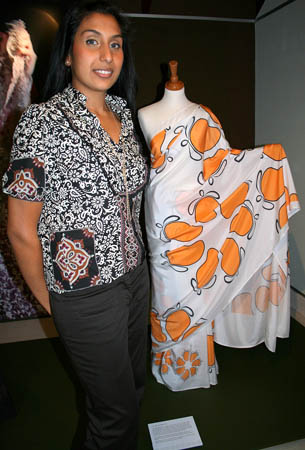
Nilesh Mistry, a Mumbai-born illustrator now based in north-west London, won the top prize with his Sari for Harrow. The five metres of silk show Harrow's coat of arms and the famous public school but also the "real" Harrow - an exquisite border of its citizens including a Somali woman in a Burka, a hoodie with a mobile phone, a Gujarati housewife, a Polish builder and Afro Caribbean woman and a mullah.Photograph: Bridging Arts/Flexeflix/PRPamela Rana, whose parents came from the Punjab in the 1970s, has created a British Sari Landscape which reflects the era in which she grew up in the UK - suitcases, old television sets and planes. The colours are the blue/grey of the British landscape, with the occasional splash of the orange and green of the Indian flag. Her sari is bordered with CCTV cameras and a fictional landscape of terraces and temples, mosques and tower blocks.Photograph: Bridging Arts/Flexeflix/PRMiranda Hicks, a textile design student at University College, Falmouth, has created a Cornish sari including ice cream cones, buckets and spades. The pale yellows and watery greens reflect the colours of a beach scene.Photograph: Bridging Arts/Flexeflix/PR
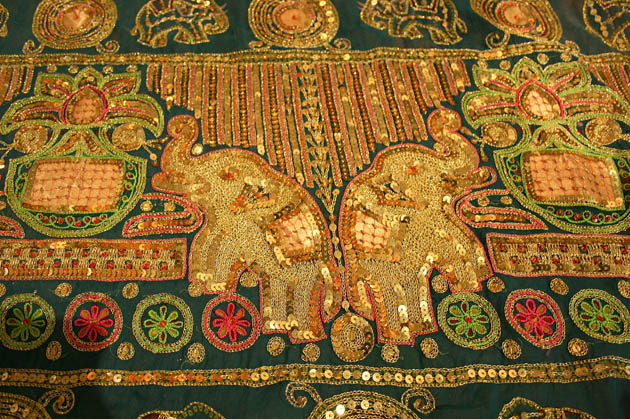
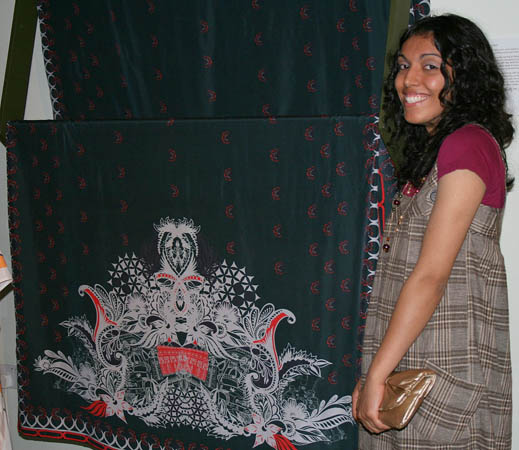
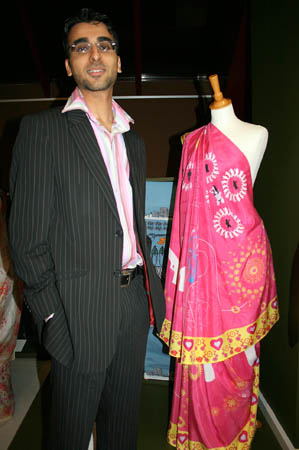
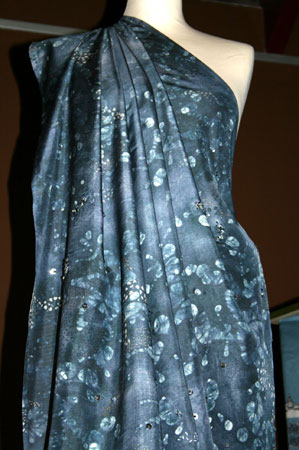
Shema Ladva used images taken at Notting Hill carnival to create her sari. 'For a long time, I've been looking at my local community, Southall, as well as the Notting Hill carnival and homelessness... My aim is to transform the 'man on the street' into high art'Photograph: Bridging Arts/Flexeflix/PRFreelance clothing designer Shilpa Rajan was inspired by mango boxes on Ealing Road, Wembley, where she lives, to create her Indian Summer Sari. 'We know that summer has arrived once we see the mango sellers' pitches on the pavement with their big, brightly coloured umbrellas and stacks of mango boxes. Summer is here and out come the mangoes. Every Asian household will have a box of 'keri' (mango) at some point during the summer'Photograph: Bridging Arts/Flexeflix/PRA Gharcholu is a traditional bridal sari in Gujarat, usually in red or green and divided into many squares bound by gold strips. It is given to the bridge at the wedding by parents of the groom and she wears it during the ceremony over the sari given to her by her mother, draping it carefully so both are visible. This symbolizes the meeting of two families, a highly significant part of a Gujarati weddingPhotograph: Bridging Arts/Flexeflix/PRRahiet Ashfaq from Fife created a Sari for Scotland. "As a Pakistani Asian born and raised in Dunfermline, I have always believed that I have a fine balance of both cultures and I aimed to reflect this in my design." She uses drawings from her last trip to Pakistan - including a highly decorated rickshaw and a tea set - to create motifs. The wide end border (pallau) is influenced by damask linens, as Dunfermline once produced fine, hand woven linens.Photograph: Bridging Arts/Flexeflix/PRSamar Abbas was born in Kenya in 1980 and moved to London 17 years ago. He has created a 'sari for the iPOD generation'. 'Music is one of the biggest influences in today's society. It inspires words that indoctrinate individuals - bad and good words. Love or hate. Live or die,' he said. Headphones and wires coil over his brilliant pink sariPhotograph: Bridging Arts/Flexeflix/PRRamim Nasim, whose parents are originally from Pakistan, was born in Hong Kong and moved to Bradford in 2005. The colours of her sari reflect the cold, damp Yorkshire climate, the muted greys and blues are patterned with delicate snowflakesPhotograph: Bridging Arts/Flexeflix/PR
Sign up to read this article
Read news from 100’s of titles, curated specifically for you.