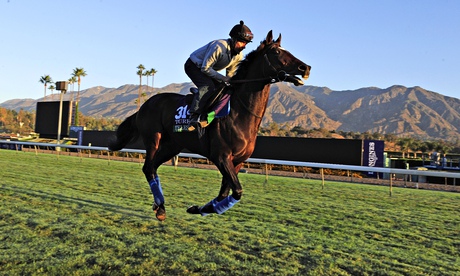
Jamie Osborne, whose Toast Of New York runs in the $5m Breeders’ Cup Classic on Saturday evening, has simple motivations for being in California this week and it is nothing to do with the sunshine. “I’m not here for Europe and I’m not here for Britain,” he said here on Thursday. “I’m here for Michael [Buckley, the horse’s owner] and I’m here for me.”
There is not a European owner or trainer who has travelled to the USA’s west coast for the Breeders’ Cup meeting this weekend who would say anything different. More than 30 horses have made the trip, at huge effort and expense, to be tested against the best that the host country has to offer and the lure is individual glory and a share of a $23.5m prize pool.
It is in the nature of a sport in which there are no draws. It is the antithesis of team sport.
But is that true for the fans as well? It is a question which British racing has started, albeit tentatively, to explore this year, in the earnest hope that the answer will be no. Every sport needs to nurture its audience and expand it wherever possible and those in charge of marketing British racing have decided to use the Breeders’ Cup, the most valuable race meeting in the US, as a chance to wave the flag.
The logic is undeniable. England gave football to the world but may not win another World Cup in any of our lifetimes. The cricket team have their moments but there will always be another downturn soon enough.
Horse racing, though, is another sport with its origins in England and 250 years later the country remains a world leader, sending horses around the world that return with foreign currency for the British economy.
It is not an easy thing to do, yet British stables have always been, and continue to be, very good at it.
The man in charge of the latest marketing push is Carter Carnegie, the international executive for Great British Racing International and an interesting mixture in himself. He was born in Paris to an American father and British mother and has a strong American accent in addition to a British passport, but is determined to extract every ounce of benefit from British racing’s annual trip to the States.
“We always want to attract people who don’t necessarily follow racing already,” Carnegie says, “and it’s all about the flag. It’s like the Olympics. The British people don’t really care about fencing, but if they happen to win a gold medal, then suddenly they care. It sometimes helps if people can root behind a flag rather than a horse. We’re not trying to reinvent the sport, it’s just about attracting a new group of people to the game because we’re doing something a little bit more patriotic.”
Carnegie has worked for the NFL and the NBA in the past and spent several years as a senior executive for the Breeders’ Cup itself, so his background is ideal. It is still early days – Team GBR branding and union flag saddlecloths are being provided for the British horses, for instance, though Cup rules ban them from the course itself – but the aim is to get British racing and its successes into the consciousness of the general sporting public, rather than enthuse those who know about it already.
“It’s a way to make racing fun, there’s nothing really serious about it, but it underlines our horses and highlights the skills of our trainers,” Carnegie says. “Britain sends more horses overseas to more big international races than any other country. It’s not easy to get a horse ready, go halfway around the world and compete at this level and be successful and it’s something that we are very good at and we should be proud of it.”
The annual British and European trip to the US will never match the Ryder Cup for intensity. Too many of the races are currently run on dirt, an alien surface to Europeans, for it to be a meeting of equals. But as one of the largest teams of European horses prepares to contest all but three of the meeting’s 13 races over the next two days, it is worth remembering that the Americans go into this event with a great deal of national pride too.
For two years, in 2008 and 2009, the Breeders’ Cup was indeed run on something close to a level playing field. The dirt at Santa Anita was replaced by a modern, synthetic surface that gave the visitors as much chance as the locals and in 2009 the Europeans came within a single race of winning as many as the Americans.
It was great news for European racing, but did not go down well with American trainers, informing an ultimately successful campaign to restore a dirt surface. The days when the Breeders’ Cup could almost justify its billing as the “World Thoroughbred Championships” have gone for now and possibly for good. But that will not diminish the achievement of any horse that can travel nearly 6,000 miles and beat the best that the biggest racing industry in the world can field in opposition. Nor the added satisfaction for those fans that have backed them to do so.