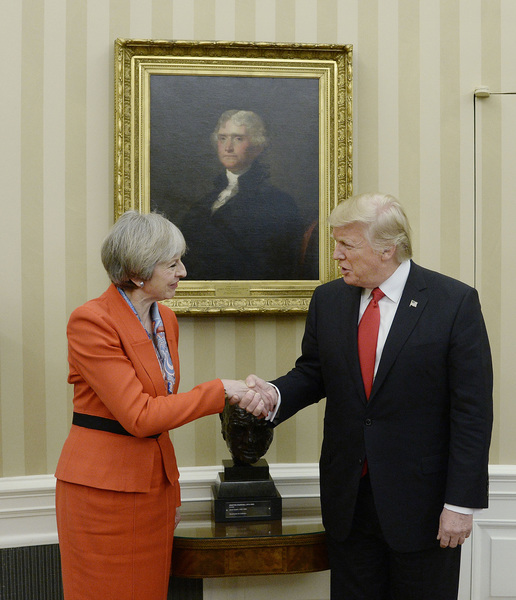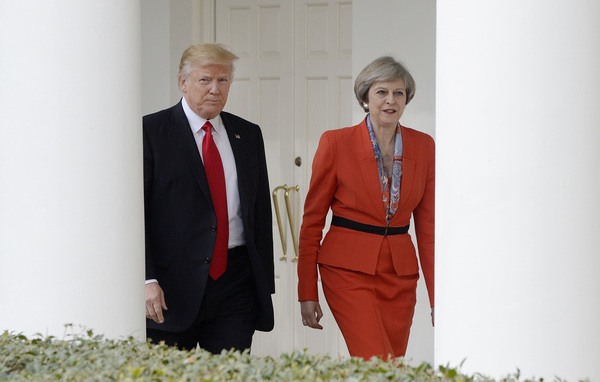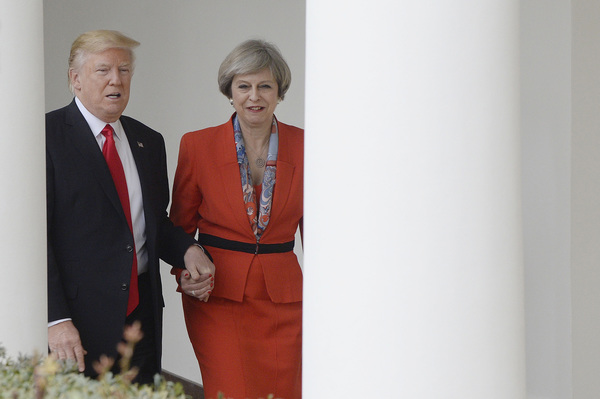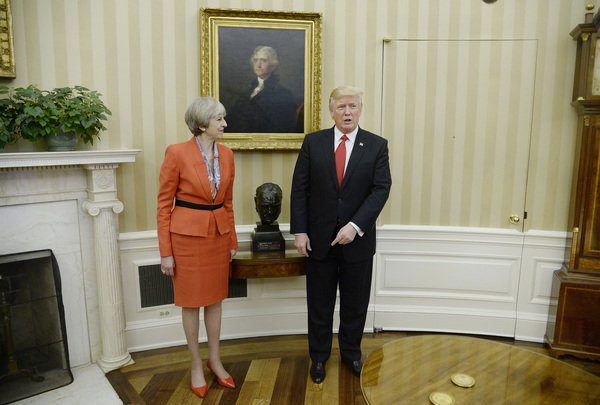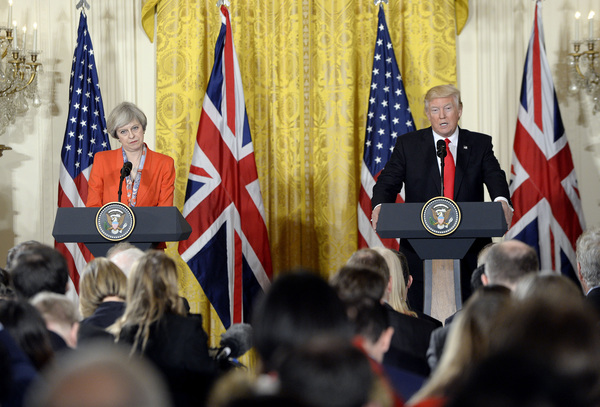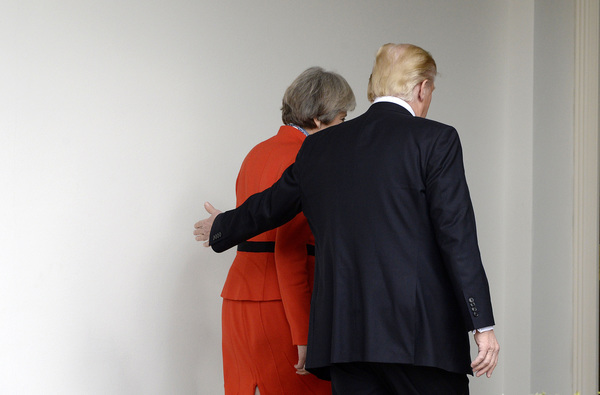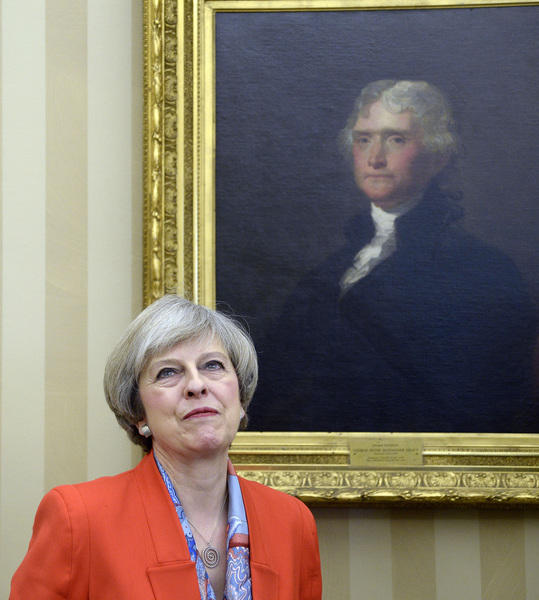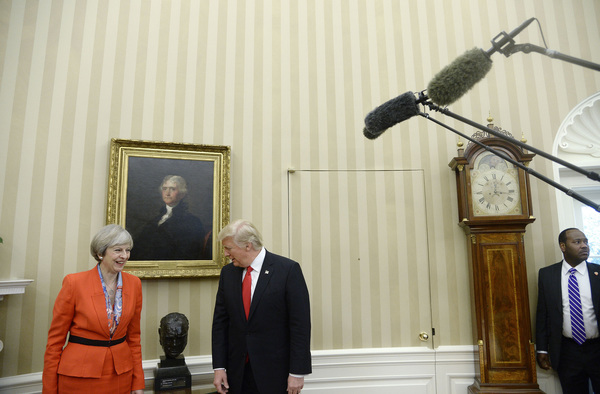
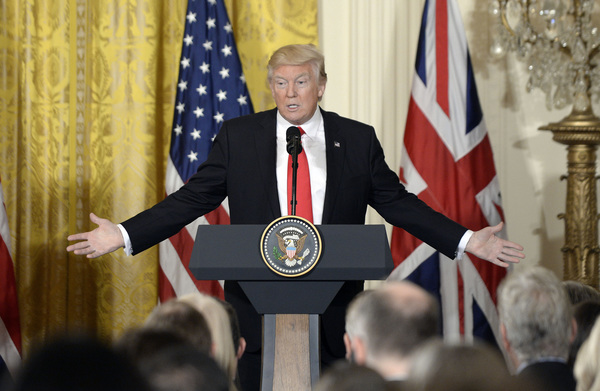
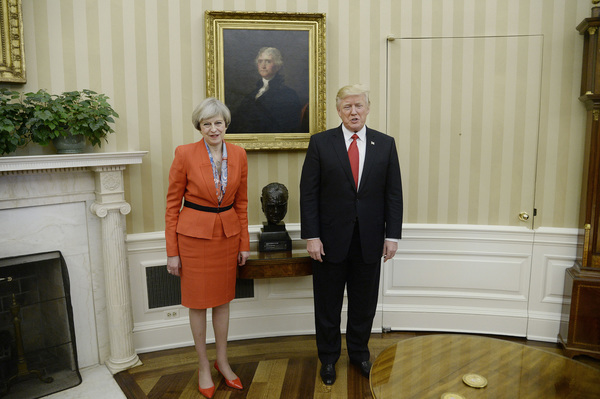
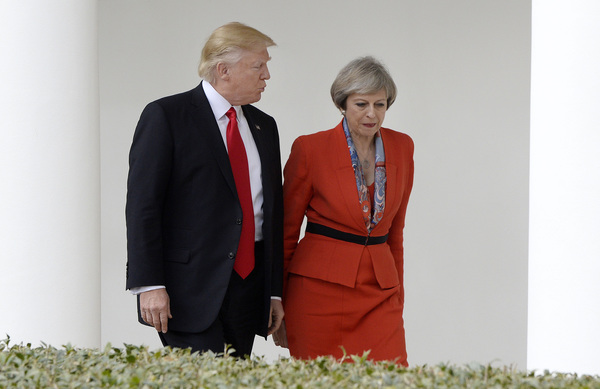
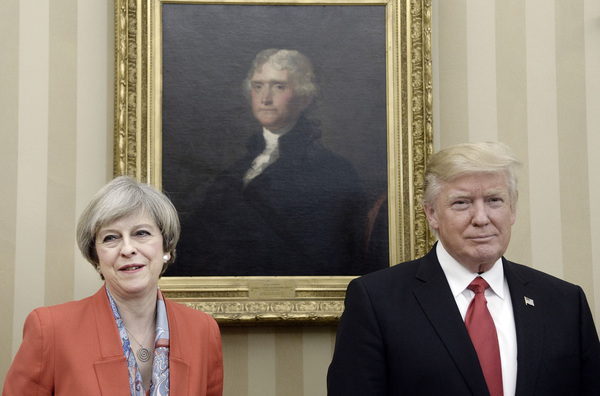
WASHINGTON _ British Prime Minister Theresa May put President Donald Trump on the record Friday as being "100 percent" behind the NATO in their first meeting at the White House.
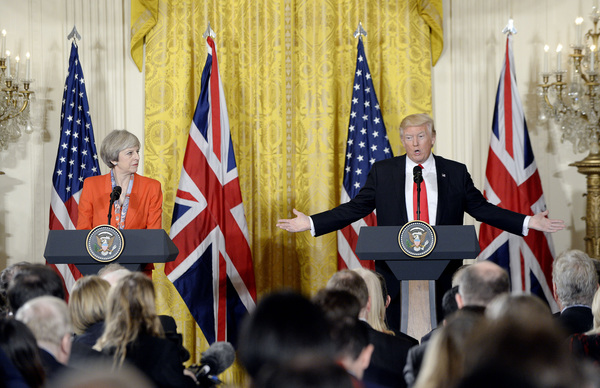
"Mr. President, I think you said, you confirmed, that you're 100 percent behind NATO," she said at a news conference. "But we're also discussing the importance of NATO continuing to ensure it is as equipped to fight terrorism and cyberwarfare as it is to fight more conventional forms of war."
Trump had previously called the military alliance created in 1949 "obsolete." But on Friday he responded quietly to her, "It's true."
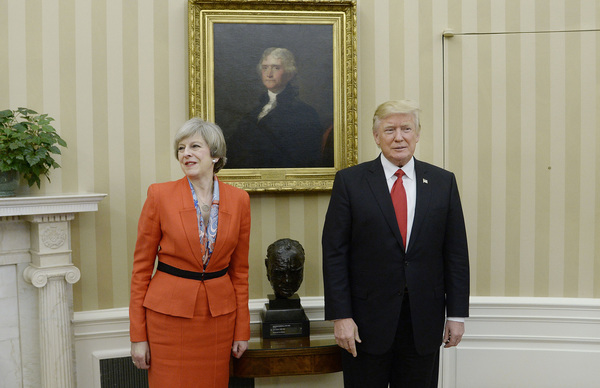
The new president, who hosted May in his first meeting with a foreign leader since his inauguration, was looking to burnish his foreign policy credentials to the many world leaders who do not know him and had expected former Secretary of State Hillary Clinton to win the election.
Many had hoped May would try to soften Trump, who in his zeal for nationalism has spoken about withdrawing from a global climate-change agreement and improving relations with Russia, possibly lifting economic sanctions that were imposed after Russia annexed Ukraine's Crimea region.
"Will Theresa May become an influential voice _ a mentor, if you will _ to President Trump?" said Heather Conley, director of the Europe Program at the Center for Strategic and International Studies. "Will, in fact, Theresa May be able to provide some counsel there?"
May affirmed her support for sanctions against Russia for its annexation of Crimea. Trump, who has alarmed some with his friendliness to President Vladimir Putin, said it was too early to say what would happen to the sanctions though he'd mentioned before he may try to ease them.
"If we can have a great relationship with Russia and with China and with all countries, I'm all for that," he said. "That would be a tremendous asset."
At his first news conference with a foreign leader, Trump adopted a more statesman-like demeanor than the combative one he displayed on the campaign trail. He spoke from a script, stayed on message and made a few jokes. The news conference was unusually brief, just 18 minutes, and he resisted any temptation to call on more reporters who screamed out to him as he left the room.
In response to a question, Trump reiterated his opinion that torture works, but said he would cede his administration's position on the subject to Defense Secretary James Mattis, a retired Marine general who opposes harsh interrogation methods.
"I don't necessarily agree, but I would tell you that he will override because I'm giving him that power," he said. "He's an expert. He's highly respected. He's the general's general. Got through the Senate very, very quickly, which in this country is not easy, I will tell you. And so I'm going to rely on him."
Congress banned torture but some published reports said this week that Trump was considering signing an executive order that would reconsider President Barack Obama's prohibition against so-called CIA black site prisons, where the interrogation methods were used during the administration of President George W. Bush.
May's visit came a day after Mexican President Enrique Pena Nieto abruptly canceled his visit to the White House planned for next week after Trump insisted again that Mexico would pay to build a wall on the border.
Trump also confirmed that he and Pena Nieto had spoken by phone for an hour Friday.
"It was a very, very friendly call. I think you'll hear that from the president and I think you'll hear that from the people of Mexico that really represent him and represent him very well," Trump said. "And I look forward to _ over the coming months, we'll be negotiating and we'll see what happens."
Later, both governments released what was termed a "joint statement" about the call. But the U.S. version left out a line that was in the Mexican one about whether Mexico would pay for the border wall, whose construction Trump ordered earlier this week. "The presidents also agreed at this point not to speak publicly about this controversial issue," the Mexican version said. The White House did not comment on the discrepancy.
Trump and May spoke about a variety of issues, including the bloodshed in Syria, the Islamic State terrorist group and their support for a new trade agreement between their nations. Trump, who earlier this week withdrew the United States from the massive Trans-Pacific Partnership trade agreement, prefers bilateral agreements, and May, who took office in July, is looking for a trading partner once Britain exits the European Union. Trump has compared his own unexpected political success to Britain's surprise vote to leave the EU.
In a speech at a Republican congressional retreat Thursday, May had praised Trump but reiterated the United States' responsibilities in the world. She was received warmly.
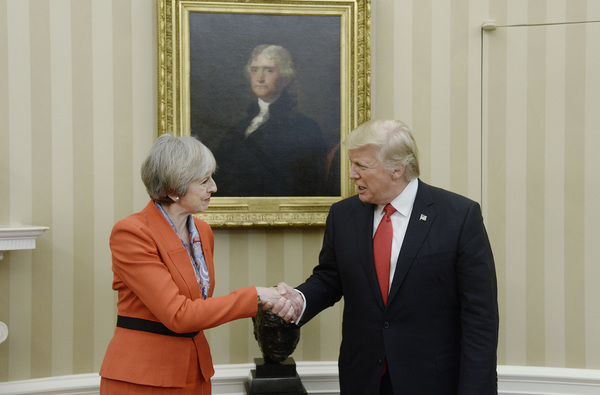
The two leaders held talks, a news conference and a working lunch, according to a White House statement that misspelled the prime minister's first name.
The United States and Britain hold what both nations call a "special relationship," and the British believe Trump chose May for the first visit to show how much her nation is valued, even as the relationship has struggled in recent years.