The man with the chainsaw in Dewsbury was in no mood for chatting to the Labour canvassers on his estate. “Miliband? No chance. He’s not a leader, is he?” said the man crossly, after being interrupted while doing DIY.
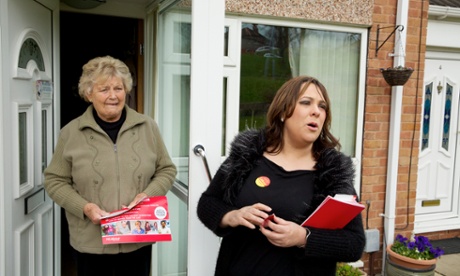
Paula Sherriff, Labour’s parliamentary candidate for the Dewsbury constituency – currently a slender Tory marginal – decided not to linger. She said: “I do try to stop and have a chat but after 22 years working in the police and health service I’ve learned who it’s worth trying to convince and who to just leave be.” Angry men wielding chainsaws fall into the latter category, she explained.
At least the scary chainsaw chap had a strong opinion, echoing the comments of the Labour MP Simon Danczuk this week, who claimed Miliband was an electoral liability and that ordinary people see doublespeak-spouting politicians as “fucking knob[s]”.
At a focus group at Dewsbury town hall on Monday, the participants struggled to summon any enthusiasm at all for the general election. Asked to bring in pictures encapsulating their feelings about the whole charade, one woman chose a photograph of someone fast asleep. Habiba, 39, a PA, said: “They don’t deliver what they promise. I don’t have any hopes. I’m not expecting anything from any of them. I will vote, simply because I know that women went through a lot for the vote.”
All were blissfully unaware that Labour and the Conservatives see Dewsbury as a key marginal. Simon Reevell, the incumbent Conservative MP, is defending a majority of just 1,526 after beating one of Labour’s young stars, Shahid Malik, in a hard-won fight that saw both parties increase their vote in 2010.
The seat is also, the focus group indicated, a prime exemplar of the mutual Labour and Conservative conundrum around much of the country of how to make the voters feel that the parties are not just much of a muchness – and are all focused elsewhere anyway.
Two years ago, Labour designated this West Yorkshire seat a top target, employing a paid organiser and “mobilisation assistant” to help healthcare worker Sherriff triumph in May’s vote. Sherriff, a Labour councillor in nearby Wakefield, whose older sister, Lee, is contesting Carlisle for the party at the election, spent nine years working in victim support for the police before becoming a manager in the dermatology department of Mid Yorkshire Hospitals NHS Trust.
Yet no one in the focus group – run by polling firm BritainThinks in partnership with the Guardian – had heard of Sherriff, despite her spending the best part of two years telling anyone who will listen that a) Reevell is a lazy “part-time” MP who spends much of his time working as a barrister instead of toiling away in parliament, and b) the Tories can’t be trusted with the NHS because Reevell had not fought the downgrading of Dewsbury and District hospital, which has resulted in some services transferring to the bigger Pinderfields general hospital 10 miles away. None of the participants even knew Reevell was their MP. Most were under the impression Labour was still in charge of their patch; two thought they were actually represented by Barry Sheerman, who has held neighbouring Huddersfield for Labour since 1979.
One key concern of the focus group participants was a feeling of being left behind, lost, forgotten by politicians who don’t understand life outside of Westminster. “I think they’ve lost touch,” said Michael, 47, a window fitter from Kirkburton. “I think it’s a more southerly thing, politics now. I don’t think it’s a northern thing any more. Although we vote, I don’t think it matters whether we do or not.”
Why Labour lost Dewsbury in 2010 is up for debate. Malik had been embroiled in the expenses scandal – but was later exonerated by the Parliamentary Commissioner for Standards – and had made a number of enemies locally, notably Khizar Iqbal, who took his revenge by standing in the election as an independent and taking 3,813 votes many thought would otherwise have gone to Labour. Boundary changes also turned a safe Labour seat into a marginal, galvanising many who felt for the first time in decades that their vote mattered. For the 2010 general election, Dewsbury lost the more pro-Labour ward of Heckmondwike, but gained the more Conservative-inclined wards of Denby Dale and Kirkburton.
On a doorstep in Dewsbury, Dorothy Hague promised Sherriff her vote. Dorothy, 78, who answered the door in her slippers, told her: “I’ve been a worker all my life, love, I couldn’t be anything else but Labour.”
Ateeque Sadique, 34, a shopkeeper in Ravensthorpe, a district heavily populated by Pakistanis, said: “I support Labour because they represent the working class. Simon Reevell doesn’t visit Asian areas and there are more empty shops in the town centre than anything else. He doesn’t seem to have done anything to attract business to the area.”
However, the focus group in Dewsbury town hall suggested some voters no longer see Labour as the voice of the working class.
The Tories call Sherriff “One Policy Paula”. Reevell accuses her of scaremongering, claiming she spread false rumours that Dewsbury hospital may shut down altogether, allowing her to later claim to have “saved it”.
Reevell is unrepentant about his second job, which earned him £44,648 last year, on top of his £67,000 MP’s salary. The former pre-tax figure, obtained from official parliamentary records, did not take into account expenses or fees he had to pay to his barristers’ chambers, he said, insisting he always put his job as an MP first, despite the records showing him spending numerous days in court, acting for both defendants and the Crown Prosecution Service, as well as military tribunals and the West Yorkshire Probation Trust. Reevell said continuing to work keeps him “in touch with real people”.
Asked by the Guardian if he did not consider being an MP a full-time job, he said: “I think that’s a really poor question. You and I both know that there are all sorts of people with all sorts of hobbies and pastimes, they do all sorts of things. You wouldn’t suggest that because somebody was the chair of a select committee they couldn’t do their job as a constituency MP.”
Talking to people around the constituency this week, votes seemed roughly split between Labour and the Conservatives, though a poll by Lord Ashcroft last year suggested Sherriff had a 10-point lead. “I’ll be voting Labour. I don’t know what Simon Reevell has done. He’s been in for five years now. Facilities have been taken away, schools have closed and hospital services have been moved away,” said Omar, a shop owner in Ravensthorpe. In Savile Town, meanwhile, one garage owner said he was sticking with the Tories, adding: “I think they’ve done a good job on the economy.”
Labour knows it is heavily reliant on votes from the Asian community, which makes up 19.4% of the constituency population, according to the last census. Yet Pakistanis and Gujaratis constitute almost half of the local Labour party, said Sherriff, who has worked hard to woo these communities, turning up at pro-Palestinian protests and talking about the right for Kashmiri self-determination. Asked whether she was prepared to speak out about the dangers of cousin marriage – prevalent among British Pakistani communities – after a well-respected study in nearby Bradford found that the children of first cousins were twice as likely to have birth defects, she looked uncomfortable, saying: “What a kind question ... I’d have to look at the statistics.” However, Sheriff said she had “absolutely no problem” with people bringing spouses over from Pakistan or elsewhere.
In Savile Town, the Guardian met many locals who couldn’t speak English, yet when asked, via an interpreter, which party they would vote for, said “Labour”. Questioned as to why, they said: “Because my family always has.” In the focus group, roughly half the participants said they were most likely to vote Labour too, not because they had anything particularly positive to say about the party, but because in their family, that’s what they did. “I lived through the miners’ strike,” said Liz, 62, from Skelmanthorpe.
Yet Labour can no longer rely on the young voters simply following their elders. In a Ravensthorpe newsagents, Ali Totti, 20, announced that he was going to vote Liberal Democrat. He said: “Paula Sherriff is just another puppet. I vote on what I see, not what people say. The older generation vote Labour because they have it glued in their heads. The views get passed down from the elders and historically they vote Labour.” As he saw it, he was breaking free.
The BritainThinks Verdict
We asked our panel to work in pairs and to imagine that selected parties were real people. Asked what the Labour party would do in its free time if it were a person, students Amanda, 41, a mother of three, and David, 21, decided it would “look around castles”. If the party were a person, it would be an accountant, they thought, or “some middle-class job”. They still considered Tories to be posher: asked the same for David Cameron’s party, Amanda and David plumped for “skiing” and “a mansion in Knightsbridge”.
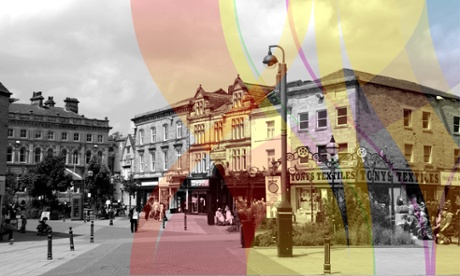
These voters in Dewsbury feel that they and their area has been forgotten by the government and politicians. They say that all the change seems to happen far away, in London or down south, while everything “always stays the same” in Dewsbury and the surrounding area. The town centre is a potent symbol of this – untouched by regeneration and investment.
Most of our panelists feel they hear absolutely nothing from politicians, and are deeply sceptical about whether this will change in the runup to the election. At best, they’re expecting a few leaflets through the letterbox, and aren’t holding out hope of meeting any of the local candidates on their doorstep or in the town centre. As a result, levels of knowledge entering into the election campaign are extremely low among this group of voters, who can’t put a name or a party to their current MP, let alone the potential candidates.